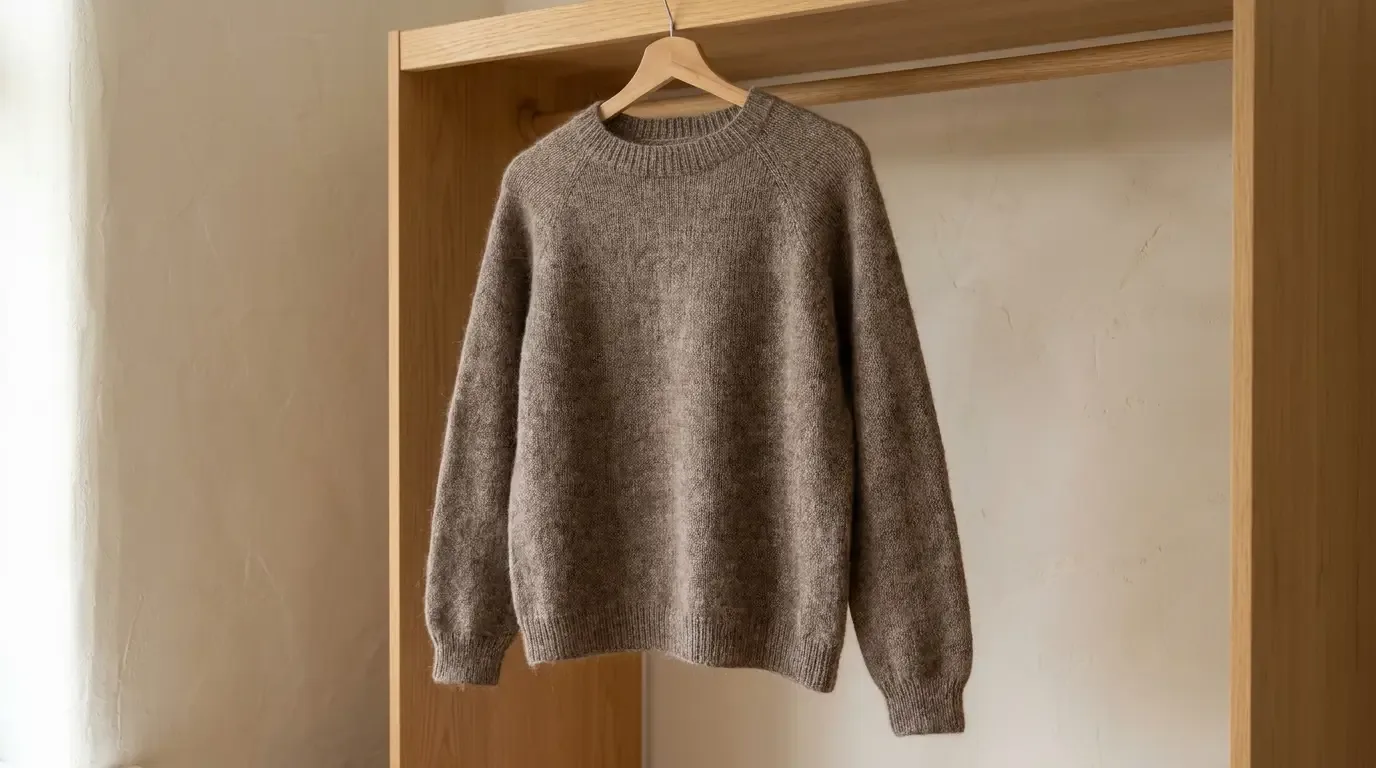
Knit this relaxed, seamless raglan pullover from the neckline down in smooth stockinette, then finish it with compact ribbing at the neck, cuffs and hem. This original HookElla one-size pattern is a calculated construction draft; it has not been physically swatched or sample-knit, so use the stated gauge and measurements as targets rather than guaranteed results.
Materials
- Approximately 900–1,050 m (985–1,150 yd) of aran-weight yarn in one heathered taupe-brown shade. This is a planning estimate, not measured consumption. A wool/alpaca blend with a smooth, even strand will give a soft fabric similar in weight and drape to the photographed pullover.
- 4.5 mm circular needles for ribbing and 5.5 mm circular needles for stockinette. Use a 40 cm / 16 in cable for the neckline if comfortable, a longer cable for the body, and either a long circular for sleeves or a preferred small-circumference method.
- 8 stitch markers, including one distinct beginning-of-round (BOR) marker.
- Smooth waste yarn or stitch holders for the sleeves.
- Tapestry needle, scissors and flexible tape measure.
Yarn brand and the photographed sweater’s exact colorway are not identified. Choose a single heathered taupe-brown shade; do not use the striped yarn shown in the supplied pattern illustration.
Finished size and fit
One adult size is written for an estimated 110 cm (43¼ in) finished chest circumference. That is intended to suit a wearer with an approximate 92–98 cm (36–38½ in) chest, giving roughly 12–18 cm (4¾–7 in) of positive ease. This is a calculated target, not a tested fit. The design is a relaxed pullover with a straight body and tapered sleeves.
Estimated measurements at target gauge:
- Chest around garment: 110 cm / 43¼ in.
- Yoke depth from collar edge to underarm: about 24 cm / 9½ in.
- Body from underarm to hem: about 40 cm / 15¾ in, including hem ribbing.
- Sleeve from underarm to cuff: about 48 cm / 19 in, including cuff ribbing.
- Neck rib: about 4 cm / 1½ in deep.
All dimensions are gauge-based estimates. The photo is a visual reference, not a measurement source. Compare the garment with a sweater that fits you before knitting the body and sleeves to their full lengths.
Gauge and swatching
Target, not measured: 16 stitches and 20 rounds = 10 cm (4 in) in stockinette in the round on 5.5 mm needles, after washing and drying the swatch as you plan to care for the sweater. Ribbing is worked on 4.5 mm needles and will have a different gauge.
To swatch in the round, cast on about 36 stitches, join without twisting and knit every round until the fabric is at least 13 cm (5 in) tall. Measure an interior 10 cm square after the swatch has relaxed. If you have too many stitches, change to a larger needle; if too few, change to a smaller needle. Swatch again. Do not rely on a flat stockinette swatch unless you account for the purl rows, which can change gauge.
At 16 stitches per 10 cm, the 176-stitch body is calculated as 110 cm around. This calculation does not verify stretch, drape or fit. The collar’s 72 stitches also require a comfortable head opening; test it over your head before continuing if you are concerned about fit.
Knitting abbreviations
- BOR: beginning of round.
- k: knit.
- p: purl.
- st(s): stitch(es).
- k2tog: knit 2 stitches together; one stitch decreased, leaning right.
- ssk: slip 2 stitches knitwise one at a time, return them to the left needle and knit them together through the back loops; one stitch decreased, leaning left.
- M1R: make one right-leaning increase by lifting the strand between needles from back to front and knitting it through the front loop.
- M1L: make one left-leaning increase by lifting the strand between needles from front to back and knitting it through the back loop.
- sm: slip marker from left needle to right needle.
- RS / WS: right side / wrong side.
- rep: repeat.
- rnd(s): round(s).
- stockinette in the round: knit every stitch on every round.
- 1×1 rib: alternate k1, p1; on following rounds, knit the knit stitches and purl the purl stitches.
- BO: bind off.
Special stitches and techniques
Raglan marker setup: Each raglan line is two stitches wide and sits between a pair of markers. On an increase round, make one stitch just before the first marker, knit the two raglan stitches between the markers, then make one stitch just after the second marker. Repeat at all four raglan lines. This adds 8 stitches per increase round while leaving the 2-stitch lines intact.
Stretchy bind-off: Knit 2, return both stitches to the left needle, and knit them together through their back loops. Knit 1, then repeat the return-and-knit-together step. Continue loosely around. If this method feels tight, use a familiar elastic bind-off that preserves the rib edge’s stretch.
Pattern instructions
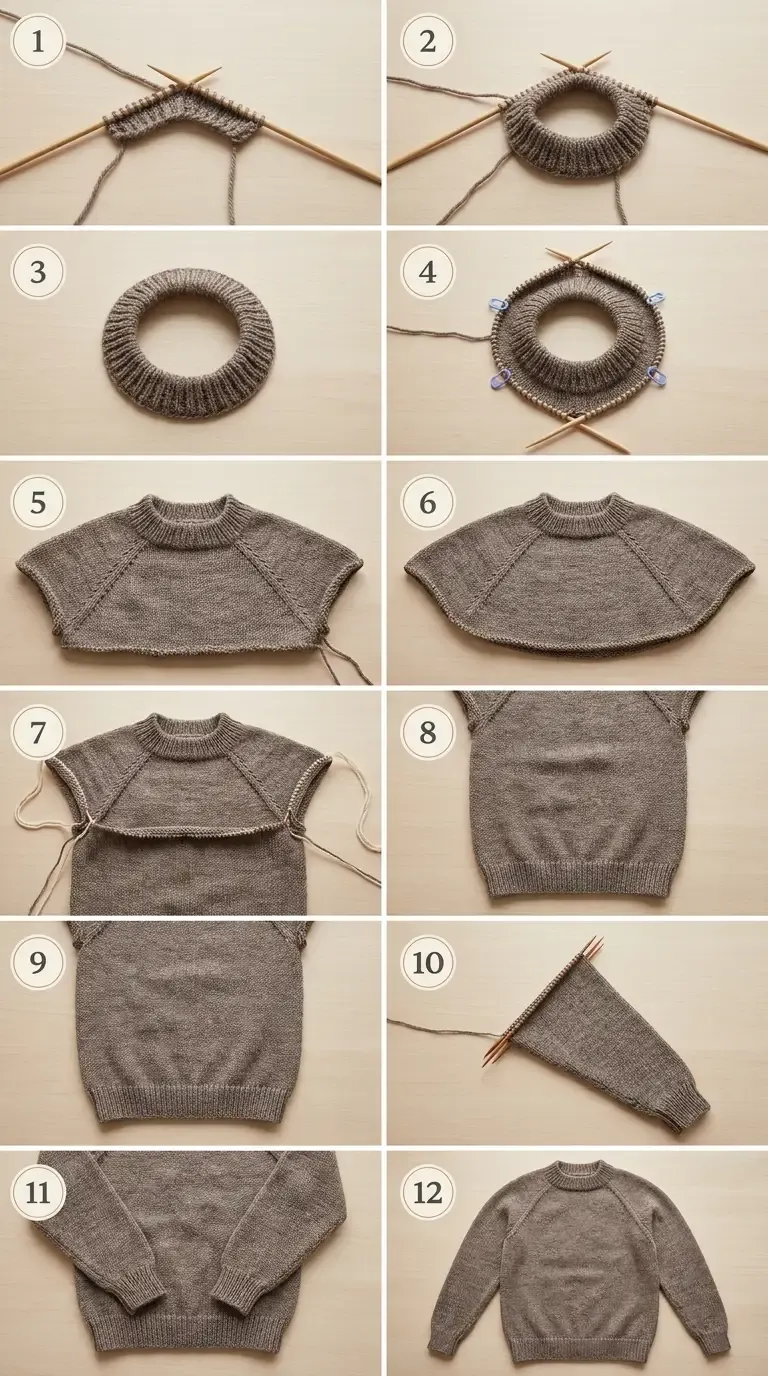
This is an original HookElla top-down raglan, worked in the round from the neck. It has a level neckline and no short rows. Beginning-of-round is at center back. Use the 5.5 mm needle for stockinette and the 4.5 mm needle for all ribbing.
Neckline
With the 4.5 mm circular needle, cast on 72 sts. Join to work in the round, taking care not to twist. Place the distinct BOR marker.
Work k1, p1 rib for about 4 cm (1½ in). End after a complete round. Change to the 5.5 mm needle.
Arrange the raglan markers
From BOR, knit 14 sts for the first half of the back. Place a marker; knit 2 raglan sts; place a marker. Knit 4 sleeve sts; place a marker; knit 2 raglan sts; place a marker. Knit 28 front sts; place a marker; knit 2 raglan sts; place a marker. Knit 4 sleeve sts; place a marker; knit 2 raglan sts; place a marker. Knit the final 14 back sts to BOR.
Count check: 28 back sts + 28 front sts + 8 sleeve sts + 8 raglan sts = 72 sts. The BOR splits the back into two 14-stitch halves. Each of the four raglan lines is enclosed by a marker pair.
Raglan yoke
-
Round 1 (increase): Knit to the first raglan marker. Work M1R, sm, k2, sm, M1L. Repeat this increase at each of the other three raglan lines, then knit to BOR. 80 sts.
-
Round 2 (plain): Knit every stitch, slipping markers as you reach them. 80 sts.
-
Round 3 (increase): Work the increase round as written for Round 1. 88 sts.
-
Round 4 (plain): Knit every stitch, slipping markers. 88 sts.
-
Round 5 (increase): Work the increase round as written for Round 1. 96 sts.
-
Round 6 (plain): Knit every stitch, slipping markers. 96 sts.
-
Rounds 7–48: Repeat Rounds 5–6 21 more times, always increasing on the first round of each pair and knitting plain on the second. This gives 24 increase rounds and 24 plain rounds in total. At the end of Round 48, you will have 264 sts: 76 back sts, 76 front sts, 52 sts in each sleeve section, and 8 raglan-line sts. The increase arithmetic is 72 + (24 × 8) = 264. The estimated yoke depth at target row gauge is about 24 cm (9½ in), but measure your knitting; row gauge and raglan geometry affect the actual depth.
Assembly: separate sleeves and begin the body
At BOR, knit 38 back sts to the first raglan marker. Knit the next 2 raglan sts. Place the next 52 sleeve sts on waste yarn without knitting them. Using a backward-loop cast-on, add 8 underarm sts. Knit the next 2 raglan sts, then knit 76 front sts and the next 2 raglan sts. Place the next 52 sleeve sts on waste yarn. Cast on 8 underarm sts. Knit the next 2 raglan sts, then knit 38 back sts to BOR.
The remaining body is 176 sts: 76 front + 76 back + 8 raglan-line sts + 16 underarm sts. Remove the yoke markers as you pass them, but keep BOR marked. The 8 newly cast-on stitches at each underarm are part of the body and later part of each sleeve pickup.
Body
Knit every round in stockinette for approximately 68 rounds, or until the body measures about 34 cm (13½ in) from the underarm. Prefer the measured length over the round estimate if your row gauge differs. Change to the 4.5 mm needle and work k1, p1 rib for about 6 cm (2⅜ in). Bind off loosely in pattern with the stretchy method. The estimated underarm-to-hem length is about 40 cm (15¾ in), including the rib.
Sleeves — make two
Return one held sleeve’s 52 sts to the 5.5 mm needle. Pick up and knit the 8 underarm cast-on sts. Place BOR at the center of these 8 underarm sts. You now have 60 sts. Join to work in the round, taking care not to twist. Knit every round.
On decrease rounds 6, 12, 18, 24, 30, 36, 42, 48, 54, 60, 66 and 72, work: k1, k2tog, knit to the last 3 sts, ssk, k1. Two stitches are decreased on each of these 12 rounds. The sleeve count becomes 36 sts (60 − 24 = 36).
Continue knitting plain rounds until the sleeve measures approximately 42 cm (16½ in) from the underarm, or until you have worked about 84 rounds total. Try the sweater on or compare with a well-fitting sleeve; adjust length before ribbing. Change to 4.5 mm needles and work k1, p1 rib for about 6 cm (2⅜ in). Bind off loosely in pattern. Make the second sleeve the same way.
Finishing
Weave in all ends on the inside without drawing the fabric tight. Close any small gaps at the underarm with the yarn tail, following the surrounding stitches. Wet-block gently according to the yarn label, laying the sweater flat and shaping the neckline, body and sleeves without stretching the ribbing. Let it dry fully before measuring. No seams, stripes or decorative pieces are added.
Fit adjustments and troubleshooting
- Check chest ease: The calculated 176 stitches yield 110 cm only at 16 stitches per 10 cm. If your swatch differs, change needle size and re-swatch before changing garment counts. Altering counts affects marker placement and raglan increases; do not simply add stitches to the body without recalculating the yoke.
- Check yoke depth: Raglan depth is influenced by gauge, shoulder slope and body proportions. Try on the yoke before separating, if possible. The 48-round depth is an estimate; do not treat it as a tested fit.
- Check sleeve length: The 84-round figure is a guide. Measure from underarm to wrist on the wearer or a sweater with a good sleeve length, and finish the stockinette section at that measurement.
- Avoid a tight collar: The neck is cast on with 72 stitches at a tighter ribbing gauge. Test the opening over the head after several rounds and use a more elastic bind-off at the cast-on edge if needed.
- Keep increases tidy: Make the lifted bar with a firm, even tension. Work the increase round at all four marker pairs and count 8 new stitches before moving on.
- Close underarm gaps: When picking up sleeve stitches, pick up through full strands at both corners. Use the yarn tail to close any remaining small opening after the sleeve is complete.
- Keep the stockinette smooth: Knit with consistent tension and use the same needle material throughout, if possible. Heathered yarn can disguise small variations, but it does not correct them.
Frequently asked questions
Is this a crochet sweater?
No. This is a knitting pattern worked with circular knitting needles. It uses stockinette stitch and ribbing, not crochet stitches or a crochet hook.
Has this pattern been sample-knit?
No. Stitch counts and dimensions are calculated from the stated targets, but the fabric, gauge, fit and yardage have not been physically tested. Swatch before knitting the garment.
Is the photographed sweater the HookElla sample?
No. The photograph is an authorized visual reference for the intended taupe color, stockinette surface and raglan silhouette. The HookElla written construction has not been physically sample-knit.
Why is the pattern written for one adult size?
This version is calculated for one 110 cm finished chest. It is not graded across multiple sizes. Use the stated gauge and compare the target finished chest with a sweater that fits before beginning.
Why does the pattern not use German short rows?
This independent version uses a level neckline with standard raglan increases. German short rows are not needed to complete these instructions and are not included. The supplied V3 source PDF was checked for its published beginning-of-round marker correction; that source-specific sequence is not reproduced as part of this pattern.
Can I knit the whole sweater on one circular needle?
Use a cable length that comfortably holds the stitches at each stage. The neckline may need a shorter cable or your preferred small-circumference method; the body can use a longer circular. Sleeves can be worked on a long circular with a small-circumference method or on needles you already use for small rounds.
How much yarn should I buy?
Plan for approximately 900–1,050 m (985–1,150 yd), then buy enough from the same dye lot to allow for personal tension, yarn variation and any length changes. This quantity is an estimate, not measured consumption.
Inspiration credit
This independent HookElla knitting pattern uses standard raglan construction and does not reproduce Florence Miller’s writing, charts, counts or photographs. The sweater’s broad visual direction was inspired by Florence Miller’s Step by Step Sweater, published by Handmade by Florence in August 2022. Her original free PDF remains her work. The supplied PDF was reviewed as a technical reference, including its beginning-of-round marker correction after German short rows; that source-specific sequence is not part of this pattern.
Inspiration credit
This is an independently written HookElla pattern using standard top-down raglan knitting techniques. The taupe raglan silhouette was visually inspired by Florence Miller's Step by Step Sweater; her instructions, charts and photographs are not reproduced here. Florence Miller's original Step by Step Sweater on Ravelry.