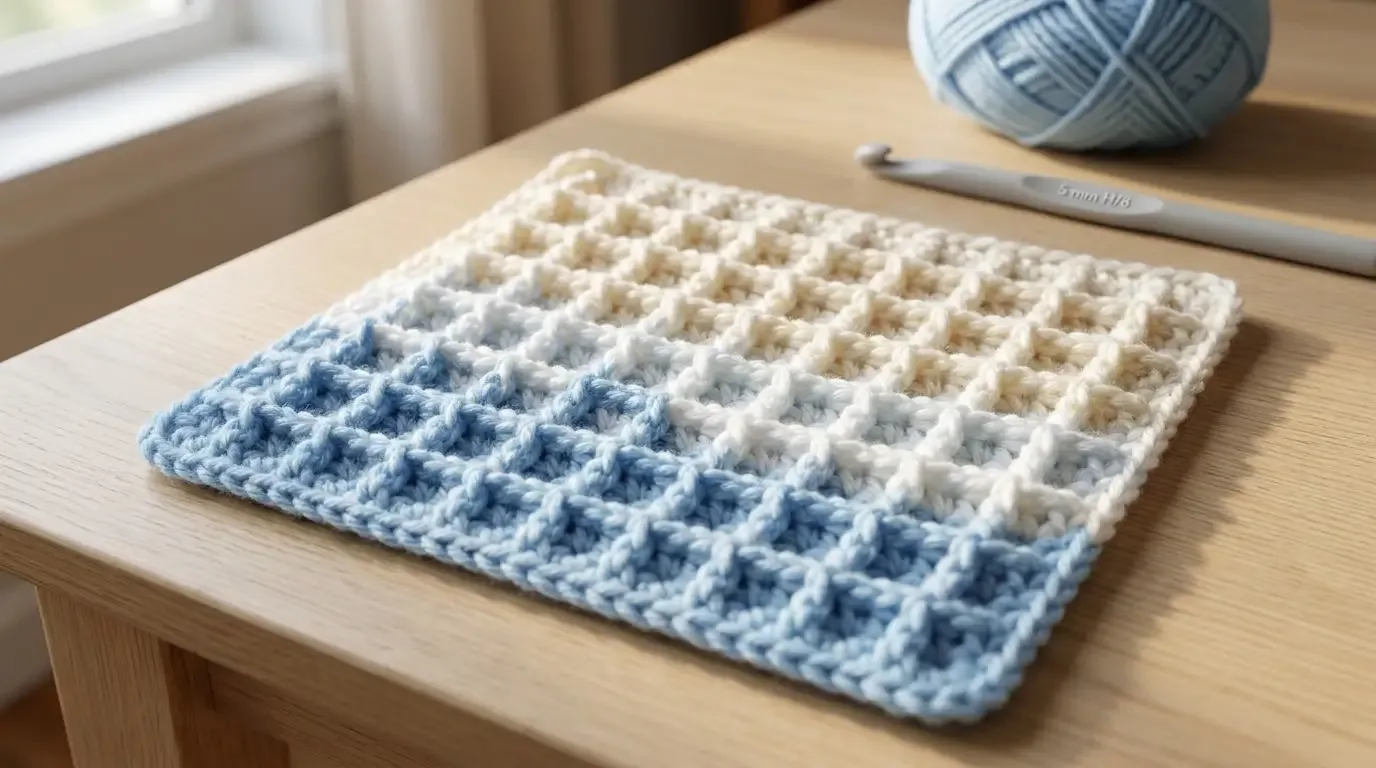
This flat blue-and-cream swatch shows a classic raised checker grid made with groups of three double crochet and three front-post double crochet. The HookElla tutorial gives each row an exact stitch count and treats turning chains consistently, so the repeat stays at 24 stitches from foundation through finish.
About the waffle grid swatch
The waffle-grid texture is created by alternating raised front-post double crochets with flat double crochets. This tutorial makes a small, flat sample rather than a blanket or wearable. Its lower rows are light blue; the upper rows are cream, with one blue-and-cream block row between the two fields.
The Crochet Everyone/Crochetss source describes a foundation multiple of six plus two chains. In its printed instructions, Row 1 skips two chains and produces the multiple-of-six working stitches, while the later turning chain is also described as a stitch. That can make the edge count unclear when full six-stitch groups are repeated. This HookElla version resolves the count by making the turning chain height-only and keeping exactly 24 worked stitches on every row.
Materials
- Smooth medium-weight (#4) yarn in light blue and cream. About 40–60 yd (37–55 m) total is a planning estimate for this 24-stitch by 20-row sample; actual use has not been measured.
- 5 mm (H/8) crochet hook, selected for this tutorial. A different yarn or hand tension may suit another hook.
- Scissors, yarn needle, tape measure, and two small yarn bobbins or clips for the transition row.
The source lists medium-weight yarn and a hook suitable for the chosen yarn but does not specify a brand, hook size, gauge, or sample dimensions. The HookElla materials above are explicit choices for this tutorial, not facts about the source sample.
Finished size and gauge
There is no fixed gauge for this stitch tutorial. Work the sample as written: 24 stitches across and 20 rows high. Its finished inch or centimeter dimensions depend on your yarn, hook, and tension, and are not claimed here. After the fabric relaxes, you can record your own gauge by measuring the center four inches and counting stitches and rows. The Yarnivo Gauge Calculator can convert those measurements; it cannot verify the appearance or physical testing of this tutorial.
Abbreviations (US terms)
- ch — chain
- dc — double crochet
- FPdc — front-post double crochet
- st(s) — stitch(es)
- rep — repeat
- RS / WS — right side / wrong side
Special stitches and row rules
Double crochet (dc): Yarn over, insert the hook under both top loops of the indicated stitch, yarn over and pull up a loop, yarn over and draw through two loops, then yarn over and draw through the final two loops.
Front-post double crochet (FPdc): Yarn over. Insert the hook from front to back and back to front around the vertical post of the indicated stitch, yarn over and pull up a loop around that post, then complete the double crochet by drawing through two loops twice. One FPdc counts as one stitch. It replaces the stitch at that position; do not also work into that stitch’s top loops.
Turning chain: Ch 2 at the start of each row after Row 1. It provides height only and never counts as a stitch. Work the first actual stitch into the first stitch of the previous row. This keeps both edges at 24 stitches and prevents the turning chain from adding a 25th position.
A row: Repeat FPdc around the next 3 stitch posts, dc in the top loops of the next 3 stitches.
B row: Repeat dc in the top loops of the next 3 stitches, FPdc around the next 3 stitch posts.
Each repeat uses six positions. With 24 stitches, work each repeat four times. Alternate A and B rows so the raised groups shift across the flatter groups and make the grid.
Pattern instructions: complete 24-stitch swatch
Foundation
With Light Blue, ch 26. The two chains nearest the hook are not worked. This leaves 24 working chains, which will make four six-stitch groups.
Rows
- Row 1 (Light Blue, RS): Dc in the third chain from the hook and in each remaining chain across. 24 dc. Turn.
- Row 2 (Light Blue, A): Ch 2, not counted. Repeat FPdc around the next 3 stitch posts, dc in the next 3 stitch tops four times. 24 sts. Turn.
- Row 3 (Light Blue, B): Ch 2, not counted. Repeat dc in the next 3 stitch tops, FPdc around the next 3 stitch posts four times. 24 sts. Turn.
- Row 4 (Light Blue, A): Work Row 2’s A sequence four times. 24 sts. Turn.
- Row 5 (Light Blue, B): Work Row 3’s B sequence four times. 24 sts. Turn.
- Row 6 (Light Blue, A): Work Row 2’s A sequence four times. 24 sts. Turn.
- Row 7 (Light Blue, B): Work Row 3’s B sequence four times. 24 sts. Turn.
- Row 8 (Light Blue, A): Work Row 2’s A sequence four times. 24 sts. Turn.
- Row 9 (transition, B): Prepare four short bobbins in work order: Light Blue, Cream, Light Blue, Cream. Ch 2, not counted. Work one B repeat, dc in the next 3 stitch tops, FPdc around the next 3 stitch posts, using one bobbin for each six-stitch repeat. Change shades after each group, completing the last pull-through of the sixth stitch with the next group’s color. 24 sts total: four six-stitch groups. Turn.
- Row 10 (Cream, A): Ch 2, not counted. Work the A sequence four times in Cream. 24 sts. Turn.
- Row 11 (Cream, B): Work the B sequence four times. 24 sts. Turn.
- Row 12 (Cream, A): Work the A sequence four times. 24 sts. Turn.
- Row 13 (Cream, B): Work the B sequence four times. 24 sts. Turn.
- Row 14 (Cream, A): Work the A sequence four times. 24 sts. Turn.
- Row 15 (Cream, B): Work the B sequence four times. 24 sts. Turn.
- Row 16 (Cream, A): Work the A sequence four times. 24 sts. Turn.
- Row 17 (Cream, B): Work the B sequence four times. 24 sts. Turn.
- Row 18 (Cream, A): Work the A sequence four times. 24 sts. Turn.
- Row 19 (Cream, B): Work the B sequence four times. 24 sts. Turn.
- Row 20 (Cream, A): Work the A sequence four times. 24 sts. Fasten off, leaving a tail for weaving in.
Color changes and count audit
Rows 1–8 make the blue lower field. Row 9 is the one-row transition, divided into four six-stitch groups in Light Blue/Cream/Light Blue/Cream order as you work across. Rows 10–20 are Cream. The row-9 mini bobbins avoid long carried floats; leave a tail at each color boundary and weave tails along the back of the matching group.
The foundation is ch 26 = 24 working chains. Row 1 has 24 dc. Rows 2–20 each use four six-position repeats: 4 × 6 = 24 stitches per row. Turning chains are excluded from all counts, and there are 20 rows in the finished sample.
Assembly instructions
This sample is one flat piece, so there are no seams or separate parts to assemble. Keep the long side edges straight by working the first actual stitch after each turning chain and counting 24 worked stitches on every row.
Finishing and care
Fasten off after Row 20. Thread each yarn tail through several stitches on the WS without drawing the fabric tight. Weave the transition-row tails along the corresponding color blocks and trim only after they are secure. Lay the swatch flat and smooth it by hand; do not stretch it to a guessed measurement. Follow the yarn label for washing and drying.
Tips and troubleshooting
- The edge has 25 stitches: The turning chain has been counted. Undo to the row start, treat ch 2 as height only, and work the first stitch into the first actual stitch.
- The repeat does not fit: Count 24 actual stitches before beginning each row. Divide them into four six-stitch groups; do not place a stitch into the turning chain.
- The grid looks like horizontal ridges: Check that A rows place FPdc around the first three posts, and B rows begin with three regular dc before the next raised group. Alternate the row types exactly as listed.
- A hole appears beside an FPdc: The front-post stitch replaces the stitch at that position. Do not work an additional dc into the top of the same stitch.
- The front-post stitch is hard to see: Identify the vertical post below the top loops. Bring the hook around the post from the front, then complete the dc normally.
- The transition row puckers: Use a separate short bobbin for each six-stitch group, keep the yarn changes relaxed, and avoid pulling the carried tails tight while weaving them in.
- The fabric feels stiff: Try a larger hook with the same yarn and remake the swatch. No fixed gauge or finished dimensions are specified for this stitch tutorial.
Frequently asked questions
Can I use this stitch for a blanket?
The six-stitch repeat can be extended across a wider foundation, but this article only provides the complete 24-stitch, 20-row swatch. Recheck the repeat count and edge stitches for any larger project.
Why does the foundation have two extra chains?
For this sample, ch 26 consists of 24 working chains plus two chains skipped at the start of Row 1. That produces four complete groups of six actual stitches.
Do I count the turning chain?
No. In this HookElla version, ch 2 is height-only. This explicit convention keeps every row at 24 actual stitches.
Is the blue-and-cream transition a complete colorwork pattern?
It is one transition row with four six-stitch blocks. Use a separate bobbin for each block in the listed color order; the rest of the sample uses one color per row.
Has the swatch been physically tested?
No. The stitch and row counts are mathematically checked, but no HookElla swatch was physically crocheted for this article. The shown HookElla photograph is the visual reference; the written sample dimensions are given only in stitches and rows.
Browse more lessons in HookElla’s Crochet Stitches / Stitch Tutorials category.
Source credit
This independently written HookElla stitch tutorial was informed by the general waffle-grid concept in Waffle Grid Crochet Stitch Pattern by Crochet Everyone, published on Crochetss.com. The source page displays an all-rights-reserved notice. Its instructions, prose, and photographs are not reproduced here.
Helpful questions
What does 6 + 2 mean for the foundation chain?
For this tutorial, chain 26: 24 chains provide the working stitches and two are skipped as the starting offset. Row 1 then contains 24 double crochets, or four complete six-stitch groups.
Does the turning chain count as a stitch?
No. Ch 2 is only for row height in this HookElla version. Work the first actual stitch into the first stitch after turning, and count 24 worked stitches on every row.
Why do the front-post stitches move between groups?
Alternating the A and B rows reverses which three-stitch group is raised. The raised blocks cross the flatter groups to make the grid.
Is there a required gauge or finished size?
No fixed gauge or inch dimensions are prescribed for this stitch sample. The sample is defined by 24 stitches and 20 rows; its physical size depends on your yarn, hook, and tension.
Has this HookElla swatch been physically tested?
No. The stitch counts and repeat are mathematically checked, but no physical HookElla sample was made for this article.
Inspiration credit
This HookElla swatch tutorial is independently written using standard dc and front-post dc techniques. Crochet Everyone/Crochetss.com is credited as the source reference for the general waffle-grid stitch concept. Its instructions, prose, and photographs are not reproduced. Waffle Grid Crochet Stitch Pattern by Crochet Everyone.