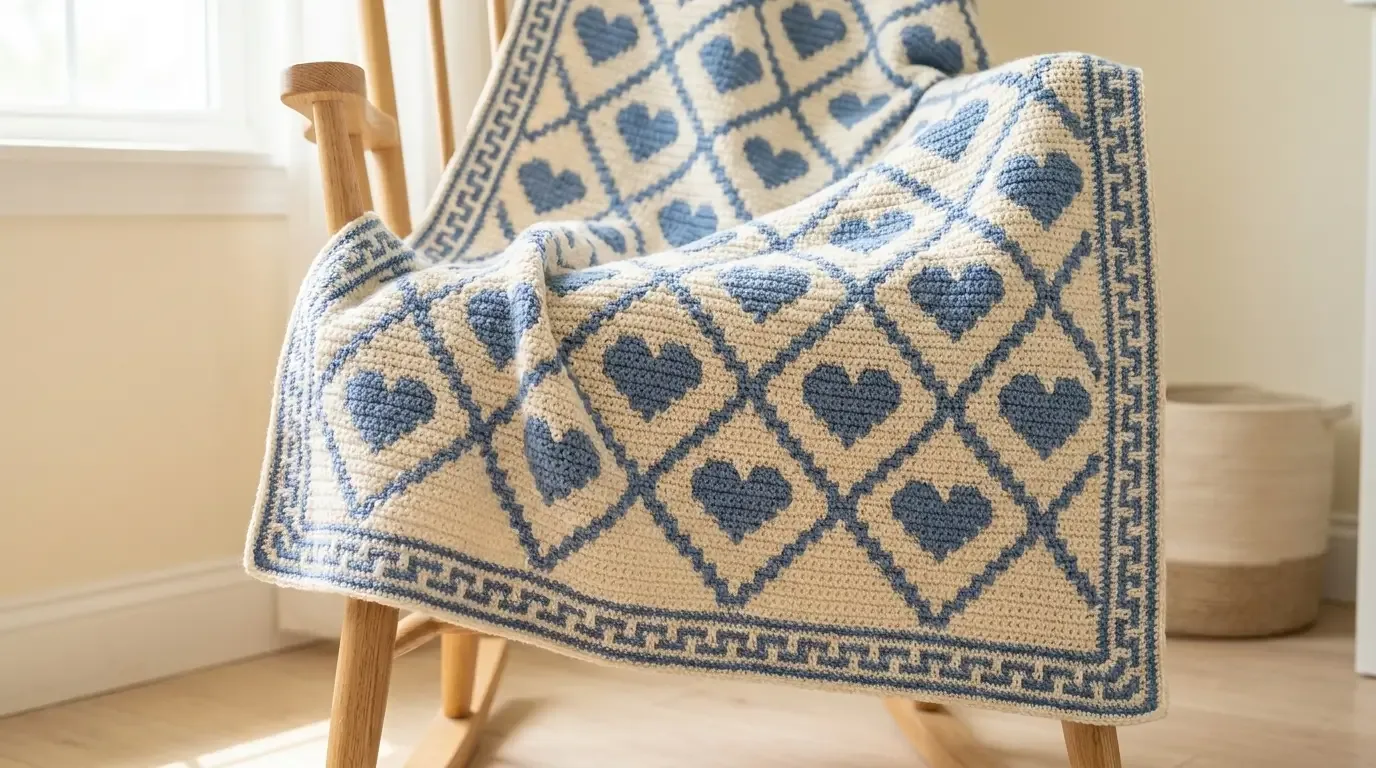
The Bluebell Heart Lattice Baby Blanket pairs warm ivory with dusty cornflower blue in a repeating heart-and-diamond mosaic. Worked flat in one direction with one color per row, the blanket is finished with a narrow two-color border.
A heart motif framed by a stepped lattice
The Bluebell Heart Lattice Baby Blanket is worked as one rectangle in overlay mosaic crochet. Warm ivory forms the soft ground; dusty cornflower blue makes a repeating heart centered inside a stepped diamond outline. Each row uses one color and is worked from the front side, so the chart and stitch placement—not carried colorwork—build the pattern.
The directions use US crochet terms. The project is suitable for an intermediate crocheter, or a confident beginner who is comfortable counting chart columns and working single crochet and dropped double crochet. The finished blanket is approximately 31 × 39 inches (79 × 99 cm) with its narrow border.
Materials
- Color A (ground): 1,150–1,450 yd (1,052–1,326 m) smooth Aran / worsted-weight #4 yarn in warm ivory
- Color B (motif): 550–700 yd (503–640 m) matching-weight yarn in dusty cornflower blue
- 5.0 mm (H-8) crochet hook, or size needed to meet gauge
- Tapestry needle, scissors, measuring tape, and locking stitch markers
The total estimate is about 1,700–2,100 yd (1,555–1,920 m), including the border. Smooth, washable yarn with clear stitch definition makes the small stepped pixels easiest to see. Buy both colors from compatible yarn lines and, when possible, from the same dye lots within each color.
Finished size and gauge
The blanket measures approximately 31 × 39 inches (79 × 99 cm) after edging. The mosaic body is about 30 × 37 inches (76 × 94 cm) before the border.
Gauge in the mosaic fabric is 13 stitches × 13 rows = 4 inches (10 cm). Five 20-stitch repeats make 100 stitches, or about 30¾ inches across. Six 20-row chart repeats make 120 mosaic rows, or about 36¾ inches long. The narrow edging adds roughly ½ inch on each side. Make, wash, and dry a swatch before starting; change hook size if your gauge differs substantially.
Abbreviations and special stitches
- A — Color A, warm ivory
- B — Color B, dusty blue
- BLO — back loop only
- ch — chain
- dc — double crochet
- rep — repeat
- RS — right side
- sc — single crochet
- sl st — slip stitch
- st(s) — stitch(es)
- YO — yarn over
- X — chart-marked dropped double crochet
- . — chart-unmarked single crochet
Dropped double crochet (drop dc)
YO and insert the hook through the unused front loop of the stitch two rows below in the same column. Draw up a loop to the height of the current row, then complete a dc. Do not work into the stitch directly below; it remains behind the long stitch. Keep the loop relaxed so the fabric does not pucker.
Mosaic method and edge setup
Work every row from the RS in the same direction. Do not turn. Use a separate strand for each row: finish the last stitch, fasten off, and return to the starting edge without turning the fabric. Leave tails long enough to weave securely; weave in as you go. The border covers the row-start edges, but it does not replace securing the tails.
In every charted row, work sc BLO in unmarked columns and a drop dc in marked columns. Work the chart five times from right to left across the 100-stitch width. Keep a removable marker in the first stitch of each 20-stitch repeat until the chart rhythm is established. Two plain setup rows precede the chart so the first dropped stitches have a same-color row two rows below to anchor into.
Original heart-lattice chart
This chart is a 20-column-wide by 20-row-high repeat. Column 1 is at the starting edge of the row. An X means work a drop dc; a dot means work sc BLO. The listed marked columns repeat five times across the blanket. Chart rows are read from the RS, right to left; the color for each chart row alternates A, B, A, B, beginning with A.
| Chart row | Marked columns in each 20-st repeat |
|---|---|
| 1 | 10–11 |
| 2 | 9, 12 |
| 3 | 8, 13 |
| 4 | 7, 14 |
| 5 | 6, 8–9, 12–13, 15 |
| 6 | 5, 7–9, 12–14, 16 |
| 7 | 4, 6–9, 12–15, 17 |
| 8 | 3, 6–15, 18 |
| 9 | 2, 7–14, 19 |
| 10 | 1, 8–13, 20 |
| 11 | 1, 9–12, 20 |
| 12 | 2, 10–11, 19 |
| 13 | 3, 18 |
| 14 | 4, 17 |
| 15 | 5, 16 |
| 16 | 6, 15 |
| 17 | 7, 14 |
| 18 | 8, 13 |
| 19 | 9, 12 |
| 20 | 10–11 |
For example, on Chart Row 8 work drop dc in columns 3 and 18, then columns 6–15, and sc BLO in all other columns. Repeat that 20-stitch instruction five times. The outer marks form the stepped diamond; the wide center marks form the heart. All unmarked stitches are still worked, so every chart row has exactly 100 stitches.
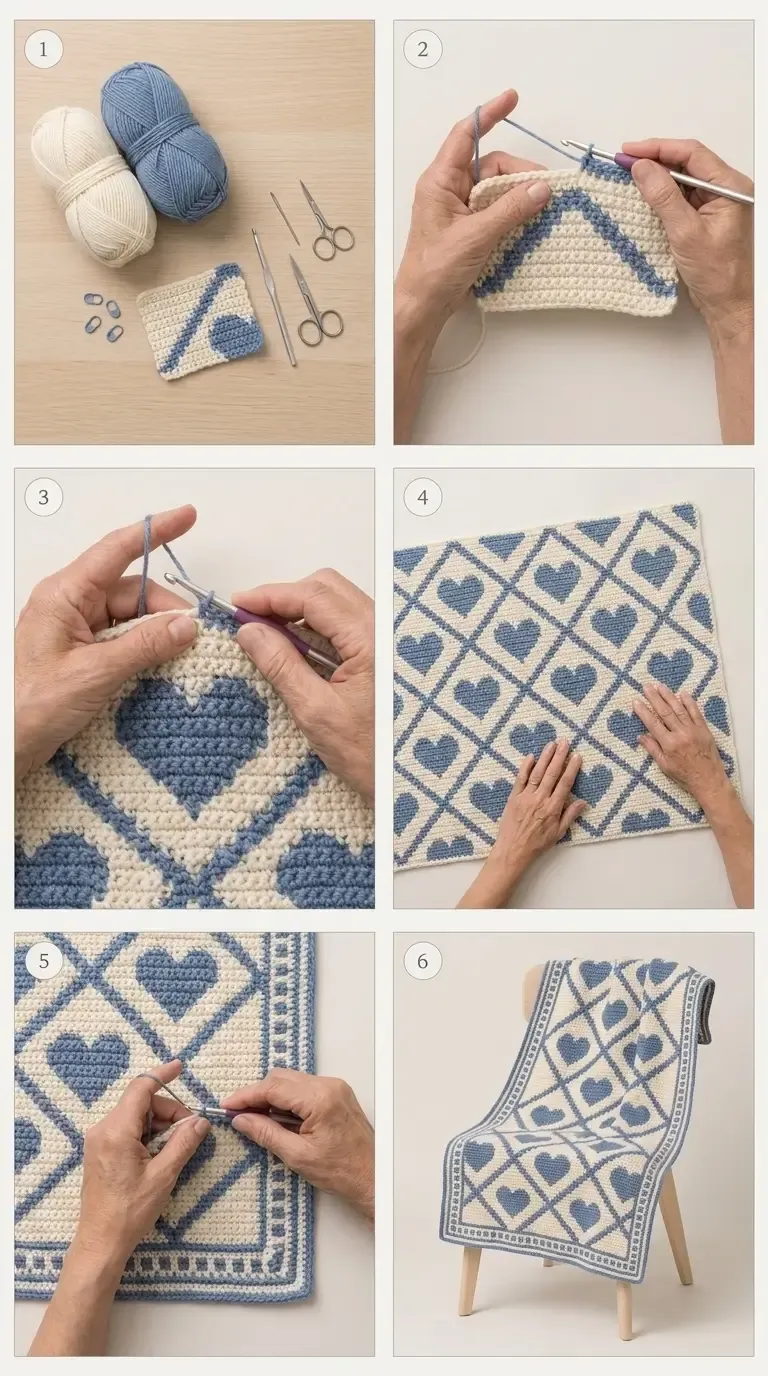
Instructions
Mosaic blanket body
With Color A, ch 101. The 100 stitches are five 20-stitch chart repeats.
- Row 1 (foundation, A): Sc in the second ch from hook and in each ch across — 100 sc. Fasten off.
- Row 2 (setup, B): Attach Color B at the same starting edge. Ch 1 (does not count), sc BLO in each stitch across — 100 sc. Fasten off. These back-loop stitches leave front loops for the chart’s dropped stitches.
- Chart Row 1 (A): Attach Color A at the same starting edge. In each 20-stitch repeat, work drop dc in columns 10–11 and sc BLO in all other columns; repeat across five times — 100 sts. Fasten off.
- Chart Row 2 (B): Attach Color B at the starting edge. Work drop dc in columns 9 and 12 of each repeat and sc BLO in all other columns — 100 sts. Fasten off.
- Chart Rows 3–20: Continue in the same manner, following the marked columns in the chart. Use A for odd-numbered chart rows and B for even-numbered chart rows. Fasten off after every row; do not turn.
- Chart Rows 1–20 form one motif repeat. Repeat the complete chart five more times (six chart repeats total, 120 chart rows). The body is 122 rows including the two setup rows. The last chart row is Row 20 in Color B. Fasten off.
At the end of every row, count 100 stitches. A dropped dc replaces one sc; it does not add a stitch. If the front loop two rows below is difficult to locate, follow the same column down and look for the unworked loop left by the earlier BLO sc. Keep the loop height consistent.
Two-color mosaic border
The border is four rounds deep. Round 1 evens the edge; Rounds 2–4 make a narrow stepped blue-and-ivory band. Mark the four corners before beginning. At each corner, work the specified 3 sc in the center corner stitch/space. The charted 8-stitch border unit repeats continuously along each side; if a side ends partway through a unit, work only the remaining chart positions before the corner increase.
Border chart (read each row in order around the edge; repeat every 8 stitches):
| Border round | Color | Stitches in each 8-st repeat |
|---|---|---|
| 1 | A | sc in every stitch; 3 sc at corners |
| 2 | B | sc BLO in every stitch; 3 sc BLO at corners |
| 3 | A | drop dc in positions 1–2 and 7–8; sc BLO in the other positions |
| 4 | B | drop dc in positions 3–6; sc BLO in the other positions |
- Round 1 (A): Join Color A at a corner. Ch 1, sc evenly around the body, working 3 sc in each corner. Along the sides, aim for one sc per row end and adjust so the edge lies flat. Join with sl st; fasten off.
- Round 2 (B): Join Color B in a corner stitch. Ch 1, sc BLO around, working 3 sc BLO in the center sc of each corner group. These unused front loops are the anchor points for the Round 4 drop stitches. Join; fasten off.
- Round 3 (A): Join A. Ch 1. Repeat the 8-stitch chart unit around: drop dc in positions 1–2 and 7–8 into the unused front loops of Round 1, and sc BLO in positions 3–6. At corners, keep the 3-sc increase in the center corner stitch/space and work ordinary sc into the two neighboring corner stitches. Join; fasten off.
- Round 4 (B): Join B. Ch 1. Repeat the 8-stitch chart unit around: drop dc in positions 3–6 into the unused front loops of Round 2, and sc BLO in positions 1–2 and 7–8. Keep the corner increase centered as in Round 3. Join, fasten off, and weave in all tails.
At the end of each border round, the stitch count may increase at the four corners. Keep the 8-stitch chart moving along each side and restart at position 1 after each corner. If the edging waves, use fewer sc along the side row ends; if it cups, add a few. Do not omit the corner increases.
Finishing, blocking, and care
Secure every row tail on the wrong side by weaving through several stitches of the same color. Do not knot tails loosely at the edge. Lay the blanket flat and square it to approximately 31 × 39 inches (79 × 99 cm). Wet-block gently if the yarn allows and let it dry fully before use. Wash according to the yarn label and reshape while damp; avoid high heat that can flatten the mosaic texture.
Customization and troubleshooting
- Width: Work a multiple of 20 stitches. For n repeats, chain 20n + 1; Row 1 will have 20n stitches. For example, six repeats use ch 121 and give 120 stitches. Width changes alter the number of full heart-and-diamond repeats.
- Length: Add or remove complete 20-row chart repeats. Each complete repeat adds one motif height; partial chart repeats can cut through a heart or the diamond point.
- Starting chain planning: The Yarnivo Blanket Starting-Chain Calculator can help compare a target width with the 20-stitch multiple. Use the pattern’s stated multiple and swatch measurements; a calculator does not automatically preserve a motif at an arbitrary size.
- Motifs look jagged: Check that chart columns are counted from the same starting edge every row and that the fabric is never turned.
- Long stitches pull or pucker: Draw each dropped dc up to the current row height before completing it. A larger hook may help if the long stitches are tight, but recheck gauge.
- A loop is missing below: The dropped dc goes through the front loop two rows below in that same column. The intervening stitch is not skipped or removed; it remains behind the drop dc.
- Border distorts: Adjust the number of sc along side edges while maintaining three sc in every corner. Continue the chart repeat around each side without forcing extra stitches into the corner itself.
For another cozy make, browse HookElla’s Baby Crochet patterns or try the Twistline Baby Blanket.
This blanket is intended for supervised cuddling and everyday use. Follow current safe-sleep guidance and keep loose blankets out of an infant’s sleep space.
Helpful questions
How many stitches are in the Bluebell Heart Lattice repeat?
The chart repeat is 20 stitches wide. Work it five times across for 100 blanket-body stitches. The foundation chain is 101 because Row 1 is worked into the second chain from the hook.
How is the heart-and-diamond chart read?
Read one chart row for each crochet row, from the right edge to the left, and repeat the 20-column chart five times across. A marked column is a dropped double crochet into the front loop two rows below; an unmarked column is a single crochet in the back loop.
Can I change the blanket size?
Add or remove complete 20-stitch chart repeats for width and complete 20-row chart repeats for length. Swatch first; changing the repeat count changes finished size and yarn use, and a different size may alter how the border fits.
Does overlay mosaic crochet use one color at a time?
Yes. Each row is worked from the front in a single color, alternating ivory and blue. Fasten off each row, then begin the next row again at the same edge.