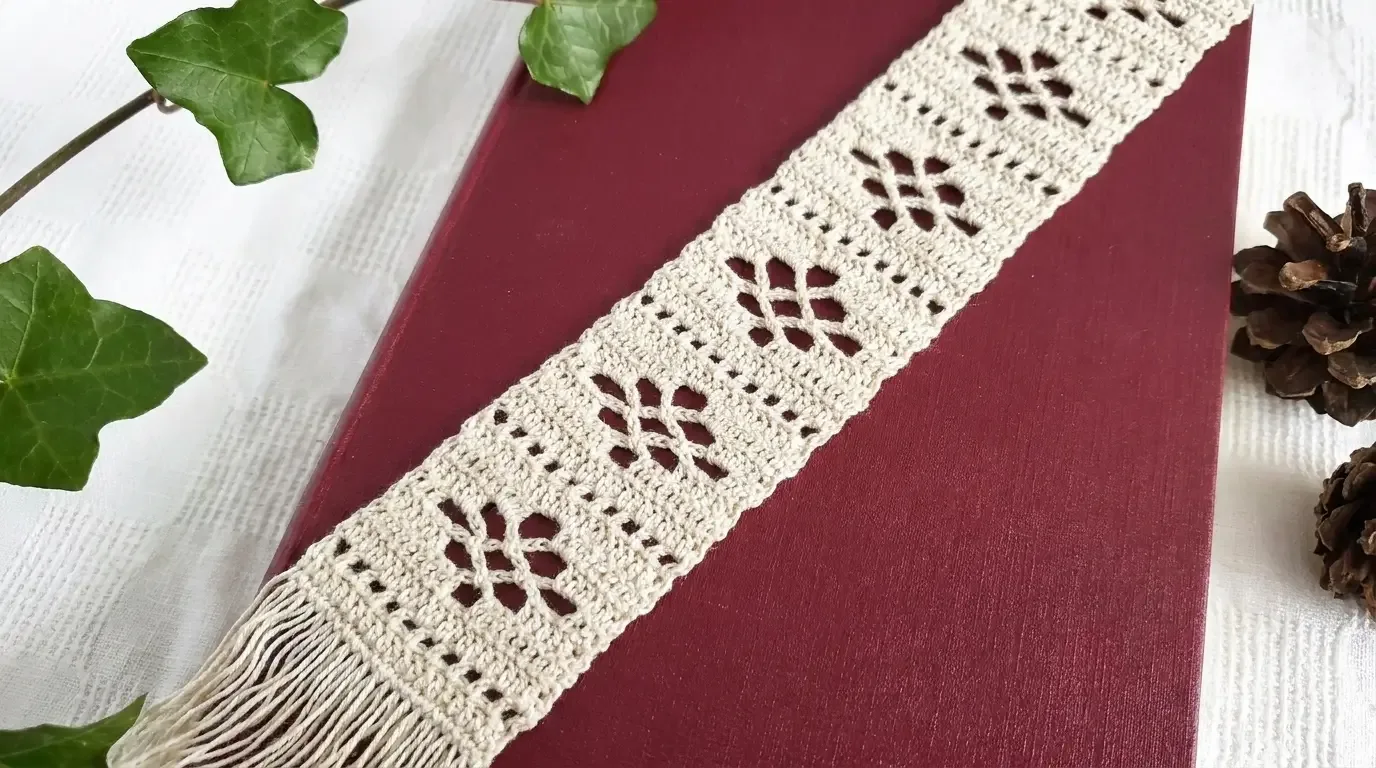
A slim ivory strip, repeated openwork flowers, and a soft fringe make this delicate bookmark a lovely handmade gift for a reader. The complete design is by Torun Johansson and is shared here with the designer's stated permission and credit.
About this pattern
Deta’s bookmark is a delicate lace strip designed by Torun Johansson (@torunjcrochet). The open flower motif grows within the strip itself, so the finished bookmark is a continuous piece rather than separate motifs sewn together. This article shares the complete instructions under the designer’s permission statement in the supplied PDF; please keep the designer credit with the pattern. The Ravelry pattern page is the source and attribution link.
The directions below use US crochet terms. They reproduce the pattern’s row sequence with expanded placement notes for clarity. The PDF’s Row 1 action gives 20 double crochets (one in the fourth chain plus 19 more); its parenthetical says 21, which conflicts with both the arithmetic and chart. Row 3 is the row that establishes 21 double crochets. The row directions below preserve the stated actions and identify that apparent parenthetical count typo rather than adding an unsupported stitch.
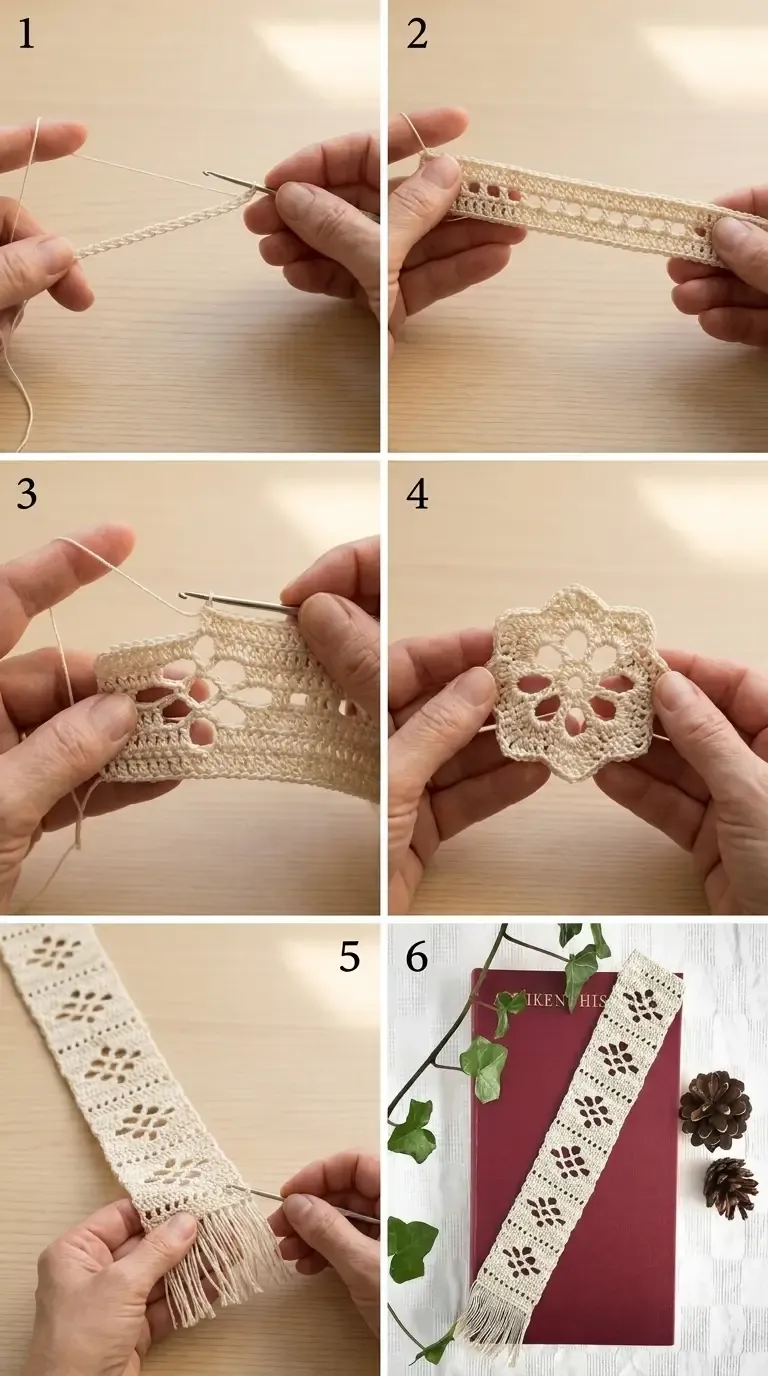
Materials
- Size 10 cotton crochet thread. The designer suggests Scheepjes Maxi Sweet Treat (Bonbon) or a comparable fine cotton thread.
- 1.25 mm or 1.50 mm crochet hook, chosen to give a firm but flexible lace fabric.
- Scissors and a fine yarn needle for securing ends.
- Matching cotton thread for the fringe.
The PDF does not specify a yardage estimate. Allow enough thread for the number of flower repeats you plan to make and for the fringe; a longer strip uses proportionally more thread. Keep the same thread and hook pairing throughout so the eyelets and flower arches remain consistent.
Finished size and fit
No fixed finished measurements are specified in the pattern PDF. The foundation is 23 chains wide, and the sample in the supplied HookElla photograph shows five complete flower repeats plus the final openwork row. Width and length vary with thread, hook, and tension. To size it for a book, make the strip a little narrower than the page block and repeat the full eight-row flower sequence until it is close to the desired length. Measure after lightly blocking, since lace opens up when shaped.
Gauge or verified sizing method
Gauge is not specified. Use the 23-chain foundation and the completed first flower repeat as your sizing check: the strip should lie flat, feel flexible, and be narrow enough to sit inside a book without covering too much text. If the fabric is stiff, use a slightly larger hook; if the eyelets are loose and the strip twists, try a smaller hook. A hook change affects the finished width and length, so judge by the blocked fabric rather than a numeric gauge.
Abbreviations (US terms)
- ch — chain
- ch-sp — chain space
- ch-3 sp / ch-5 sp — space made by the specified number of chains
- dc — double crochet
- rep — repeat
- sk — skip
- sl st — slip stitch
- st(s) — stitch(es)
- rem — remaining
Special stitches and construction notes
- Turning chain: At the start of Rows 1 and 3–9, the ch-3 is treated as the first double crochet unless a row says otherwise. The Row 2 ch-4 serves as the edge stitch and first chain arch in the lace setup.
- Work into a chain space: Insert the hook under the chain arch and around the space, not into an individual chain loop.
- Openwork flower repeat: Rows 4–9 shape the flower opening and petals inside the straight-sided strip. The slip stitches anchor the arches; they do not add height like a double crochet.
- Turn after every row. The chain spaces at the edge are part of the pattern; keep them relaxed and consistent.
Pattern instructions
Foundation
Chain 23. Keep the chain relaxed so the bottom edge does not pull in.
Setup and flower repeat
- Row 1: Dc in the 4th ch from the hook, then dc in each of the remaining 19 chains. Turn. 20 sts. (All are dc.) The accompanying PDF’s parenthetical “21 dc” does not match its written chain arithmetic or chart; follow the 20 stitches made by the written action.
- Row 2: Ch 4 (counts as the edge dc and first ch-1 arch), sk the first dc, dc in the next dc. *Ch 1, sk the next dc, dc in the next dc; rep from * 8 more times. Turn. The row has 10 dc positions, counting the beginning ch-4 as one, and 10 chain arches counting the ch-1 within the ch-4.
- Row 3: Ch 3 (counts as dc), dc in the first ch-sp, dc in the next dc. *Dc in the next ch-sp, dc in the next dc; rep from * 9 more times. Turn. 21 sts. (All are dc.)
- Row 4: Ch 3 (counts as dc), dc in the next 8 sts, ch 3, sk the next 3 sts, dc in each of the remaining 9 sts. Turn. 18 sts. (All are dc, plus one ch-3 sp.)
- Row 5: Ch 3 (counts as dc), dc in the next 5 sts, ch 5, sl st into the ch-3 sp, ch 5, sk the next 3 sts, dc in each of the remaining 6 sts. Turn. 12 sts. (All are dc, plus two ch-5 arches and one anchoring sl st.) The first arch spans the three stitches before the center space; the second spans the three skipped stitches after it.
- Row 6: Ch 3 (counts as dc), dc in the next 2 sts, ch 5, sl st in the first ch-5 sp, ch 5, sl st in the next ch-5 sp, ch 5, sk the next 3 sts, dc in each of the remaining 3 sts. Turn. 6 sts. (All are dc, plus three ch-5 arches and two anchoring sl sts.)
- Row 7: Ch 3 (counts as dc), dc in the next 2 sts, 3 dc in the first ch-5 sp, ch 5, sl st in the middle ch-5 sp, ch 5, 3 dc in the third ch-5 sp, dc in each of the remaining 3 sts. Turn. 12 sts. (All are dc, plus two ch-5 arches.)
- Row 8: Ch 3 (counts as dc), dc in the next 5 sts, 3 dc in the first ch-5 sp, ch 3, 3 dc in the next ch-5 sp, dc in each of the remaining 6 sts. Turn. 18 sts. (All are dc, plus one ch-3 sp.)
- Row 9: Ch 3 (counts as dc), dc in the next 8 sts, 3 dc in the ch-3 sp, dc in each of the remaining 9 sts. Turn. 21 sts. (All are dc.)
Repeat to length and final edge
Rows 2–9 make one complete flower repeat. Work that eight-row sequence five times total for the five-flower length shown in the supplied finished photo. For a shorter or longer bookmark, use a different whole number of repeats; keep each repeat complete so the flower sequence ends on Row 9. Then work one final Row 2 to finish with the same open edge as the sample. Fasten off and secure the final loop.
For a row-by-row checklist, HookElla’s crochet row counter can help keep track of the eight-row repeat; the full stitch directions remain here.
Assembly
The bookmark body is one continuous strip; no motif joining or sewing is needed. Weave in the starting and ending tails along the solid edge stitches on the reverse, taking care not to close the flower openings or distort the side edges.
Finishing and care
Cut matching lengths of cotton thread for fringe and attach them across one short end, spacing them evenly through the edge stitches. The PDF does not prescribe a fringe length or bundle count, so choose a modest fringe that will sit comfortably outside the book and trim the ends evenly. Wet-block gently: pin the strip straight, open the lace flowers without stretching the long edges, and let it dry fully. Follow the thread manufacturer’s care instructions; store the bookmark flat or inside the book rather than hanging it by the fringe.
Fit adjustments and troubleshooting
- The strip curls along its sides: Check that the turning chains are not tight, and block the piece flat. If the curl remains, test a slightly larger hook.
- The arches look uneven: Keep chain tension consistent and place each anchoring slip stitch into the center of the named chain space.
- The sides widen or narrow: Count the solid setup row after Row 3 (21 dc) and keep each flower’s return row at 21 dc. Make the same number of arches on both sides of each center flower opening.
- The bookmark is too short or long: Add or remove complete Rows 2–9 repeats rather than stopping mid-flower. The sample shown uses five repeats and one final Row 2.
- The cotton feels too firm: Try the larger hook within the suggested range and reassess the fabric after blocking. Fine thread is naturally delicate; avoid pulling the bookmark sharply when removing it from a page.
Frequently asked questions
How do I make the bookmark longer?
Add or remove complete eight-row flower repeats, then work the specified ending row so the last motif has a finished edge.
Can I use a different thread?
Choose a fine cotton thread that gives a flexible, readable lace fabric at gauge; a heavier thread changes both width and length.
Designer credit
This is Deta’s bookmark by Torun Johansson (@torunjcrochet), shared with the designer’s requested attribution under the permission statement in the supplied PDF. Please retain this credit when sharing the pattern or finished photos. Visit the Deta’s bookmark Ravelry page for the designer’s listing.
Helpful questions
What thread and hook are used for Deta's bookmark?
The designer suggests size 10 cotton crochet thread and a 1.25–1.50 mm hook. Fine thread and hook differences affect the finished width and drape.
How many flower repeats are shown in the sample?
The supplied finished photograph shows five flower repeats. The written repeat can be worked additional or fewer times to suit the book, while keeping the repeat complete.
Is this an original HookElla pattern?
No. Deta's bookmark was designed by Torun Johansson. It is shared with attribution under the permission statement in the supplied pattern PDF.