The Lost in Time shawl has the kind of texture that invites a closer look. This HookElla showcase celebrates Johanna Lindahl’s distinctive design, shares planning ideas for your own version, and points you to the designer’s authorized pattern.
A closer look at Lost in Time
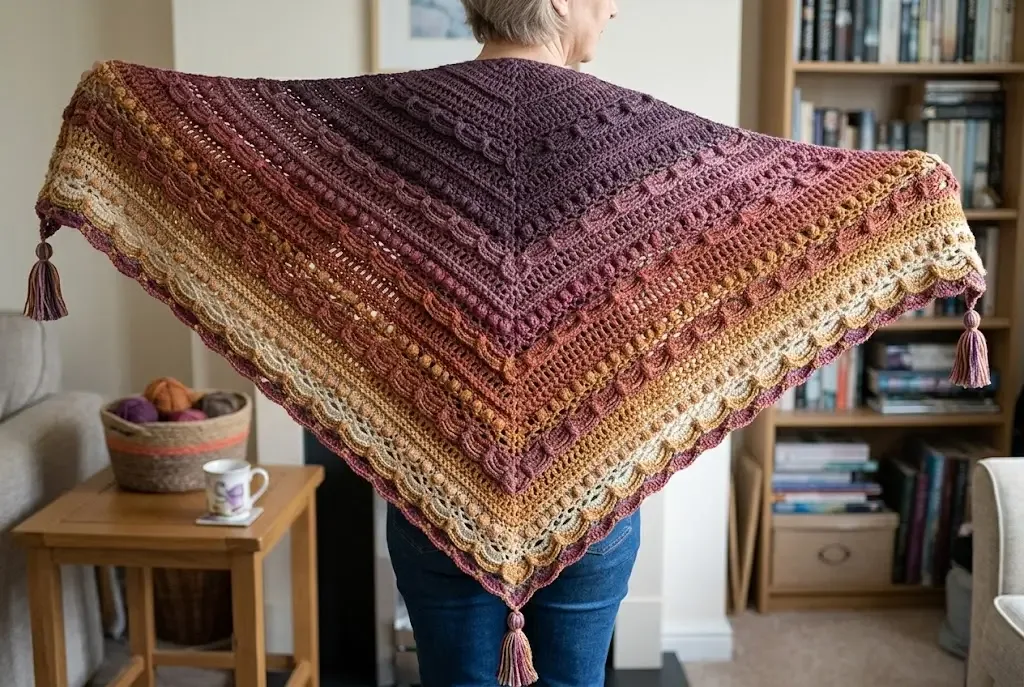
Lost in Time is a celebrated triangular shawl designed by Johanna Lindahl of Mijo Crochet and published in March 2017. Its appeal comes from contrast: open spaces sit beside raised ridges, rounded popcorn details punctuate the surface, and a decorative edge gives the triangle a finished, heirloom feel. The result is richly textured without looking busy from a distance.
This post is an original HookElla editorial guide, not a replacement pattern. We do not reproduce the written instructions, charts, stitch counts, or designer photography. For the complete authorized pattern and translations, visit the Lost in Time listing on Ravelry or Mijo Crochet’s pattern page.
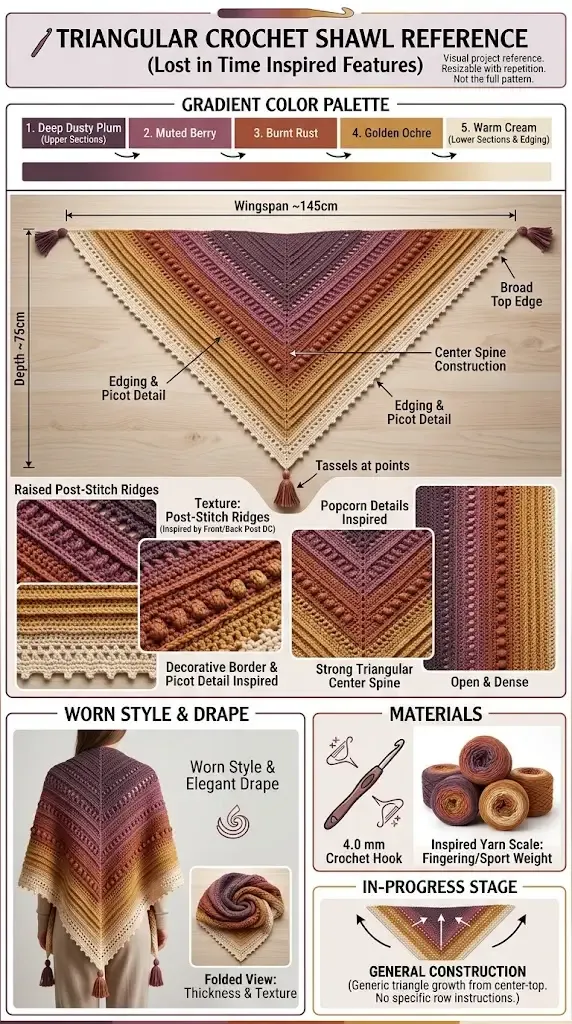
Why the texture stands out
The shawl’s surface is built from a conversation between post stitches and open chain spaces. Raised front- and back-post work creates long ribs that catch the light, while popcorn-like bobbles add small, rounded points of relief. Decorative edging and picot-inspired details frame the triangle so the silhouette reads clearly when worn.
Unlike a plain triangle, the design rewards slow viewing: each repeat changes the rhythm just enough to keep the fabric engaging. The dense and open areas also help the shawl drape rather than becoming a stiff, heavily embossed fabric.
Construction at a high level
The project grows from a center point into a triangular wrap. A center spine anchors the rows, and increases along the outer edges widen the piece symmetrically. The published design is organized around a 12-row repeat, so makers can continue repeating the sequence until the shawl reaches a comfortable wingspan and depth.
That repeat-based construction makes the project adaptable. A neckerchief-size triangle can use only a few repeats; a generous shoulder wrap simply continues farther. Keep notes at the end of each repeat and measure after blocking, since lace openings relax substantially when wet-blocked.
Yarn and palette planning
Public listings describe a fingering-weight Catona version using a 4.0 mm hook and approximately six to seven 50 g skeins. Yardage varies by version and size; Ravelry lists roughly 700–1,000 m. Treat those figures as planning guidance, not a guarantee.
Gradient or solid?
- Gradient: Let a long color-change cake move from deep plum at the center through berry, rust, ochre, and cream. The changing shades emphasize the triangular growth and make each texture band easy to spot.
- Solid: A single jewel tone creates a more graphic, shadowed texture. Plum, forest, ink blue, or warm cinnamon all show the ridges beautifully.
- Autumn palette: Pair dusky plum with muted berry, burnt rust, golden ochre, and warm cream for a market-day shawl that works with denim and neutral layers.
Make a small swatch in your chosen yarn and wash it before committing. A softer, drapier yarn will produce a different hand than a firm mercerized cotton, even with the same hook.
Working confidently without losing your place
When you use the authorized pattern, keep a row tracker beside your project. Mark the first and last row of each 12-row repeat, and place a removable marker at the center spine. Count the repeat’s landmarks—edge increase, center point, and texture section—rather than trying to count every loop in a long row.
Post stitches are easiest to check from the front of the fabric: raised ribs should remain in deliberate vertical or diagonal lines, while recessed channels sit between them. If a bobble appears on the wrong side, undo only to the last landmark instead of pulling back an entire repeat.
Blocking and finishing
After weaving in tails, soak the shawl according to the yarn label and press out excess water without wringing. Pin the center point first, then stretch the wings evenly and use a ruler to keep the top edge balanced. Ease picots and scalloped details into a consistent rhythm; do not pull them so tightly that the edge cups.
Allow the shawl to dry completely before removing pins. A gentle re-block after washing can restore the crisp triangular outline and open the chain spaces.
Styling ideas for fall
- Drape the point over one shoulder and secure it with a small shawl pin over a denim jacket.
- Wrap it twice as a soft scarf with the textured edge showing at the neckline.
- Wear a plum-to-ochre gradient with a cream sweater, ankle boots, and a wool hat for an autumn market walk.
- Fold it into a triangle and tie the ends loosely over a long coat for a polished commute layer.
Because the shawl is customizable, it also makes a thoughtful gift: choose the recipient’s favorite colors, work a smaller neck wrap, or make a full-size version for someone who loves dramatic texture.
Difficulty and realistic expectations
The finished look is impressive, but the challenge is organizational rather than mysterious. Expect advanced-beginner to intermediate skills: reading a repeat, recognizing front- versus back-post placement, forming popcorn texture, and keeping edge increases consistent. The first repeat is a learning pass; after that, the rhythm becomes much easier to anticipate.
FAQ
Does HookElla provide the written pattern?
No. Lost in Time belongs to Johanna Lindahl / Mijo Crochet. Please use the authorized Ravelry or Mijo Crochet page linked above for the complete pattern.
What hook size is associated with the public sample?
The publicly listed Catona version uses a 4.0 mm hook. Always follow the designer’s current pattern notes and swatch in your own yarn.
Can I substitute yarn?
Yes, provided the substitute gives comfortable drape and enough yardage. Changing fiber or weight changes the scale, texture, and meterage, so swatch and plan by finished measurements rather than skein count alone.
How do I choose a stopping point?
Measure the blocked triangle across its wingspan and down the center spine. Stop at a complete repeat when the shawl reaches the coverage you want, following the designer’s instructions for the final edging.
Final thoughts
Lost in Time remains memorable because its construction is practical and its texture is richly layered. If you love post-stitch ridges, bobbles, and a decorative edge, it is a rewarding project to explore in your own palette. Visit Johanna Lindahl and Mijo Crochet for the authorized pattern, then let your yarn choice and chosen size make the finished wrap uniquely yours.
Helpful questions
Is the full Lost in Time pattern reproduced here?
No. This is an editorial showcase. The written pattern, charts, stitch counts, and original photographs remain with Johanna Lindahl and Mijo Crochet; use the authorized source link for the pattern.
What size is the designer’s sample?
Public pattern listings describe a Catona sample at roughly 145 cm wingspan and 75 cm along the center spine. Your size will vary with yarn, hook, tension, and how many repeats you work.
Can the shawl be made larger or smaller?
Yes. The design is known for its customizable repeat structure. Follow the designer’s instructions to stop at the dimensions you want, then allow extra yarn for a larger wrap.
Is this a beginner project?
It is best for an advanced beginner or intermediate crocheter who is comfortable reading a repeat, working post stitches, making popcorn texture, and maintaining a growing triangle.