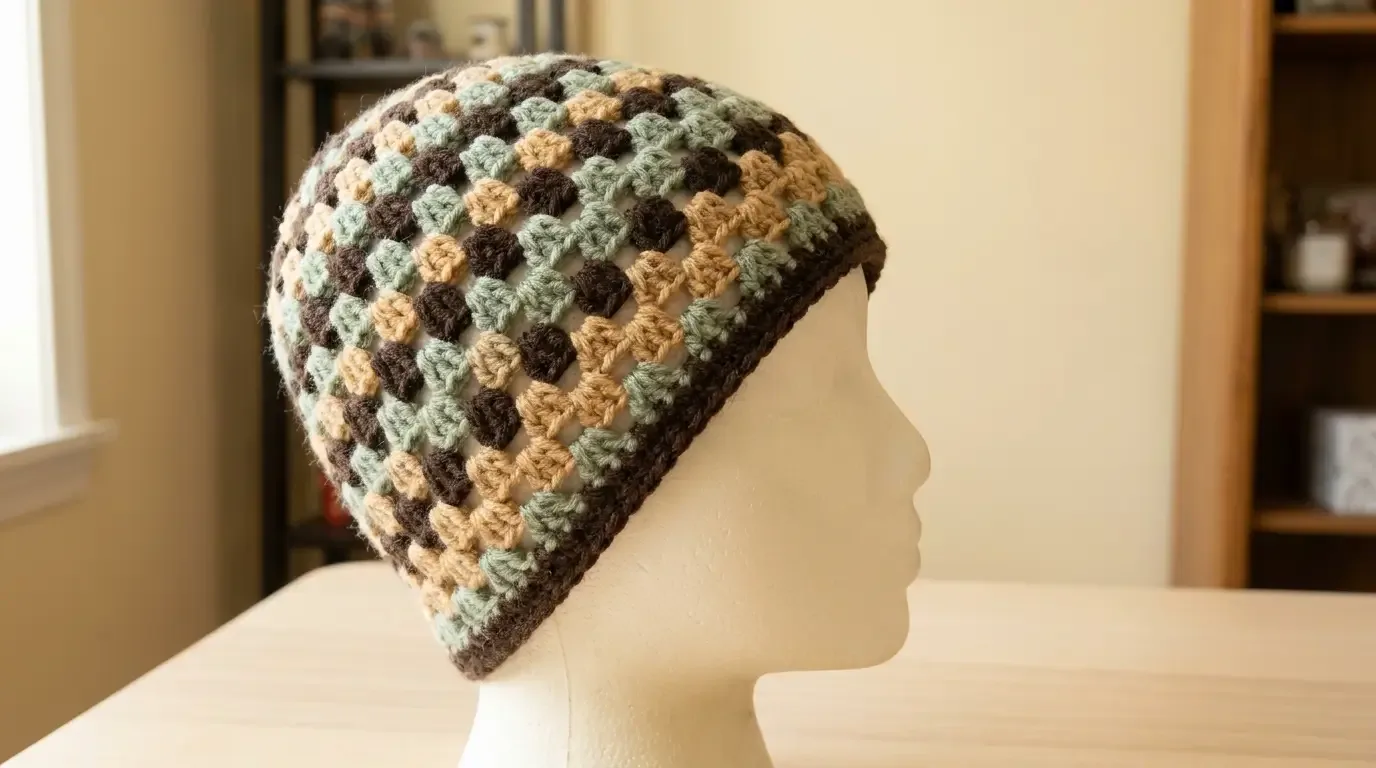
This untested original HookElla beanie uses small granny clusters that shift through Coffee, Light Sage, and Buff, with a rounded crown and a narrow Coffee edge. Its gauge, circumference, and height are estimates, not physically verified results.
About this pattern
This close-fitting beanie is worked from the crown down in joined rounds. Each cluster is a group of three double crochets in one chain space. Coffee, Light Sage, and Buff alternate cluster by cluster, and the starting shade advances each round to make a gently shifting mosaic. Two simple Coffee rounds finish the open edge; there is no folded cuff, pom-pom, or separate decoration.
The stitch counts below are fully specified, but HookElla has not crocheted a sample; the pattern has not been physically tested. This is published as an untested original pattern: gauge, crown depth, relaxed circumference, yardage, and total height are calculated or planning estimates, not confirmed finished measurements. The pattern does not promise a verified adult fit; use the measurement checks as guidance and adjust your own tension or length as needed.
Materials
- Red Heart Super Saver #4 medium/worsted-weight acrylic in Coffee, Light Sage, and Buff.
- 150–200 yd (137–183 m) total, estimated across all three colors. The amount used in each shade will vary with the strand rotation and personal tension.
- 5 mm (H/8) crochet hook, or a size that approaches your measured cluster gauge.
- Three small balls or yarn bobbins, stitch marker, measuring tape, scissors, and a yarn/tapestry needle.
Finished size and fit
One adult size is written for a target head circumference of about 22–23.5 in (56–60 cm). The target relaxed circumference of the hat is approximately 21–22 in (53.5–56 cm), providing modest negative ease if the fabric stretches comfortably. These are intended targets, not measured HookElla results.
The target height is approximately 8–9 in (20–23 cm) from crown center to lower edge, pending swatching and physical verification. At 20 cluster-and-gap positions and a relaxed circumference of 21–22 in, the calculated circumference-based diameter is 6.68–7.00 in (17.0–17.8 cm). This is a geometric estimate, not a measured hat size. Crown rise and adult fit are not established until the actual yarn-and-hook sample is measured.
Gauge and swatch check
No independently measured HookElla gauge is available. Use the following as a provisional planning target, then measure a sample made in the exact cluster fabric:
- Around the body, aim for 20 cluster-plus-gap positions in 21–22 in of relaxed circumference. This is about 3.64–3.81 cluster positions per 4 in, or 1.05–1.10 in per position.
- For height planning, record how many rounds of the cluster fabric make 4 in. No independent HookElla vertical gauge is established, and crown rounds may measure differently from straight body rounds; do not infer a verified height from stitch counts alone.
For your own fit check, measure the crown after Round 9: a 21–22 in relaxed circumference corresponds to a calculated diameter of 6.68–7.00 in, with an estimated crown rise target of 2.75–3.25 in. The ideal flat-circle radial growth implied by the circumference target is about 0.33–0.35 in per +2-cluster increase; the finished fabric will dome, so this calculation is not a fit test. Continue through Round 21, then compare the estimated body height (5.0–5.5 in) and overall height after Round 23 (8–9 in) to your desired fit. These are planning targets only; no HookElla gauge swatch or finished sample has been measured. A crochet gauge calculator can help convert your measurements, but it cannot verify crown shape or stretch.
Abbreviations (US terms)
- BLO — back loop only
- ch — chain
- cl — granny cluster
- dc — double crochet
- MR — adjustable magic ring
- rep — repeat
- sc — single crochet
- sl st — slip stitch
- sp — space
- st(s) — stitch(es)
Special stitches and construction notes
Granny cluster (cl): Work 3 ordinary US dc into the indicated chain-1 space. The three dc are all made in one space. After the cluster, make the specified ch 1; that chain space is not a dc and is not included in the cluster or dc count.
Beginning chain: At the start of Rounds 1–21, ch 2 for height only; it does not count as a dc or as part of the first cluster. Work a full three-dc cluster into the indicated space. This creates a slightly taller starting point; keep it loose and place the join at the back. For Rounds 22–23, ch 1 for height only; it does not count as a stitch.
Round joins and positioning: Join each round with a sl st to the first actual dc of that round, not to the beginning chain or the joining slip stitch. After joining a granny round, sl st into the adjacent final ch-1 space immediately before the first dc; this is the space where the next round begins. These slip stitches do not count as stitches or clusters. Do not turn.
Three-color sequence: Use the shades in this order: Coffee → Light Sage → Buff → repeat. Round 1 starts with Coffee; advance the starting shade one place in that palette for each new round. Therefore Rounds 1–21 start Coffee, Light Sage, Buff in sequence (Round 21 starts with Coffee). Within each round, advance one shade for every cluster. A cluster is always three dc in one shade. After its third dc, complete the final pull-through with the next assigned shade; work the following ch 1 in that incoming shade. One exception keeps the seam aligned: after the last cluster, use the color assigned to start the next round for the final ch-1 space and joining slip stitch, even if that skips a shade in the within-round cycle. Rounds 22–23 are entirely Coffee.
Use one bobbin or small ball per shade. Keep the unused strands inside the hat, carry them loosely behind the work, and catch long floats every few clusters on the wrong side. Do not pull floats tight across the fabric; leave enough slack for the crown and body to stretch. Untwist the bobbins before they snarl. At a round join, use the planned next-round shade for the non-counted joining slip stitch, then move into the adjacent final chain space in that same shade. The join may show slightly, so keep it at the back and check that the color offset advances consistently.
Complete pattern instructions
Crown expansion
With Coffee and a 5 mm hook, make an adjustable MR. This corrected crown adds two clusters on each increase round, rather than four; the increases are placed in two approximately opposite spaces and shifted around the circumference so they do not stack into visible spokes. Count the existing ch-1 spaces from the current round’s starting space, moving in the direction of crochet. At each listed increase position, work 2 cl in that one existing space; in every other existing space, work 1 cl. Put a ch 1 after every new cluster, including both clusters at an increase position. This creates two additional cluster-and-gap positions per round. Counts list clusters, dc, and ch-1 spaces.
- Round 1: Ch 2 (height only). Work 4 cl into the MR, placing a ch 1 after each cluster. Join with a sl st to the first actual dc. 12 sts. (12 dc; 4 clusters; 4 ch-1 spaces.)
- Round 2: Start in the adjacent final ch-1 space. Increase in existing spaces 1 and 3 of 4. Join. 18 sts. (18 dc; 6 clusters; 6 ch-1 spaces.)
- Round 3: Increase in existing spaces 2 and 5 of 6. Join. 24 sts. (24 dc; 8 clusters; 8 ch-1 spaces.)
- Round 4: Increase in existing spaces 3 and 7 of 8. Join. 30 sts. (30 dc; 10 clusters; 10 ch-1 spaces.)
- Round 5: Increase in existing spaces 4 and 9 of 10. Join. 36 sts. (36 dc; 12 clusters; 12 ch-1 spaces.)
- Round 6: Increase in existing spaces 5 and 11 of 12. Join. 42 sts. (42 dc; 14 clusters; 14 ch-1 spaces.)
- Round 7: Increase in existing spaces 6 and 13 of 14. Join. 48 sts. (48 dc; 16 clusters; 16 ch-1 spaces.)
- Round 8: Increase in existing spaces 7 and 15 of 16. Join. 54 sts. (54 dc; 18 clusters; 18 ch-1 spaces.)
- Round 9: Increase in existing spaces 8 and 17 of 18. Join. 60 sts. (60 dc; 20 clusters; 20 ch-1 spaces.)
For Rounds 2–9, sl st into the adjacent final ch-1 space, ch 2 (height only), then work one cluster in each unlisted old space and two clusters consecutively in each listed old space. After every new cluster, make its own ch 1. At each round end, join to the first actual dc, then sl st into the final ch-1 space to position for the next round. The increase positions above are counted anew from the next round’s starting space.
Cluster body
For each round, start in the adjacent final ch-1 space as described above. Ch 2 for height, then work 1 cl in every ch-1 space around, with ch 1 after each cluster. Join to the first actual dc. The beginning ch 2 and all slip stitches are excluded from the count.
- Round 10: 1 cl in each of 20 spaces. 60 sts. (60 dc; 20 clusters; 20 ch-1 spaces.)
- Rounds 11–21: Repeat Round 10. 60 sts. (60 dc; 20 clusters; 20 ch-1 spaces per round.)
Rounds 10–21 are twelve plain cluster rounds. Do not increase after Round 9. Use the color sequence for every cluster, including the last cluster before the seam. This gives eight smaller, staggered increase steps followed by a longer straight body, keeping the crown rounded while maintaining the photographed beanie’s adult depth.
Coffee lower edge
Switch to Coffee. The last granny round contains 20 clusters × 3 dc = 60 dc tops and 20 separate chain spaces, for 80 positions total.
- Round 22: Ch 1 (height only). Repeat [sc in the top of each of the next 3 dc, sc in the next ch-1 space] 20 times; join to the first sc. 80 sts.
- Round 23: Ch 1 (height only). Sc in each stitch around; join to the first sc. 80 sts.
Fasten off and weave in all ends securely on the inside. The two Coffee sc rounds form a narrow lower edge; do not fold it into a cuff.
Assembly and finishing
No separate pieces or side seam are needed. Confirm the hat is not twisted at the round join, arrange the join at the back, and weave each color tail through several stitches on the inside. Trim tails only after they are secure. The finished edge remains open and straight, with no folded brim, pom-pom, or appliqué.
The supplied six-stage infographic is intentionally not shown: it illustrates the superseded five-round increase schedule reaching 20 clusters at Round 5, while these corrected written instructions reach 20 clusters at Round 9. The image file is preserved unchanged but should be corrected before it is used alongside this pattern.
Fit adjustments and troubleshooting
- Check the adult circumference: Twenty cluster-and-gap positions at the provisional target pitch of 1.05–1.10 in project to 21–22 in relaxed. Measure the actual fabric; if it differs, the intended fit is not established by stitch count alone.
- Crown ruffles: Confirm there are exactly two increase spaces per round and one cluster in every other space. Measure the Round 9 edge and check that it lies smoothly without waves.
- Crown cups sharply: Check your own crown rise and outer edge as you work. Round 9’s 6.68–7.00 in diameter and 2.75–3.25 in rise are planning estimates only, not guaranteed measurements.
- Color floats snag: Catch carried strands periodically on the inside, especially where a shade skips two clusters. Leave slack and do not crochet tightly over several strands at once.
- Color seam looks like a stripe: Keep the round join at the back, use the next-round start shade for the final ch-1 space and joining slip stitch, and advance the starting color exactly one place per round.
- Hat is too short or tall: The crown and body cluster rounds may have different vertical gauge. Once the crown shape is right, adjust body length only by adding or removing complete rounds within Rounds 10–21; remeasure before working the Coffee edge.
This is a single adult-size schedule, not a graded range. A larger or smaller circumference requires recalculating crown increases, cluster repeats, body positions, and the 80-sc lower edge together.
Frequently asked questions
Is this pattern physically tested?
No. The target gauge, adult circumference, crown proportions, yardage, and finished height have not been confirmed on a crocheted HookElla sample. The repeat and stitch-count arithmetic has been checked, but swatching and fitting are still necessary.
How are the crown increases distributed?
Each increase round adds two clusters in opposite chain spaces. Their positions shift around the crown as specified in Rounds 2–9, and the count reaches 20 clusters at Round 9. This is the written construction; the finished crown proportions and fit are estimates because no physical sample has been made.
Does the chain-1 space count as a stitch?
It is counted separately as a space, not as a dc or cluster. Each cluster round has 20 clusters, 60 dc, and 20 chain-1 spaces after Round 9.
Can I use the source designer’s pattern instead?
This HookElla page contains its own complete directions. Viv Crochets’ design is credited below as inspiration, but the source instructions and photographs are not reproduced here.
Browse more cold-weather projects in HookElla’s Wearables & Accessories collection.
Helpful questions
Is this Viv Crochets' Granny Stitch Beanie pattern?
No. These are independently specified HookElla instructions with a different cluster increase schedule, color-placement method, adult-size target, and two-round Coffee edge. Viv Crochets is credited at the end as broad visual inspiration only.
Has the adult fit been tested?
No. The circumference, row gauge, and finished height are targets or estimates for the maker to check with a swatch and measuring tape. The stitch-count arithmetic has been reviewed, but the hat has not been physically sample-tested.
How do I keep the three colors from tangling?
Use a small ball or bobbin for each shade, park the two unused strands inside the hat, and untwist them regularly. Keep floats relaxed and catch them on the wrong side so they cannot snag.
Can I make the hat in one color?
Yes, the stitch counts are independent of color. A single shade will make the same cluster fabric but will not have the pictured three-color mosaic effect.
Inspiration credit
This is an independently specified HookElla construction. Viv Crochets' three-color granny-stitch beanie is credited as broad visual inspiration; its instructions, charts, and photographs are not reproduced here. Granny Stitch Beanie by Viv Crochets.