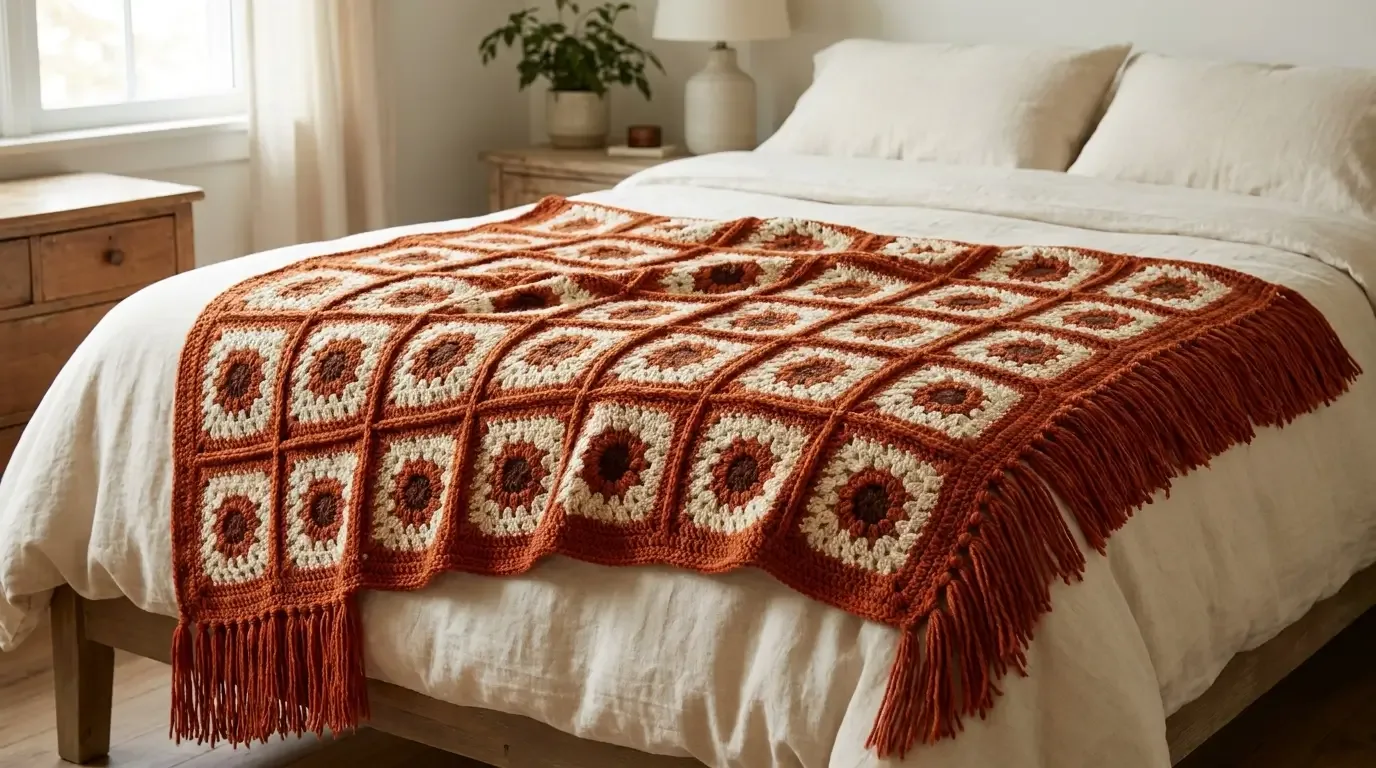
A classic granny square becomes a striking autumn blanket when every motif carries a burnt-orange frame and the joins are raised into a graphic grid. This HookElla pattern uses 48 blocked squares in a 6 × 8 layout, a simple cream-and-orange colour rhythm, and fringe across both short ends.
A warm, graphic granny-square blanket
The Burnt Orange Granny Grid Blanket pairs the comfort of granny squares with a strong, architectural seam. Cream flower-like centres glow against orange borders, while the orange joins sit slightly proud of the motifs to create a tidy grid. Fringe on both short ends completes the vintage throw shape shown in the HookElla images.
This is an original HookElla pattern written from the supplied technical construction: 48 motifs, 6½-inch blocked squares, a 6 × 8 layout, raised orange joining, orange border, and short-end fringe.
Finished size and yarn plan
Make 48 motifs, arranged 6 across × 8 down. At 6½ inches each, the motif field measures approximately 39 × 52 inches. After the raised join and border, the blanket typically finishes close to 42 × 58 inches, with fringe extending the short ends by several inches.
Plan on approximately:
- 2,000–2,400 yd burnt-orange #4 yarn for centres, frames, joins, border, and fringe;
- 1,500–1,900 yd cream #4 yarn for the middle rounds;
- a 5.5 mm (I/9) crochet hook;
- yarn needle, scissors, stitch markers, rustproof pins, blocking mats, and a measuring tape.
Yardage varies with tension and fringe length. Buy extra orange if you want a generous fringe or a deeper border.
Abbreviations (US terms)
MR magic ring, ch chain, sl st slip stitch, sc single crochet, dc double crochet, st stitch, sp space, rep repeat, rnd round.
Motif pattern: make 48
Each motif follows the same colour order: orange centre, cream middle, orange frame. Keep the colour placement consistent so the blanket reads as one coordinated field.
Round 1 — orange centre
With burnt orange, make an MR. Ch 3 (counts as dc) and work 15 dc into the ring. Join with a sl st to the top of the beginning ch-3. You have 16 dc. Fasten off.
Round 2 — cream cluster ring
Join cream in any gap between two dc. Ch 3 (counts as dc), 2 dc in the same gap, then work 3 dc in every gap around. Join with a sl st to the top of the beginning ch-3. You have 16 three-dc clusters. Fasten off.
Round 3 — cream square shaping
Join cream in the gap before any cluster. In the first corner space work (3 dc, ch 2, 3 dc). Work 3 dc in each of the next two spaces, then make the next corner in the following space. Repeat around until four corners are formed. Join with a sl st to the first dc and fasten off.
Each side has two side clusters between its corners. If your motif is cupping, loosen the corner chains; if it ripples, check that no extra cluster has been added.
Round 4 — orange frame
Join burnt orange in any corner ch-2 space. Work (3 dc, ch 2, 3 dc) in that corner, then 3 dc in every side space to the next corner. Repeat around all four sides and join. Fasten off.
Round 5 — orange edging
Join orange in a corner. Ch 1, then work sc evenly across the side, placing (sc, ch 2, sc) in each corner space. Join with a sl st and fasten off. Your motif should measure close to 6½ inches square.
Weave in ends on the wrong side, leaving no tails along the outer frame. Make all 48 motifs before final blocking.
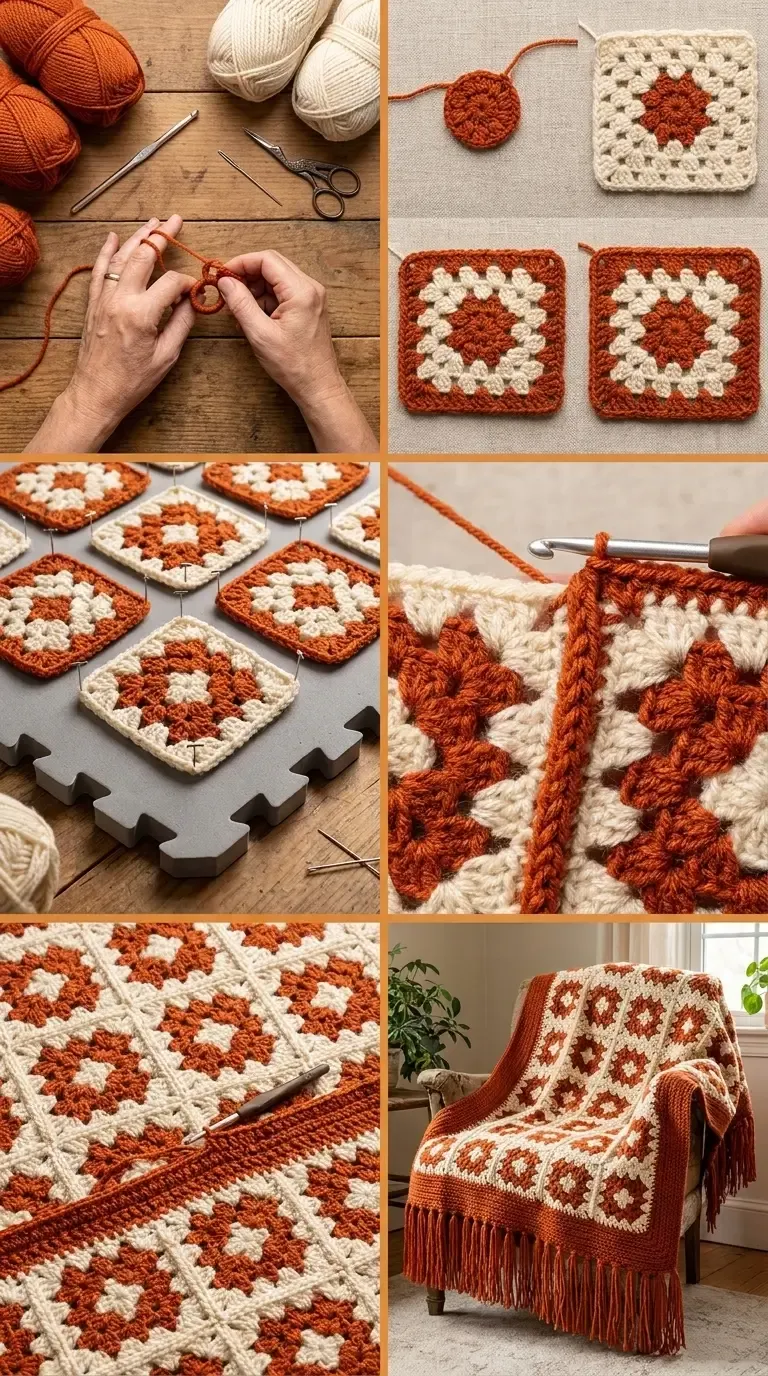
The construction image shows the HookElla motif, blocking, grid join, border, and fringe sequence.
Block every motif
Lightly mist each square and pin it to a 6½-inch template. Align the four corners and keep the orange edging straight. Let the motifs dry completely before removing the pins.
Do not skip this step. A one-quarter-inch difference multiplied across six columns can make the join pull, wave, or drift. Blocking is what allows the raised orange grid to stay straight.
Arrange the 6 × 8 grid
Lay the motifs in six columns and eight rows. Alternate the visual weight of the colour centres: avoid placing all-dark or all-light centres in one block. Photograph the final arrangement before joining.
The long dimension runs across the eight-row direction, while the short ends are the two six-motif edges that will receive fringe. Keep the same orientation for every square unless you intentionally want a quarter-turn pattern.
Raised orange joining
Join with burnt-orange yarn and the same 5.5 mm hook, working through the outer loops of neighbouring Round 5 edges.
- Join motifs into six-motif strips first, keeping right sides facing up.
- Work a neat whipstitch or mattress stitch through matching outer loops, keeping the orange yarn visible as a raised line.
- Join the eight strips together, matching every corner and crossing seam.
- At each intersection, pass the needle through the meeting loops twice so the grid stays secure without a bulky knot.
Keep the seam tension even. Pulling too tightly will cup the motifs; leaving the seam too loose will create gaps. Press the joined blanket flat before adding the border.
Orange border
With burnt orange, join in any corner. Work sc evenly around the entire blanket, placing (sc, ch 2, sc) at each corner. Work two or three additional rounds of sc, or until the border measures about 1½ inches deep.
For a raised outer edge, work the final round in BLO slip stitch or reverse single crochet. Keep the border flat by adding an extra sc at a corner only if the edge begins to pull.
Fringe on both short ends
Cut orange strands 10–12 inches long. Using two or three strands together, fold a bundle in half and pull the loop through the edge stitch with a hook. Draw the loose ends through the loop and snug gently.
Add fringe to both short ends only, spacing bundles about ½ inch apart. Trim across a straight template for an even finish. A fringe comb or wide-tooth comb helps separate the strands before the final trim.
Resizing guidance
Keep the 6½-inch motif size and change the rectangle in whole squares:
- 5 × 7 motifs: approximately 32½ × 45½ inches before border;
- 6 × 8 motifs: the documented throw, approximately 39 × 52 inches before border;
- 7 × 9 motifs: approximately 45½ × 58½ inches before border.
Add columns for width and rows for length. Recalculate orange joining yarn from the total seam length, and add extra cream and orange for the larger motif count. Keep fringe on the two shorter ends so the blanket hangs consistently.
Troubleshooting and care
- Motifs do not match: block again and measure the orange outer edge, not the centre.
- Grid waves: loosen the join or ease fullness at intersections.
- Blanket skews: check that every strip has the same motif count before cross-joining.
- Border ruffles: reduce corner stitches or use a smaller hook for the final round.
- Fringe tangles: braid or loosely tie the ends for storage, then comb them out before display.
Wash according to the yarn label and dry flat when possible. Support the blanket from underneath when moving it, especially while damp, so the raised joins and fringe do not stretch.
For another modular HookElla project, explore the Battenberg Blanket Showcase or browse the Blankets & Home collection.
The Burnt Orange Granny Grid Blanket is a satisfying rhythm of centre, cream, frame, join, and fringe. Make the squares slowly, block them carefully, and the finished throw will carry its autumn palette beautifully from bed to chair to reading nook.
Helpful questions
How many squares are needed?
Make 48 identical motifs and arrange them six squares across by eight squares down.
What size will the finished blanket be?
The motif field is about 39 by 52 inches before the border and fringe. A typical finished size is approximately 42 by 58 inches, depending on join and border tension.
Which colours are used?
Each motif begins with a burnt-orange centre, moves through cream rounds, and finishes with a burnt-orange frame and edging.
How does the raised grid join work?
Motifs are aligned and joined with burnt-orange yarn through the outer loops, creating a visible raised seam between every square.
Can I make the blanket larger?
Yes. Add columns or rows in whole motifs, then recalculate the border perimeter and fringe length. Keep every square the same blocked size.
Why is blocking important?
Blocking makes all 48 squares equal, which keeps the grid straight and prevents the blanket from becoming skewed during joining.