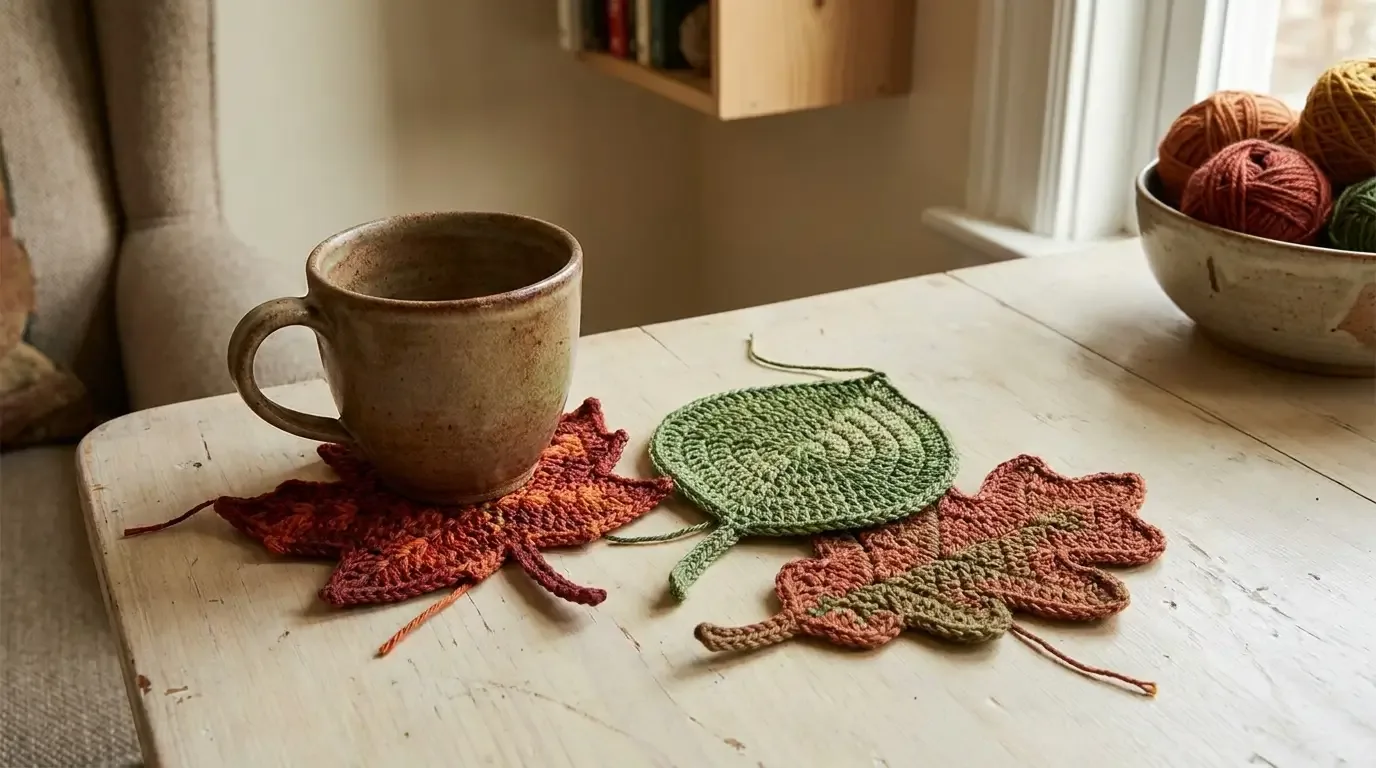
Make a little autumn table set with three distinct leaf silhouettes: a five-point maple, a long pointed birch, and a ruffled oak. Each coaster is worked flat with fingering-weight cotton and a 2.5 mm hook, then finished with a short stem and a gentle blocking.
Three little leaves for an autumn table
The Harvest Swirl set includes a five-point maple-style leaf, a slim birch-style leaf, and a ruffled oak-style leaf. All three use the same fine cotton and small hook, but each has a different foundation and edge shaping. Make them in rust, sage, copper, and gold shades, or use one color for a coordinated set.
The motifs are small, flat, and quick to block. The pattern uses US crochet terms. The maple is worked outward from a circular center; the birch and oak begin with a long foundation chain that forms a center spine.
Materials and size
- Fingering-weight / #1 cotton yarn: approximately 15–20 yd (14–18 m) per leaf, in rust, green, copper, or other autumn colors; allow about 50–60 yd (46–55 m) for a three-leaf set, including stems and tails
- 2.5 mm crochet hook
- Tapestry needle and scissors
- Rustproof pins and a blocking mat
Each motif is approximately 7–9 cm (2¾–3½ in) at its longest point. The maple measures about 7–8 cm across; the birch and oak are about 7–9 cm from tip to tip. Exact size depends on yarn and tension. A gauge swatch is not essential for these decorative motifs; work evenly and keep the fabric flat.
Abbreviations and special stitches
- ch — chain
- dc — double crochet
- hdc — half double crochet
- MR — adjustable magic ring
- rep — repeat
- sc — single crochet
- sl st — slip stitch
- st(s) — stitch(es)
- tr — treble crochet
All stitches use US terminology. Joined rounds begin with ch 1, which does not count as a stitch. Join with a sl st to the first actual stitch. The birch and oak foundation-chain round is worked on both sides of the chain; after the first side, rotate the work and crochet into the unworked loops along the underside.
For a picot, ch 2 and sl st into the first of those two chains. The picot does not count as a stitch in the round. For a treble crochet (tr), yarn over twice, insert the hook, yarn over and pull through, then draw through two loops three times.
Maple-style leaf
With rust or variegated autumn cotton, make an MR.
Round 1: Ch 1, work 20 sc into the ring. Join to the first sc. (20)
Round 2: Ch 1, work 2 sc in each st around. Join to the first sc. (40)
Round 3 — five points: Ch 1. Work the following sequence in the first 8 stitches of Round 2, then repeat it 4 more times over each next group of 8 stitches: sl st in first st, sc in next 2 sts, hdc in next st, work dc, tr, picot, tr, dc all in next st, hdc in next st, sc in next 2 sts. Join to the first sl st. (55 stitches, plus 5 picots)
Fasten off and weave in the tail. The five repeated groups each use 8 center stitches and form one maple point with a shallow valley before the next point.
Birch-style leaf
With green cotton, ch 29.
Round 1: Work 3 sc in the second ch from the hook, sc in the next 26 ch, work 3 sc in the last ch. Rotate to the underside of the foundation and sc in the unworked loops of the next 26 ch. Join with a sl st to the first sc. (58)
Place a marker in the middle sc of each 3-sc turn at the two ends of the oval.
Round 2: Ch 1. Sc in the first st of the first 3-sc tip; in the marked middle st work sc, hdc, picot, hdc, sc; sc in the third st of the tip. Sc in each of the next 26 side sts. At the second marked tip, work sc in the first st, sc, hdc, picot, hdc, sc in the marked middle st, and sc in the third st. Sc in each of the remaining 26 side sts. Join to the first sc. (64 stitches, plus 2 picots)
Fasten off and weave in the tail. The original chain forms the long center axis and the two increased ends create the pointed tips.
Oak-style leaf
With copper or rust cotton, ch 25.
Round 1: Work 3 sc in the second ch from the hook, sc in the next 22 ch, work 3 sc in the last ch. Rotate to the underside and sc in the unworked loops of the next 22 ch. Join with a sl st to the first sc. (50)
Mark the middle sc of each 3-sc turn.
Round 2 — scalloped edges: Ch 1. Sc in the first st of the first 3-sc tip; in the marked middle st work sc, hdc, dc, picot, dc, hdc, sc; sc in the third st. Along the next 22 side sts, repeat 7 times: sl st in next st, sc in next st, work hdc, dc, hdc in the next st. Sc in the final side st. At the second marked tip, repeat the same tip sequence. Along the remaining 22 side sts, work the same 7 scallop repeats, then sc in the final side st. Join to the first sc. (88 stitches, plus 2 picots)
Fasten off and weave in the tail. The slip stitches form the valleys between the rounded oak lobes.
Crocheted stems and veins
Make one stem for each leaf in matching or contrasting cotton. Ch 6, sl st in the second ch from the hook and in each remaining ch back toward the starting end. Fasten off with a sewing tail. Position the stem at one end of the leaf’s center axis and sew it firmly to the wrong side, overlapping the leaf by about 1 cm.
For a raised center vein, thread a short length of matching yarn on a tapestry needle and make small, even surface stitches from the stem toward the opposite tip. On the maple, run the vein from the stem into the center circle; add two short diagonal branches if desired. Secure the ends on the wrong side without pulling the leaf out of shape.
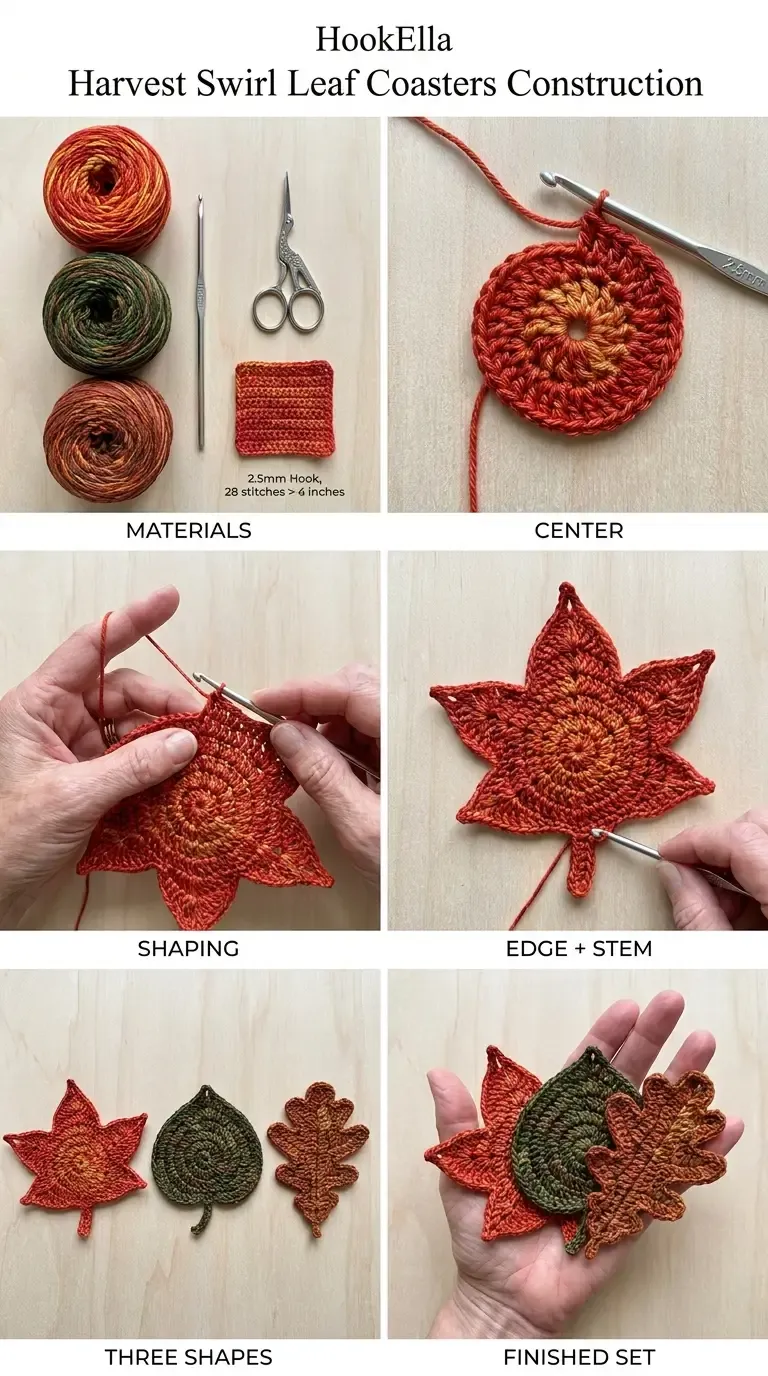
The construction image shows the three silhouettes and finishing stages; use the written rounds above for exact stitch placement and counts.
Blocking and use
Weave in all yarn ends securely. Lightly dampen each leaf, arrange the points and scallops, and pin the motifs flat. Let them dry fully before removing the pins. Follow the cotton yarn’s care label; reshape the leaves while damp after washing.
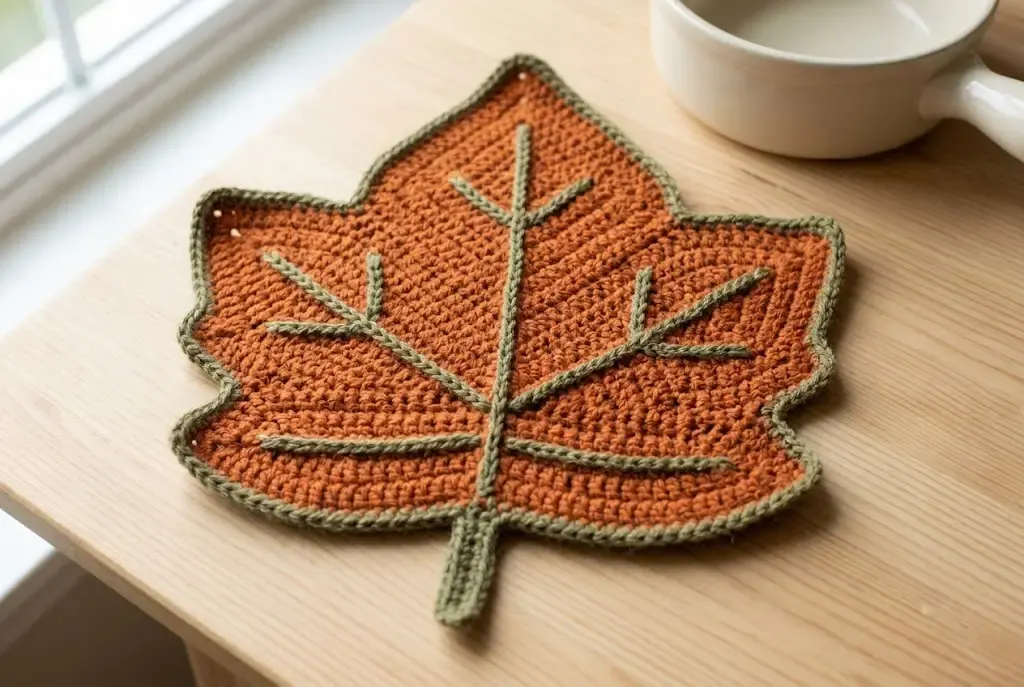
These small cotton motifs work as coasters for cups and glasses or as autumn table accents. They are not heatproof trivets, so keep hot cookware off them. For another seasonal table project, see the Crochet Maple Leaf Table Mat or browse more ideas in Blankets & Home.
Helpful questions
How large are the leaf coasters?
With fingering cotton and a 2.5 mm hook, the maple is about 7–8 cm across and the birch and oak are about 7–9 cm long. Cotton and personal tension can change the finished measurements.
What yarn works best for leaf coasters?
Smooth fingering-weight cotton gives a defined edge and absorbs small drips. Use three autumn shades or choose a different color for each shape.
Do I need to make all three shapes?
No. Each leaf is a separate motif with its own instructions, so you can make one shape or a mixed set.
Can these protect a table from hot cookware?
No. These are decorative coasters for cups and glasses, not trivets. Do not place hot pans or cookware on them.