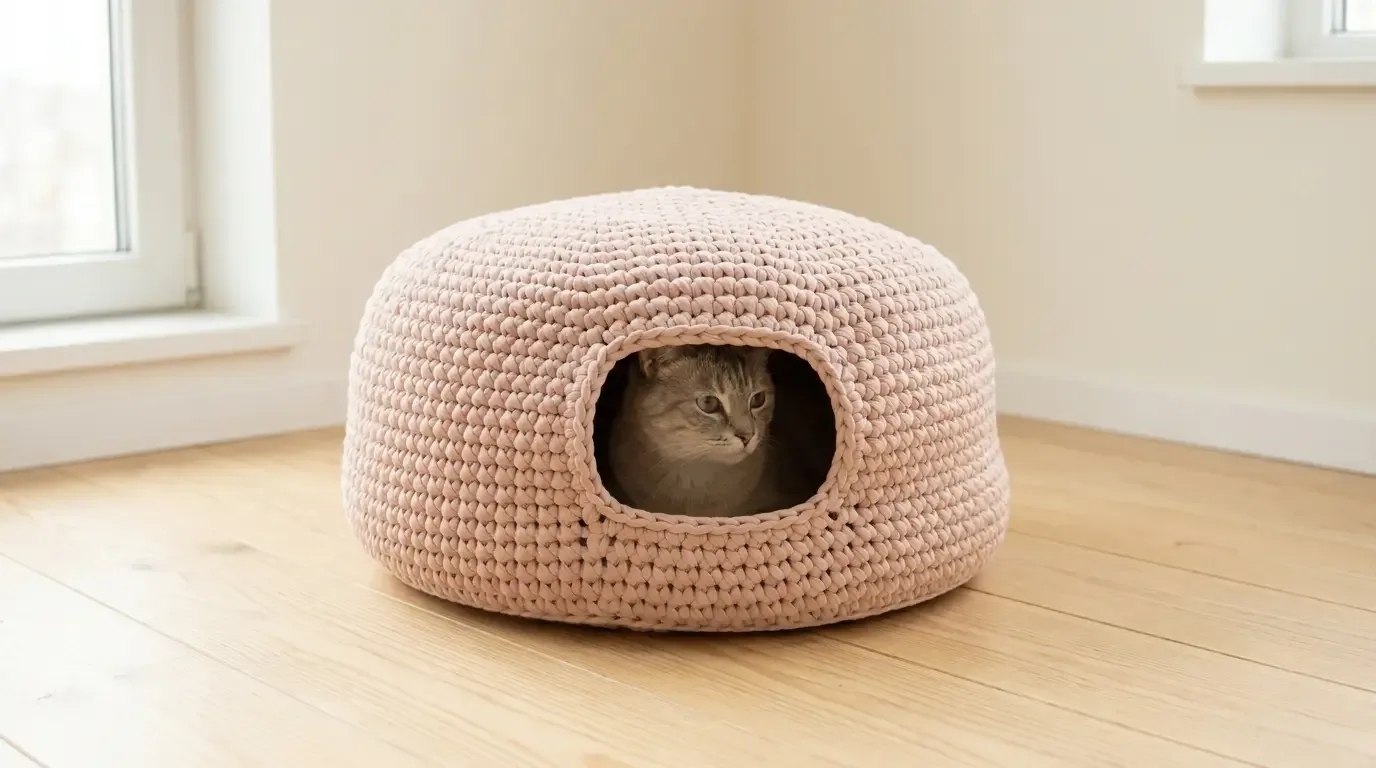
A quiet corner for a curious cat, this one-piece crochet nest grows from a firm circular base into a low rounded dome. Solid blush-pink T-shirt yarn, dense single-crochet rounds, and a small reinforced entrance keep the silhouette sturdy, simple, and soft.
A soft little room for a catnap
The Nest Crochet Cat Bed is shaped like a low, rounded cave: broad enough for a curled-up cat, but compact enough to sit beside a sofa or sunny window. A single shade of pale blush-pink T-shirt yarn gives the bed a calm, modern look, while dense horizontal rounds create the structure a freestanding pet nest needs.
The project is worked from the bottom up. A circular base expands first, the walls rise without seams, a small rounded-rectangular doorway is opened in the front, and the crochet reconnects above the opening before decreasing into the dome. There is no cushion, second opening, ear, or dangling decoration in this design.
Materials and fabric check
- thick T-shirt yarn or carpet yarn in solid pale blush pink, a little over 1 kg;
- 8 mm crochet hook;
- stitch marker, scissors, and a large blunt yarn needle;
- tape measure and a flat surface for checking the circle;
- optional removable fleece pad cut to fit the finished floor, if your cat prefers extra softness.
The goal is a dense, flexible fabric rather than a rigid basket. Work a small swatch in single crochet and tug it gently: the stitches should close back together without leaving large holes. If the yarn is unusually thin, hold it double or choose a smaller hook. If it is too stiff to bend comfortably, go up one hook size while checking that the bed still stands.
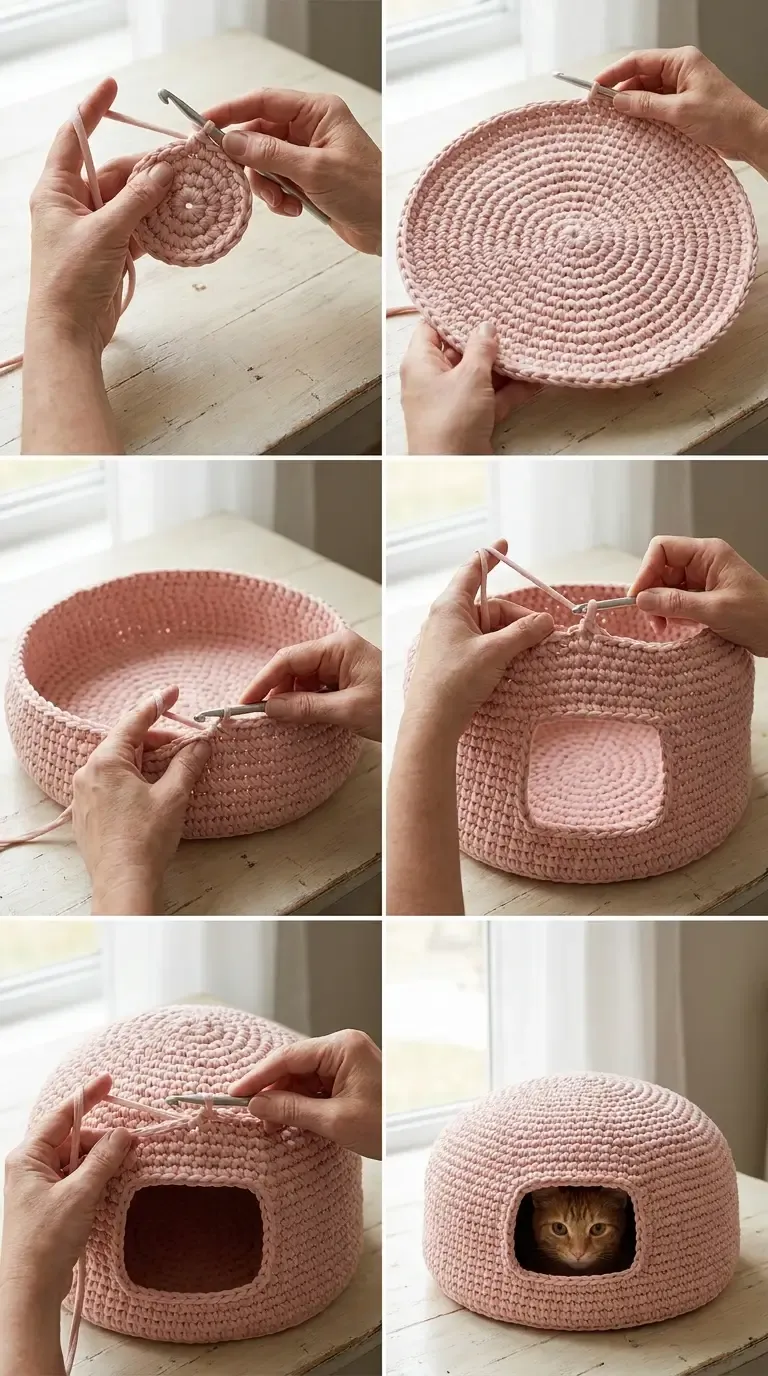
The HookElla construction image shows the one-piece path from flat base to finished dome.
Size and proportion checkpoints
Aim for a finished footprint of approximately 37 × 37 cm and a height of about 20 cm. The front entrance is approximately 15 cm wide × 11 cm high. These proportions create a low, den-like profile; changing the base diameter without changing the wall height can make the opening feel too small or the dome too steep.
Measure the base after the final increase section, then check the wall height before shaping the doorway. Measure the opening from the floor line to its highest point, not along the curved edge. Let your cat’s shoulder width guide adjustments: a larger cat needs a wider entrance and a broader base, while a kitten may prefer the snug original proportions.
Construction plan
- Begin with the circular floor. Form a small adjustable centre and work compact single-crochet rounds. Increase evenly so the disk stays flat; a ruffle means the increases are too frequent, while a bowl shape means they are too sparse.
- Set the turning point. Once the base reaches the target diameter, work a transition round that stops adding width. Keep the stitches tight and place the marker at the same point each round.
- Raise the lower walls. Continue in even single-crochet rounds until the sides stand upright. Hold the work on the floor after every few rounds to make sure the base remains level and the wall does not flare.
- Shape the front doorway. At the centre front, crochet across one side, skip the doorway span, and continue on the other side. On the following rows, work back across the opening with turning chains so the wall grows upward on both sides. Keep the corners rounded rather than cutting a sharp square hole.
- Reconnect above the opening. Once the entrance reaches approximately 11 cm high, bridge the two sides with single crochet. Continue in the round again, working around the full nest and reinforcing the doorway edge with a neat additional pass of single crochet.
- Close the dome. Work even rounds until the top begins to curve inward, then decrease gradually and evenly. The crown should settle into a broad low dome rather than a tall point. Stuffing is not required; the yarn and compact stitches provide the shape.
- Finish securely. Fasten off at the back, weave the tail through several dense stitches, and trim it flush. Run your fingers around the entire entrance and floor to find any loose loops before the cat uses the bed.
Keeping the doorway sturdy
The entrance is the busiest part of the nest, so keep its lower corners smooth and its top edge gently rounded. If the opening stretches during use, add a reinforcing round of single crochet around the perimeter, placing extra care at both lower corners. Avoid decorative edging that could catch claws or invite chewing.
Check that the doorway remains open when the dome relaxes. If the fabric folds inward, lightly reshape the crown by hand and move the nest to a flat surface. Never use wire, plastic boning, or hard inserts inside this soft pet bed.
Resizing for another pet
To make a wider nest, add one or more evenly spaced increase rounds to the base, then keep the walls the same height proportionally. Enlarge the doorway at the same time so the opening remains comfortable. For a smaller nest, stop the base earlier and shorten the wall section before opening the front.
Use the actual measurements rather than a fixed stitch count when resizing. T-shirt yarn varies widely in thickness and stretch, so a measuring tape and a tension sample are more reliable than copying a number from another project. Keep the dome low and broad; a tall crown can become unstable when a cat leans against it.
Pet-safe finishing and care
Wash or spot-clean according to the yarn label and let the nest dry completely before returning it to the floor. Inspect the bed regularly for pulled loops, frayed yarn, or loose tails, especially if your cat likes to knead or chew. Replace the nest if the fabric develops a hole that could catch a claw.
Place the finished bed away from heaters, open flames, damp floors, and unstable furniture. Introduce it without forcing your cat inside; a familiar blanket or a few treats nearby can make the new den feel inviting. The blush-pink dome is designed to be a quiet resting place, not a climbing toy.
Helpful questions
What size is the finished cat nest?
The reference size is approximately 37 × 37 cm across and 20 cm high, with an entrance about 15 cm wide and 11 cm high.
What yarn works best?
Use thick T-shirt yarn or carpet yarn in one solid pale blush-pink shade. The dense fabric needs a strong, washable yarn that can hold its shape.
Why use an 8 mm hook?
An 8 mm hook keeps the super-bulky strands workable while producing tight single-crochet rounds. Adjust only after making a small tension sample; the fabric should not show large gaps.
Is the bed made in separate pieces?
No. The base, walls, doorway transition, and upper dome are crocheted as one continuous nest, which reduces seams and gives the entrance a clean outline.
Is the nest safe for every cat?
Check the finished bed for gaps, loose tails, and rough yarn ends before use. Place it on a stable, dry floor and supervise pets that chew yarn or attempt to climb on the dome.