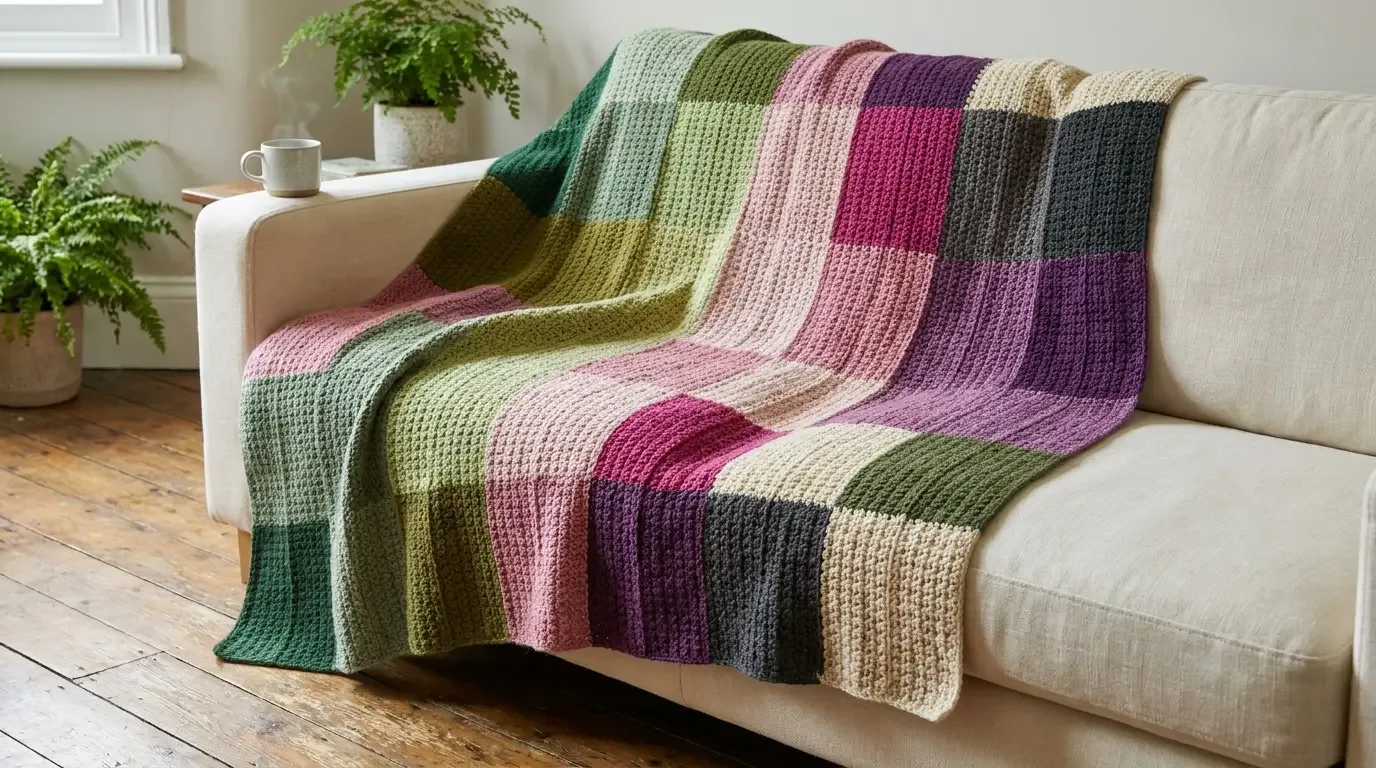
The Rainforest Patchwork Squares Blanket turns simple two-half-treble clusters into a modern colour-blocked throw. Greens, purples, pinks, cream, and graphite flow through twelve vertical strips, while a slip-stitch join-as-you-go method keeps the patchwork connected as you crochet.
A patchwork blanket with rainforest colour energy
The Rainforest Patchwork Squares Blanket has the look of a carefully pieced quilt but is crocheted one vertical strip at a time. Each block is made from a softly textured cluster stitch, and the palette moves between deep greens, pistachio, cream, purple, pink, and charcoal. The result feels graphic and relaxed at the same time.
The original colour story is credited to The Crochet Swirl. The Rainforest Patchwork Squares Blanket link and its Rainforest page remain as credit links; the HookElla strip, cluster, and join instructions below are written for this article.
Verified project details
The documented blanket measures approximately 120 × 120 cm (47 × 47 in). It uses DK-weight yarn, a 4 mm hook, and approximately 2,655 m (2,903 yd) across nine shades in the sample palette.
The construction is the key idea: make 12 vertical strips, each containing 12 colour blocks, with 14 rows per block. That produces a 12-by-12 visual grid. The second strip onward is joined to the previous strip as you crochet using a slip-stitch join-as-you-go method, so there is no large sewing session at the end.
Materials and colour planning
Gather:
- DK yarn with clear stitch definition;
- approximately 2,655 m (2,903 yd) for the full sample size;
- a 4 mm crochet hook, or the size needed for your tension;
- scissors and a yarn needle for ends;
- stitch markers and a colour chart or notebook.
The source palette includes Cypress, Parchment, Grape, Meadow, Pale Rose, Graphite, Pistachio, Fuchsia Purple, and Lincoln. You can copy that rainforest mood or build your own nine-colour story. Keep at least one neutral shade to break up saturated blocks.
The cluster texture
The fabric is built from two half trebles in the same space. In UK terms this is a pair of htr; in US terms it is a 2-hdc cluster. Each row works into the spaces between the clusters below, with a single half treble at the far edge to keep the strip straight.
The cluster creates small raised windows without complicated post stitches. Use a relaxed loop height so the fabric remains supple, and keep the turning chain consistent at the end of every row.
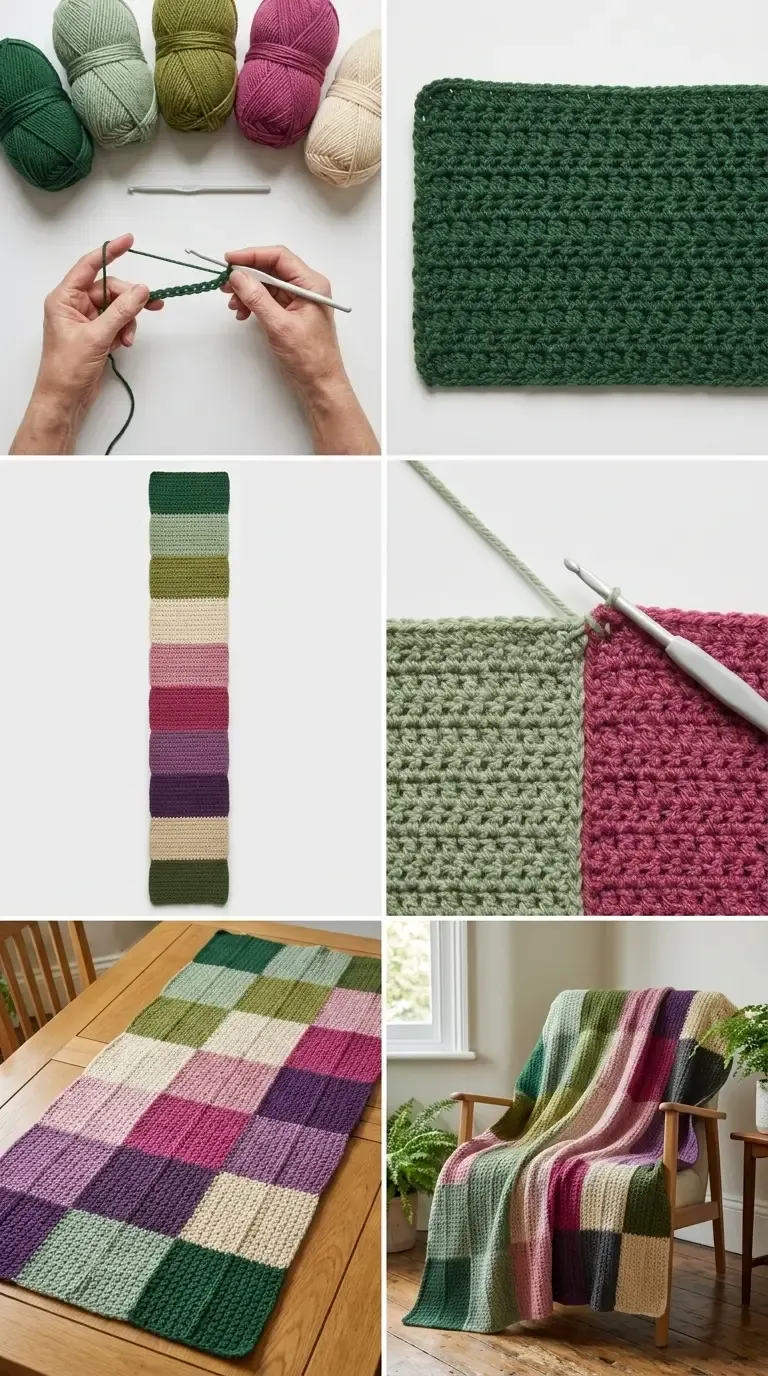
The HookElla image accompanies the original strip and joining instructions below.
Strip and block rhythm
Each colour block is 14 rows. Change colour at the end of a block by completing the final yarn over with the new shade. This keeps the top edge clean and avoids a visible knot inside the patchwork.
Work 12 blocks in the first strip for a total of 168 rows. Record the colour order as you go. The following strips use their own colour sequence and are attached to the previous strip while the rows are worked, creating the staggered patchwork effect shown in the HookElla reference image.
Make two practice blocks before beginning the full blanket. This lets you test the 14-row height, understand where the edge half treble sits, and practise the join without risking a long strip.
Slip-stitch join-as-you-go
The join is worked at the end of each block rather than after all strips are complete. Bring the new strip beside the existing strip, insert the hook around the matching edge stitch or post, and pull through with a slip stitch. Use one chain between joins whenever the edge feels tight so the strip turns without puckering.
Keep the joining slip stitches snug but flexible. Pulling too tightly will draw the new strip into a fan; leaving them loose will create gaps. Check the alignment after every few blocks so the grid stays square.
The source notes that a 10 cm square can become slightly longer and narrower once joined because of the stitch drape. That is normal. Measure the completed blanket rather than trying to force every joined block back into a perfect square.
Border choices
The original sample can remain borderless, allowing the colour blocks to reach the edge. If you prefer a framed finish, work a simple round of sc in a neutral shade, then one or two additional rounds in a colour pulled from the blanket. Add a calm corner treatment and keep the stitch count even so the patchwork edge does not ripple.
Block the blanket after the border, pinning the corners and easing the long edges. A light mist is enough for acrylic DK yarn; avoid high heat.
Resizing guidance
To make the blanket narrower or wider, change the number of vertical strips. To make it shorter or longer, change the number of 14-row colour blocks per strip. Keep the block count whole so colour transitions stay aligned.
For example:
- 8 strips × 10 blocks: a compact lap throw;
- 10 strips × 12 blocks: a wider sofa blanket;
- 12 strips × 14 blocks: a longer bed or reading blanket.
Recalculate yarn by comparing your new total number of blocks with the 144 blocks in the documented 12 × 12 field. Add extra yarn for an optional border.
Gauge, care, and troubleshooting
Gauge is flexible, but it controls the final size and yardage. A tighter fabric creates a smaller blanket and more pronounced texture; a looser fabric creates a larger, drapier throw. Wash a swatch before choosing your hook because acrylic DK can relax.
- Blocks are too tall: reduce turning-chain tension or use a smaller hook.
- The strip narrows: check that every row begins in the first space and ends with the edge half treble.
- Join puckers: loosen the slip stitch or add the intended ease chain.
- Colours drift: keep a written 12-block chart for every strip.
- Ends overwhelm the project: weave them in after each strip rather than waiting until all 12 are joined.
Wash and dry according to the yarn label. Lay the blanket flat to dry and reshape the corners while damp. For another modular blanket, explore HookElla’s Battenberg Blanket Showcase or browse the Blankets & Home collection.
The Rainforest blanket is a satisfying balance of repetition and colour play: fourteen rows establish a block, twelve blocks build a strip, and twelve strips become a complete square. Practise the join on two blocks, then let the palette carry the design.
Helpful questions
Who designed the Rainforest Patchwork Squares Blanket?
The Crochet Swirl is credited for the original colour concept. HookElla supplies the strip, texture, and join method in this article.
What size does the blanket finish?
The public pattern details give an approximate finished size of 120 × 120 cm, or 47 × 47 inches.
How is the blanket assembled?
It is built as 12 vertical strips. Each strip contains 12 colour blocks of 14 rows, and every strip after the first is joined to its neighbour as it is crocheted.
What stitch is used?
The texture uses groups of two half treble stitches in UK terminology, equivalent to two half double crochet stitches in US terminology.
Do I need to add a border?
No. The original sample can be left borderless for a clean patchwork edge, but a simple border may be added after all strips are joined.
Can I change the colours or size?
Yes. Keep the 14-row block rhythm and adjust the number of strips or blocks. Changing yarn weight or hook size will alter the finished dimensions and yardage.