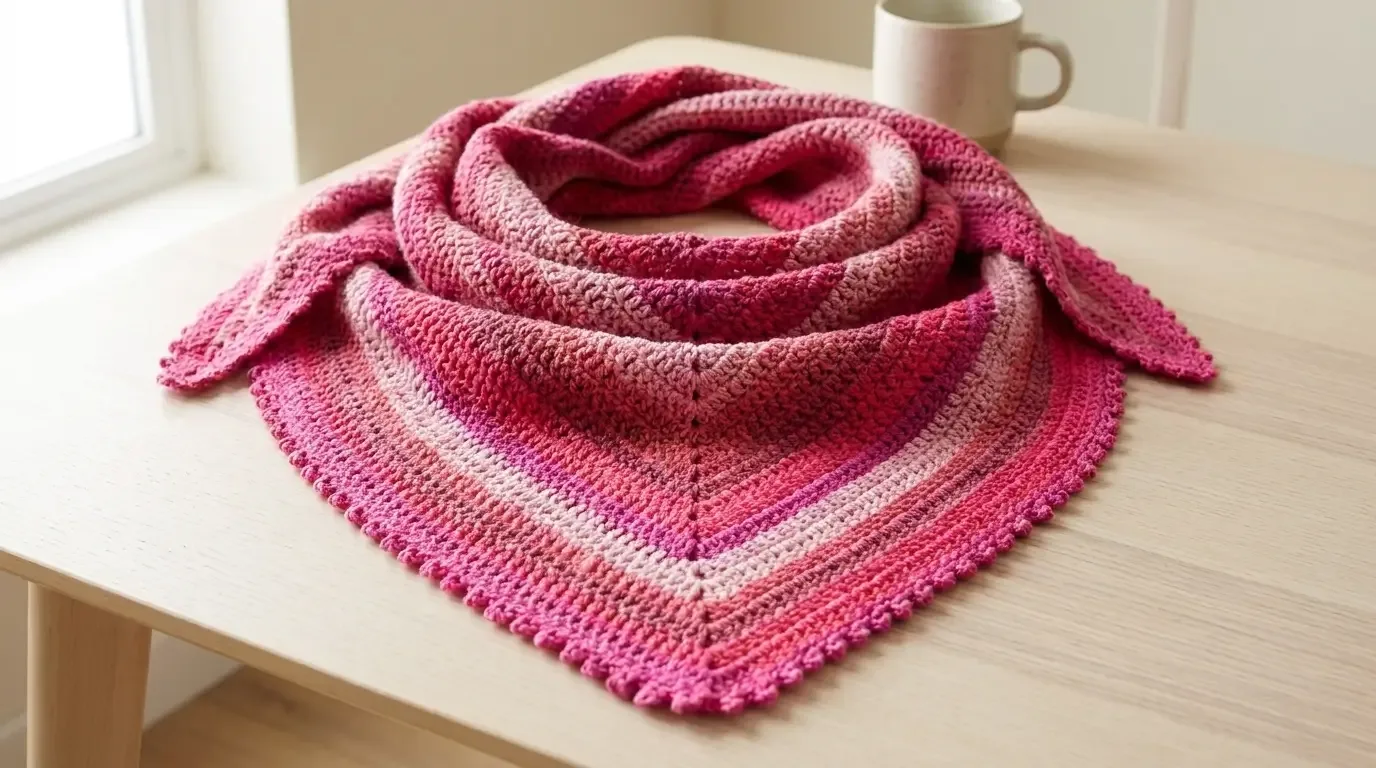
Berry, rose, and pale pink shades melt across this easy-to-customize triangular shawl. The HookElla version uses a standard center-grown double-crochet fabric and a light picot finish on the two sloping sides, while leaving the wide straight edge plain.
A pink triangle with a light picot edge
This original HookElla shawl is a single triangular piece worked from a small center ring. A chain-2 space stays open at the center of every row, making a visible spine as the shawl grows. The body is plain double crochet so a gradual cake or ombré yarn can create the berry-to-rose-to-pale-pink movement. Small picots edge the two sloping sides; the wide straight edge is deliberately left plain.
The construction below is an independently specified, standard center-space triangle. Crafftzy’s design is inspiration for the general pink ombré shawl style, not the source of these written HookElla instructions. This pattern has been mathematically reviewed but has not been physically sample-tested.
Materials
- Approximately 1,200–1,500 m (1,310–1,640 yd) of soft DK / light-weight yarn. At 300 m (328 yd) per 100 g ball, plan for 4–5 balls; keep an extra ball available if your yarn has less yardage or your tension is dense. This is a planning estimate, not measured consumption.
- 5.5 mm (I/9) crochet hook, or the size needed to approach the target gauge
- Scissors and a yarn needle
- Blocking mats and rust-resistant pins
- Optional: locking stitch marker for the center chain-2 space
Choose a soft yarn with a smooth strand and gradual pink color changes. A DK acrylic, wool blend, or cotton blend can work; fiber and drape will affect the finished feel.
Finished size and fit
The written sample is 46 rows. At the target gauge below, the calculated blocked size is approximately 53 in (135 cm) across the wide straight edge × 23 in (58 cm) deep from the center-start point to that edge. Expect variation with yarn, tension, and blocking. These measurements are calculated from the stated gauge; they are not physical sample measurements.
Gauge and size check
The target gauge is 14 dc × 8 rows = 4 in (10 cm) in plain double crochet after washing and blocking a swatch. This is a design target, not a gauge confirmed by a physical HookElla swatch. Make a generous swatch, block it as you intend to block the shawl, and adjust the hook until the 4-inch measurements are close. A crochet gauge calculator can convert your measured swatch gauge into projected dimensions; it does not test or automatically resize this shaped pattern.
The final row has 186 dc. At 14 dc per 4 in, that is about 53 in wide. Forty-six rows at 8 rows per 4 in give about 23 in of depth.
Abbreviations (US terms)
- ch – chain
- dc – double crochet
- rep – repeat
- RS / WS – right side / wrong side
- sc – single crochet
- sl st – slip stitch
- sp – space
- st(s) – stitch(es)
- yo – yarn over
Turning chains count as one dc throughout the body. Chain spaces are not included in the dc stitch count.
Special stitches and construction notes
- Center increase: Work (dc, ch 2, dc) into the center ch-2 space. The two dc widen the triangle while the chain-2 opening remains at the center.
- Picot: After the designated sc, ch 3, then sl st into the top loops of that same sc. This makes one small point.
- Row-end sc: Insert the hook under the side loop/turning-chain edge of a row end, yarn over, pull up a loop, yarn over and pull through both loops.
The row-count formula is 4 × row number + 2 dc. Row 1 has 6 dc; each later row adds 4 dc: one extra at each outer edge and two in the center chain-2 space. The ch-2 space itself is never counted as a stitch.
Pattern instructions
Foundation
Ch 4. Join with a sl st to the first ch to form a small ring. Do not twist the chain.
Rows
-
Row 1 (RS): Ch 3 (counts as 1 dc), work 2 dc into the ring, ch 2, work 3 dc into the ring. Turn. 6 sts. (6 dc; one center ch-2 space is not counted.)
-
Row 2 (WS): Ch 3 (counts as the first dc), dc in the same first st, dc in each dc until the center ch-2 space, work (dc, ch 2, dc) in that space, dc in each remaining dc to the final st, work 2 dc in the final st. Turn. 10 sts. (10 dc; center ch-2 space is not counted.)
-
Row 3: Rep Row 2. 14 sts. (14 dc.)
-
Rows 4–9: Rep Row 2 on each row. Stitch counts at the end of Rows 4, 5, 6, 7, 8, and 9 are 18, 22, 26, 30, 34, and 38 dc, respectively.
-
Row 10: Rep Row 2. 42 sts. (42 dc.)
-
Rows 11–19: Rep Row 2 on each row. At the end of Row 19, 78 dc.
-
Row 20: Rep Row 2. 82 sts. (82 dc.)
-
Rows 21–29: Rep Row 2 on each row. At the end of Row 29, 118 dc.
-
Row 30: Rep Row 2. 122 sts. (122 dc.)
-
Rows 31–39: Rep Row 2 on each row. At the end of Row 39, 158 dc.
-
Row 40: Rep Row 2. 162 sts. (162 dc.)
-
Rows 41–45: Rep Row 2 on each row. At the end of Row 45, 182 dc.
-
Row 46: Rep Row 2. 186 sts. (186 dc; one center ch-2 space is not counted.) Fasten off and weave in the body ends.
Rows 2–46 are the same repeat, worked 45 times total. In every row, work one dc in each existing dc except the first and last stitch, where you make 2 dc; then work exactly 1 dc, ch 2, 1 dc in the center ch-2 space. This yields the checked count 4r + 2 dc on Row r: Row 10 = 42, Row 20 = 82, Row 30 = 122, Row 40 = 162, and Row 46 = 186.
Assembly
The shawl is one continuous piece, so there are no panels, motifs, seams, or joins to assemble. Lay it flat with RS facing and identify the two sloping row-end edges and the long straight Row 46 edge before adding the edging.
Picot edging and finishing
The two diagonal sides each have 46 row ends. Work them separately so the wide straight edge remains completely unbordered.
For the first diagonal side, with RS facing, attach yarn at one corner of Row 46. Ch 1 (does not count as a stitch), sc once into the side of each row end from Row 46 toward the starting ring. After every second sc, make a picot: ch 3, sl st into the top loops of the most recent sc. You will have 46 sc and 23 picots along this side. Work 1 additional sc around the foundation ring to reinforce the tip, then fasten off.
Repeat on the other diagonal side: 1 sc in each of its 46 row ends, a picot after each pair of sc, and 1 additional sc around the foundation ring. That side also has 46 sc and 23 picots. Do not work across the final 186-dc straight edge. Weave in all remaining tails without pulling the fabric out of shape.
Wash and block gently according to the yarn label. Pin the triangle to the calculated proportions, smooth the center spine, and open each picot with a pin. Avoid stretching the center chain spaces or forcing the fabric to a measurement that does not match your gauge.
Fit adjustments and troubleshooting
- For a smaller shawl: Stop after a complete row. For Row r, the body count is 4r + 2 dc; the approximate width is
(4r + 2) × 4 ÷ your dc gauge per 4 in, and the depth isr × 4 ÷ your row gauge per 4 in. - For a larger shawl: Continue repeating Row 2 after Row 46, keeping the same increases. Recalculate the new width and depth with your blocked swatch gauge and reserve extra yarn. More rows make the straight edge wider and the center-to-edge depth longer.
- Sides are ruffling: Check that the first and last stitch receive 2 dc each, not 3, and that the center space gets only
(dc, ch 2, dc). - The shawl cups or pulls: Check your gauge and make sure you have not missed either outer-edge increase or one of the two center dc.
- The center opening closes: Confirm you preserve the ch-2 space on every row and do not crochet into the chain links themselves.
- Picots look crowded: Keep the stated one-picot-per-two-row-ends rhythm; do not add extra sc between the 46 marked row ends.
- Gradient changes at an awkward spot: Let a long color cake run naturally. If joining a new ball, join at a row edge and weave the tail in on the WS rather than adding a join at the center spine.
Frequently asked questions
Is the straight edge meant to have a border?
No. The picot edging is worked only along the two diagonal sides. Leave the 186-dc wide edge plain.
Can I use a solid color instead of ombré yarn?
Yes. The stitch pattern is a plain dc triangle, so a solid shade, planned stripes, or a gradient cake all work. For a gradual ombré, choose the starting end of the cake to control which shade appears near the center point.
Is this Crafftzy’s original pattern?
No. This is an independently written HookElla pattern using a standard center-grown dc triangle and its own count schedule. It does not reproduce Crafftzy’s tutorial instructions.
Has the yarn estimate or finished size been sample-tested?
No. The body counts and gauge-based dimensions are calculated, while the yarn amount is a planning estimate. Actual yarn use, drape, and dimensions depend on the yarn and crocheter; make and measure a blocked swatch before committing.
What should I do if my gauge differs?
Change hook size and recheck a blocked swatch before starting, or use your measured gauge in the sizing formulas. Gauge tools can project measurements, but they cannot guarantee drape or automatically preserve the shape.
For another original shawl, see the Roseheart Wing Shawl or browse Wearables & Accessories.
Helpful questions
Is this the complete HookElla pattern?
Yes. The 46-row body, count formula, two diagonal picot edges, finishing, and sizing guidance are included here. It is an independently written HookElla pattern, not Crafftzy’s row-by-row tutorial.
What size will the 46-row shawl be?
At the stated target gauge of 14 double crochets and 8 rows per 4 inches, the calculated size is about 53 inches wide by 23 inches deep before individual blocking differences. These are gauge-based estimates, not sample-tested measurements.
Do I add a border across the straight edge?
No. The two diagonal edges receive picots; leave the wide straight edge unbordered.
Can I make the shawl larger or smaller?
Stop after any complete row for a smaller triangle, or work more rows for a larger one. Row n contains 4n + 2 double crochets; recalculate width and depth using your own blocked gauge before adding rows.
Has this pattern been physically tested?
No. Its stitch counts and dimensions have been checked mathematically, but no crochet sample has been made to verify the fabric or yarn estimate.
Inspiration credit
The pink ombré triangular-shawl styling was inspired by Crafftzy’s shawl project. These instructions are HookElla’s independently developed construction, not Crafftzy’s pattern. Crafftzy’s Ravelry listing.