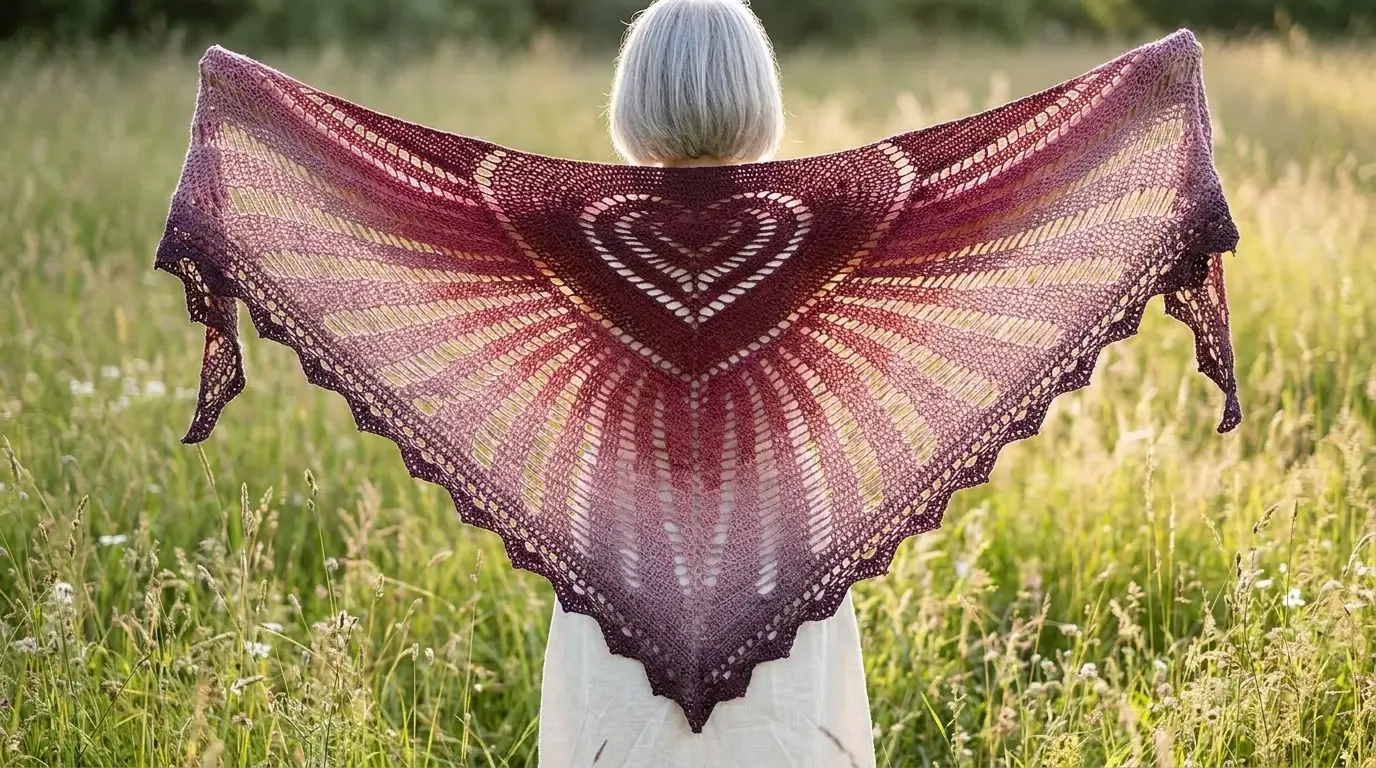
The Roseheart Wing Shawl opens from a burgundy centre into sweeping rose and plum wings. Three increase spines shape four flared panels, nested arched loops create the heart focal point, and long lace windows carry the gradient toward a pointed lower edge.
A heart opening into wings
The Roseheart Wing Shawl is an original HookElla crochet pattern built from the top centre outward. Three permanent increase spaces divide the shawl into four panels. The centre panels hold the layered heart lace, while the outside panels open into long windows that give the finished shawl its dramatic wing shape.
The pattern uses US crochet terminology. It suits an intermediate crocheter who can recognise stitches and chain spaces, maintain several markers, and work evenly along row ends.
Finished measurements and shape
After blocking, the shawl measures approximately:
- 72 inches (183 cm) from wing tip to wing tip;
- 30 inches (76 cm) from the top centre to the lowest point; and
- approximately 20 inches (51 cm) across the nested heart area.
The body has 50 rows. Row 1 begins with four groups of three double crochet separated by three marked chain spaces. Every later row adds two pattern positions to each panel, so each panel grows from 3 positions on Row 1 to 101 positions on Row 50. The full final row contains 404 pattern positions, plus the three permanent chain-2 increase spaces.
Yarn and materials
- 1,500 m (1,640 yd) fingering / 4-ply gradient yarn, approximately 300–350 g
- 3.5 mm (E-4) crochet hook
- 5 locking stitch markers
- Yarn needle
- Scissors
- Blocking mats and rustproof pins
The photographed colour flow begins with wine burgundy, moves through muted rose, and finishes in deep plum. Reserve approximately 180 m (197 yd) of the darkest outer shade for the heart-lace loops and pointed edging. If working from one cake, wind off the reserved yarn before beginning.
Choose a smooth fingering yarn with good stitch definition. Cotton-acrylic, cotton, or a firmly twisted wool blend will keep the long windows open after blocking.
Gauge
20 pattern positions × 7.5 rows = 4 inches (10 cm) in the blocked body pattern.
A pattern position is one double crochet, one chain-1 space replacing one stitch, or one chain-3 window replacing two stitches. Gauge is measured across a mix of solid and lace rows, not the heart-lace loops.
Gauge controls both wingspan and yardage. Make at least 12 body rows as a swatch, block it, and measure through the centre of a panel.
Abbreviations
- ch - chain
- dc - double crochet
- hdc - half double crochet
- picot - ch 3, sl st in the first ch
- RS / WS - right side / wrong side
- sc - single crochet
- sl st - slip stitch
- sp - space
- st(s) - stitch(es)
- tr - treble crochet
Panel stitches
The four panels are numbered from the beginning edge of the row:
- Panel 1: first outer wing
- Panel 2: first centre-heart panel
- Panel 3: second centre-heart panel
- Panel 4: second outer wing
Move a marker into each chain-2 increase space as you work. The third marker identifies the centre of the shawl; the other two mark the wing spines.
Solid panel (S)
Dc in every pattern position. Work 1 dc in each ch-1 space and 2 dc in each ch-3 window from the previous row. Dc in every existing dc.
Short mesh panel (SM)
Dc in the first position, then repeat ch 1, skip 1 position, dc in the next position across the panel. Because every panel contains an odd number of positions, the repeat ends with a dc.
Long window panel (LW)
Dc in the first position. Repeat ch 3, skip 2 positions, dc in the next position while at least three positions remain. Work dc in each final one or two positions that remain after the last full repeat.
Recovery row
A recovery row is a solid panel row worked after lace. Work 1 dc in every dc, 1 dc in every ch-1 space, and 2 dc in every ch-3 window. This restores the exact panel position count before the next lace row.
Universal row framework
Every body row after Row 1 uses this framework:
- Ch 3 and turn. The ch-3 is the new outer-edge position; do not work an additional dc beside it before beginning Panel 1.
- Work the stated pattern across every existing position of Panel 1, beginning in the first stitch. When working over lace, remember that a ch-1 space is one position and a ch-3 window is two positions.
- In the marked ch-2 sp, work (dc, ch 2, dc) and replace the marker. The first dc adds one position to the panel just completed; the second dc adds one position to the panel that follows.
- Work the stated pattern across every existing position of Panel 2. Repeat the marked-space increase.
- Work the stated pattern across every existing position of Panel 3. Repeat the marked-space increase.
- Work the stated pattern across every existing position of Panel 4, ending in the top of the turning ch.
- Work 1 more dc in that same turning ch for the new outer-edge position.
The two new outer-edge positions and the six dc added at the marked spaces increase the shawl by 8 pattern positions per row. Each panel gains two positions: one at each of its boundaries. The position count after any body row is:
8 × row number + 4 positions
Centre start
Ch 4 and join with a sl st to form a ring.
Row 1 (RS): Ch 3 (counts as dc), 2 dc in ring, ch 2, 3 dc in ring, ch 2, 3 dc in ring, ch 2, 3 dc in ring. Turn. Place a marker in each ch-2 sp. - 12 dc and three marked spaces.
Rows 2–8: Use the Universal Row Framework and work S across all four panels.
At the end of Row 8, each panel contains 17 positions and the row contains 68 positions in total.
Heart-lace section
The heart-lace section concentrates open fabric in Panels 2 and 3 while keeping the two outer panels solid. Work the following four-row sequence four times, for Rows 9–24.
Heart Repeat A
- Panel 1: S
- Panel 2: SM
- Panel 3: SM
- Panel 4: S
Use the Universal Row Framework, including all edge and marked-space increases.
Heart Repeat B
Work a recovery row: S across all four panels.
Heart Repeat C
- Panel 1: S
- Panel 2: LW
- Panel 3: LW
- Panel 4: S
Use the Universal Row Framework.
Heart Repeat D
Work a recovery row: S across all four panels.
Repeat Heart Rows A–D three more times. At the end of Row 24, each panel contains 49 positions and the complete row contains 196 positions.
Wing-lace section
The wing section moves the longest windows into the outside panels and keeps a smaller lace rhythm beside the heart. Work the following four-row sequence six times, for Rows 25–48.
Wing Repeat A
- Panel 1: LW
- Panel 2: SM
- Panel 3: SM
- Panel 4: LW
Use the Universal Row Framework.
Wing Repeat B
Work a recovery row: S across all four panels.
Wing Repeat C
- Panel 1: SM
- Panel 2: S
- Panel 3: S
- Panel 4: SM
Use the Universal Row Framework.
Wing Repeat D
Work a recovery row: S across all four panels.
Repeat Wing Rows A–D five more times. At the end of Row 48, each panel contains 97 positions and the complete row contains 388 positions.
Rows 49–50: Work S across all four panels using the Universal Row Framework. Row 50 finishes with 101 positions per panel and 404 positions total. Fasten off.
Construction overview
The body begins with a small centre fan, then expands through three marked spines. Short windows establish the open heart ground. Long windows radiate through the outer panels, and the pointed edging extends the wing silhouette.
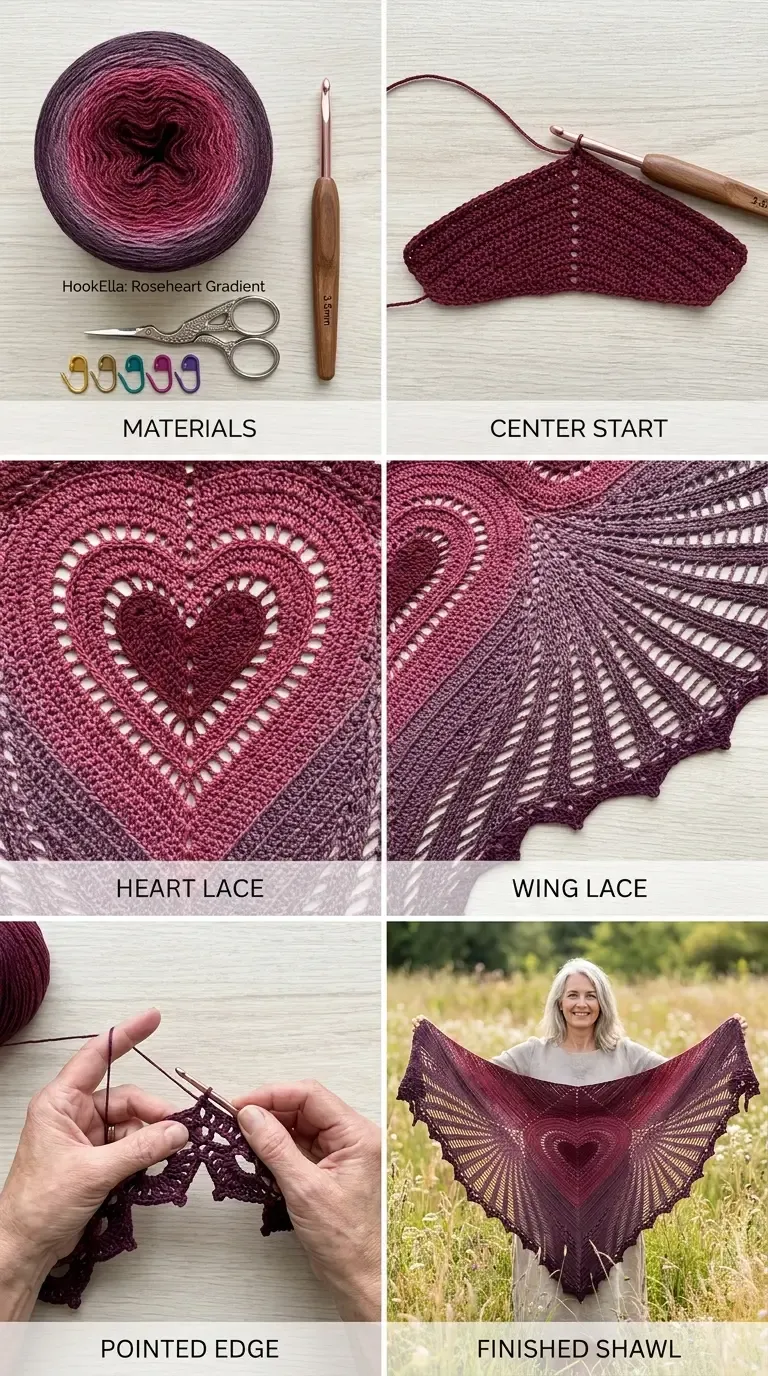
The construction image follows the same sequence as the written HookElla pattern: materials, centre start, heart lace, wing lace, pointed edge, and finished shawl.
Nested heart-lace loops
Make three flexible lace loops with the reserved dark yarn. Their chain counts are all multiples of three, so the arches close evenly.
Inner loop
Ch 72 and join with a sl st to the first ch without twisting.
Arch Round: Ch 1, sc in the same ch, ch 3, skip 2 ch, sc in the next ch around. Join with a sl st to the first sc. Fasten off with a 20-inch (50 cm) sewing tail.
Middle loop
Ch 108. Repeat the Arch Round as for the inner loop.
Outer loop
Ch 144. Repeat the Arch Round as for the inner loop.
Shape and attach the hearts
Lay the blocked shawl RS up. For each loop, place the joining point at the lower heart point on the central increase spine. Mark the opposite side of the loop for the top cleft, then place one marker halfway along each side to form the two rounded lobes.
Pin the inner loop over approximately Rows 7–16, the middle loop over Rows 5–20, and the outer loop over Rows 3–24. Keep all three lower points aligned on the central spine. Shape the arches into smooth lobes rather than sharp corners.
Using the long tail, sew each sc anchor to the shawl with one small matching stitch. Leave every ch-3 arch free. Secure the top cleft, both lobe peaks, and bottom point twice, then weave the tail through nearby stitches on the WS.
Top-edge band
With RS facing, join yarn at one wing tip. Work along the row-end edge to the centre start, then along the second row-end edge to the opposite wing tip.
Band Row 1: Ch 1. Work approximately 2 sc for every 3 row ends, placing 3 sc in the centre-start ring. Adjust the rate locally so the edge lies flat. Turn.
Band Row 2: Ch 1, sc in every sc across. Fasten off.
Pointed lower edging
Work the edging across the final body row only, from one wing tip to the other.
Edging Row 1 (RS): Join yarn at the first stitch. Ch 1 and sc in every dc, working 1 sc in each ch-1 space and 2 sc in each ch-3 window. Work (sc, ch 1, sc) in each of the three marked ch-2 spaces. Do not turn.
Edging Row 2: Sl st to the next sc, ch 1, sc in the same st. Ch 5, skip 4 sc, sc in the next sc across. At each marked spine and at the centre of the shawl, use ch 7 instead of ch 5. If fewer than four stitches remain before a marked point or the final stitch, divide the skipped stitches evenly on both sides. Do not turn.
Edging Row 3: In each ch-5 sp work (sc, hdc, dc, tr, picot, tr, dc, hdc, sc). In each ch-7 spine sp work (sc, hdc, dc, 2 tr, picot, 2 tr, dc, hdc, sc). Sl st in every sc between spaces. Fasten off.
Adjusting the size
For a smaller shawl, work four wing repeats instead of six, then Rows 49–50. The finished wingspan will be approximately 60 inches (152 cm), depending on gauge.
For a larger shawl, add complete four-row wing repeats before Rows 49–50. Each repeat adds:
- 8 positions to every panel;
- 32 positions to the full row;
- approximately 3 inches (7.5 cm) of blocked depth; and
- approximately 6 inches (15 cm) of wingspan.
Allow 180–220 m (197–240 yd) for each added repeat plus its share of edging. The heart loops do not need to change unless you want a larger centre motif; increase each loop by a multiple of 12 chains to preserve even arches.
Finishing and blocking
Weave in all body and edging ends. Soak the shawl according to the yarn label and remove excess water without twisting. Pin the top band into a gentle curve, then pin the three spine points and every picot along the lower edge.
Open the long wing windows evenly and shape the shawl to approximately 72 × 30 inches (183 × 76 cm). Check that the nested hearts remain centred while damp. Allow the shawl to dry completely before removing the pins.
Troubleshooting
- A panel is short by one position: Check the outer-edge increase and both sides of the adjacent marked ch-2 space. Each panel must gain two positions per row.
- The long windows drift: Count the complete positions in that panel, including two positions for every ch-3 window.
- The centre pulls upward: Loosen the three marked ch-2 spaces or replace them with ch 3 on the next recovery row.
- The wings ruffle: Your edge or spine increases are too loose. Use a smaller hook for recovery rows or block with less width.
- The heart loops pucker: Remove the sewing stitches and repin the loop with gentler curves. Attach only the sc anchors, never the ch-3 arches.
- The pointed edge curls: Add one extra skipped stitch beneath the crowded shells or block each picot farther apart.
- The gradient ends too early: Stop after a complete wing repeat and reserve the final 180 m for the hearts and edging.
For another statement accessory, explore HookElla’s Champagne Crochet Scarf or browse Wearables & Accessories.
The Roseheart Wing Shawl is designed to feel dramatic without becoming unpredictable: three marked spines control the growth, every lace row has a matching recovery row, and the nested arches give the centre a clear handmade signature.
Helpful questions
Is the complete Roseheart Wing Shawl pattern included here?
Yes. The centre start, panel framework, heart-lace loops, wing repeats, size adjustments, pointed edging, finishing, and printable HookElla pattern are all included.
How large is the finished shawl?
At the stated blocked gauge, the shawl measures approximately 72 inches (183 cm) from wing tip to wing tip and 30 inches (76 cm) from the top centre to the lowest point.
How much yarn does the shawl require?
Allow approximately 1,500 m (1,640 yd) of fingering or 4-ply gradient yarn. Reserve about 180 m (197 yd) for the three heart-lace loops and pointed edging.
How is the heart made?
Three flexible chain-arch loops are crocheted separately, shaped into nested hearts over the centre panels, and secured at their single-crochet anchor points. The arches remain open and create the layered heart-lace focal point.
Can I make the shawl smaller or larger?
Yes. Stop after any complete four-row wing repeat for a smaller shawl, or add more four-row repeats before the two solid finishing rows. Each repeat adds about 3 inches (7.5 cm) of depth after blocking.
Can I use a solid colour?
Yes. The geometry and lace remain clear in a solid yarn. For a gradient, begin with burgundy at the centre and arrange the cake so the deepest plum reaches the edging.