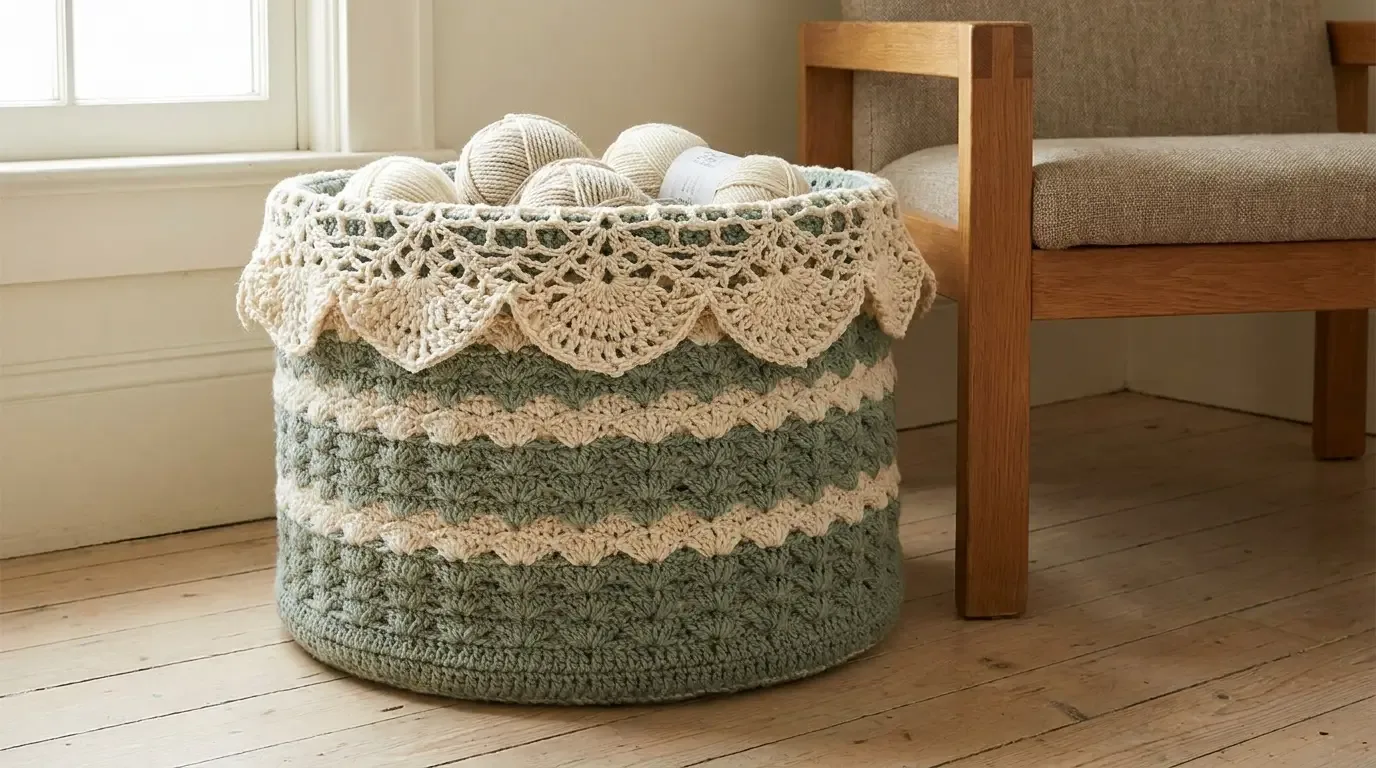
This generously sized basket starts with a firm round base, rises into straight shell-textured walls, and finishes with warm ivory lace folded over the rim. The sage-and-ivory color plan gives the middle body visible shell bands while keeping the upper section solid sage.
A substantial basket with a lace-draped rim
This sage-and-ivory crochet basket has a firm round base, straight walls, and a textured middle made from repeating shell rounds. Two narrow ivory bands break up the sage shells; seven solid sage rounds form the upper wall beneath a lighter, one-strand fan lace that folds over the rim. The finished basket is approximately 12 inches across and 11 inches high (30 × 28 cm).
The basket is worked in joined rounds. Two strands of worsted-weight yarn are held together for the base and structural body, then a single strand of warm ivory makes the lace trim. This pattern uses US crochet terms. It suits a crocheter comfortable with joined rounds, half double crochet, double crochet, and color changes.
Materials
- Worsted-weight / category 4 yarn: approximately 300–400 yd (274–366 m) sage and 200–250 yd (183–229 m) ivory. Hold two strands together for the full base and body. The lace edge uses one strand of ivory. Yardage varies with yarn stiffness, tension, and basket size, so keep extra yarn available.
- 8 mm (L) crochet hook for the base
- 6.5 mm (K) crochet hook for the body
- 4 mm (G) crochet hook for the one-strand lace
- Stitch marker, yarn needle, scissors, and measuring tape
Choose a firm, tightly plied yarn. Two strands of soft yarn can still make a flexible basket, so check the fabric as you work. The size guide for this sample is about 12 inches across after Base Round 10, about 9–10 inches of wall after 28 body rounds, and approximately 11 inches overall once the lace is folded down. A small swatch in the doubled body yarn can help compare hook and tension before starting. The Yarnivo Gauge Calculator can convert measured swatch stitches and rows into gauge; use the basket’s measured diameter and height—not the calculator alone—to judge the final size.
Abbreviations and special stitches
- BLO — back loop only
- ch — chain
- dc — double crochet
- hdc — half double crochet
- inc — work 2 stitches in the next stitch
- rep — repeat
- sc — single crochet
- sk — skip
- sl st — slip stitch
- st(s) — stitch(es)
- sp — space
4-dc shell
Work 4 dc into the same stitch. In the body shell round, skip the next 3 stitches after each shell. Each shell repeat uses 4 stitches from the previous round and makes 4 dc, so the count stays at 80 stitches (20 shells).
Pattern notes
- Work the base and body with two strands held together; use one strand for the lace only.
- Join every round with a sl st to the first stitch. Ch 1 at the start of a sc or hdc round; it does not count. For a shell round, ch 1 before the first 4-dc shell; it also does not count.
- Place a marker in the first stitch of each round and move it as you work. Keep the 80 body stitches evenly counted.
- Change color by fastening off at the round join and joining the next color there. Weave the ends into the thick fabric as you go.
Round base
With two strands of sage held together and the 8 mm hook, make a magic ring. If you prefer a chain ring, ch 3 and join with a sl st; work Round 1 into the ring.
Round 1: Ch 1, 8 hdc in ring; join to first hdc. (8 hdc)
Increase by 8 stitches on every round. The repeat in Round n is hdc in the next (n − 2) stitches, 2 hdc in the next stitch, repeated 8 times. Follow the table:
| Round | Repeat | Stitch count |
|---|---|---|
| 2 | 2 hdc in each stitch around | 16 hdc |
| 3 | Hdc in next 1, 2 hdc in next × 8 | 24 hdc |
| 4 | Hdc in next 2, 2 hdc in next × 8 | 32 hdc |
| 5 | Hdc in next 3, 2 hdc in next × 8 | 40 hdc |
| 6 | Hdc in next 4, 2 hdc in next × 8 | 48 hdc |
| 7 | Hdc in next 5, 2 hdc in next × 8 | 56 hdc |
| 8 | Hdc in next 6, 2 hdc in next × 8 | 64 hdc |
| 9 | Hdc in next 7, 2 hdc in next × 8 | 72 hdc |
| 10 | Hdc in next 8, 2 hdc in next × 8 | 80 hdc |
After Round 10, the base should lie flat and measure about 12 inches (30 cm) across. If it cups, try a larger hook; if it ripples, try a smaller hook or recheck the eight increase points. Do not add an extra increase round unless you also adjust the body repeat count.
Turn the base and build the walls
Switch to the 6.5 mm hook, keeping two strands held together. The body is worked over 80 stitches; each shell repeat spans four stitches.
Round 11 (turning ridge, Sage): Ch 1, sc in BLO of each stitch around; join. (80 sc)
Solid Sage round: Ch 1, sc in each stitch around; join. (80 sc)
Sage shell round: Ch 1. *Work a 4-dc shell in the next stitch, sk the next 3 stitches; rep from * 20 times; join to the first dc. (20 shells; 80 dc)
Work the following color-and-texture schedule. Every round is joined; the ch 1 at the beginning does not count.
| Round(s) | Color | Round instruction | Count |
|---|---|---|---|
| 12–15 | Sage | Solid Sage round | 80 sc each |
| 16 | Sage | Sage shell round | 20 shells / 80 dc |
| 17 | Sage | Solid Sage round | 80 sc |
| 18 | Sage | Sage shell round | 20 shells / 80 dc |
| 19 | Sage | Solid Sage round | 80 sc |
| 20 | Ivory | Shell round | 20 shells / 80 dc |
| 21 | Ivory | Solid sc round | 80 sc |
| 22 | Sage | Sage shell round | 20 shells / 80 dc |
| 23 | Sage | Solid Sage round | 80 sc |
| 24 | Sage | Sage shell round | 20 shells / 80 dc |
| 25 | Sage | Solid Sage round | 80 sc |
| 26 | Ivory | Shell round | 20 shells / 80 dc |
| 27 | Ivory | Solid sc round | 80 sc |
| 28 | Sage | Sage shell round | 20 shells / 80 dc |
| 29 | Sage | Solid Sage round | 80 sc |
| 30 | Sage | Sage shell round | 20 shells / 80 dc |
| 31 | Sage | Solid Sage round | 80 sc |
| 32–38 | Sage | Solid Sage round | 80 sc each |
The two ivory bands are each one shell round followed by one single-crochet round. Sage shell rounds create the textured middle between and below those bands, and Rounds 32–38 make the solid sage upper section. At the end of Round 38, the wall should measure about 9–10 inches (23–25 cm) from the base turning ridge. If your gauge is shorter, add solid Sage rounds before the lace; if taller, remove some of Rounds 32–38.
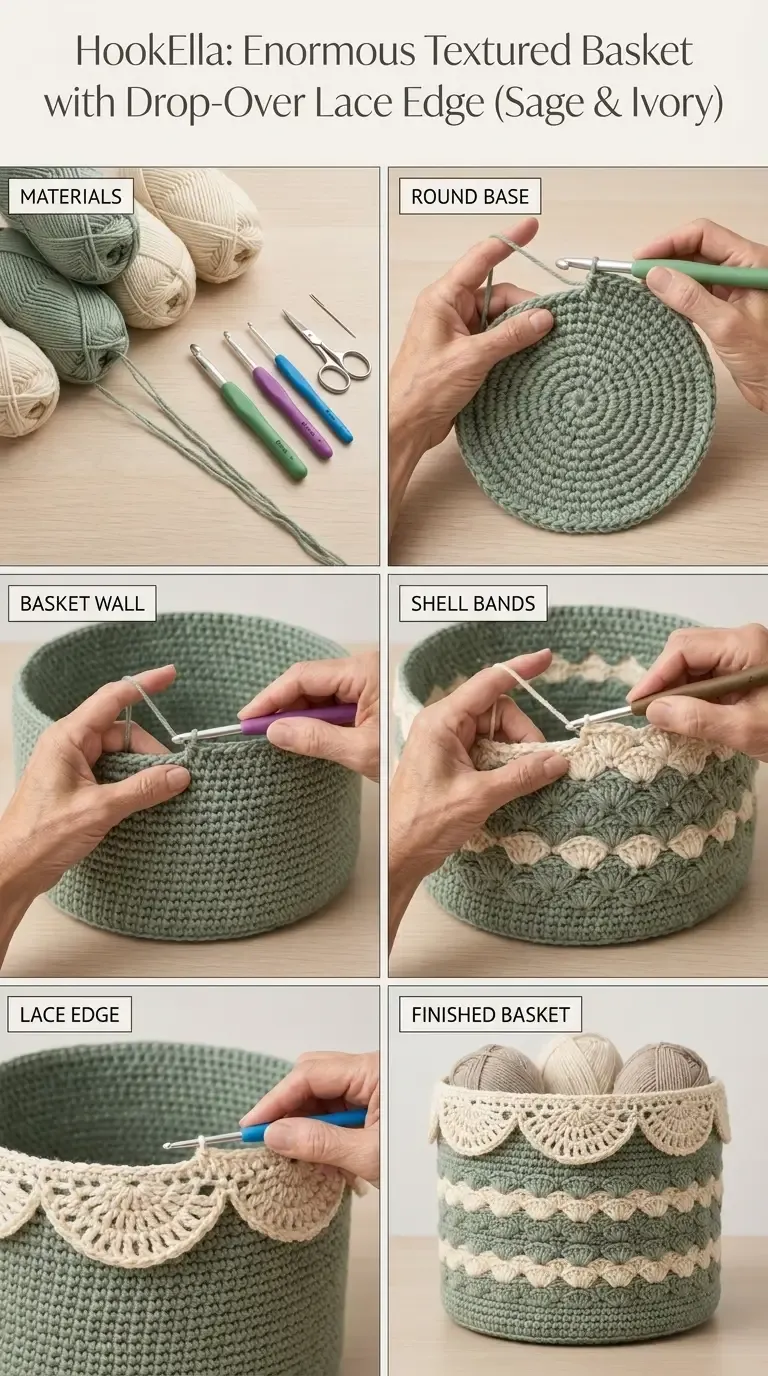
The six panels show the base, structural walls, contrasting shell bands, and lace finish made in the written pattern.
One-strand drop-over fan lace
Fasten off the doubled body yarn. With one strand of ivory and the 4 mm hook, attach yarn at the upper rim. The 80-stitch rim divides into 20 groups of four.
Lace Round 1 (arch round): Ch 1. *Sc in next 2 stitches, ch 6, sk next 2 stitches; rep from * 20 times. Join with a sl st to the first sc. (40 sc and 20 ch-6 arches)
Turn the basket upside down so the top rim points toward the floor. This keeps the next lace rounds working down the outside of the basket.
Lace Round 2 (fan round): Ch 1. *Work 6 dc in the next ch-6 arch, sc in the next 2 sc; rep from * 20 times. Join with a sl st to the first dc. (20 fans, 40 sc anchors; 160 stitches total)
Lace Round 3 (picot edge): Ch 1. *Sc in next dc, hdc in next dc, dc in next dc, ch 3 and sl st in the first ch to make a picot, dc in next dc, hdc in next dc, sc in next dc, sc in next 2 anchor sc; rep from * 20 times. Join with a sl st to the first sc and fasten off. (20 fan points; 160 stitches, plus picots)
Let the lace fall over the rim. If the arches pull the basket top inward, use a relaxed tension or increase each arch to ch 7; keep the 20 arches evenly spaced. If the edge flares excessively, return to ch 6 and check that Round 1 has exactly 20 arches.
Finishing and care
Weave in the doubled-yarn ends through several dense stitches on the inside. Weave the lace tails into the ivory fans without drawing the arches tight. Shape the base into a circle, stand the walls upright, and smooth the upper sage section. Lightly steam or damp-block only if the yarn label permits; keep heat away from acrylic and do not flatten the shells. Let the basket dry fully before filling it.
Use it for yarn, folded throws, toys, or other light household items. The lace is decorative, so avoid hanging weight from the rim. Follow the yarn label for cleaning and reshape the basket while damp.
Troubleshooting and size changes
- Base curls upward: the base may be too tight. Try a larger hook for the base, and confirm that each round has eight evenly spaced increases.
- Base waves or ruffles: check that no extra increases were added; try a smaller hook if the count is correct.
- Walls lean or flare: confirm every body round has 80 stitches, and use the 6.5 mm hook for the walls. Dense yarn held double can loosen if the hook is too large.
- A shell band shifts at the join: mark the first stitch consistently and begin each joined round in the same place. The shell round has 20 repeats of four stitches each.
- Changing the diameter: for a base ending at Round B, the count is 8 × B stitches, with 2 × B shell repeats and 2 × B lace arches. The sample ends Round 10 with 80 stitches, 20 shells, and 20 lace arches. Measure before building the walls; a changed base will change the basket’s proportions and yarn use.
- Changing the height: add or remove complete solid Sage rounds at the top of the wall before making the lace. This adjusts the upper section without changing the shell-band sequence.
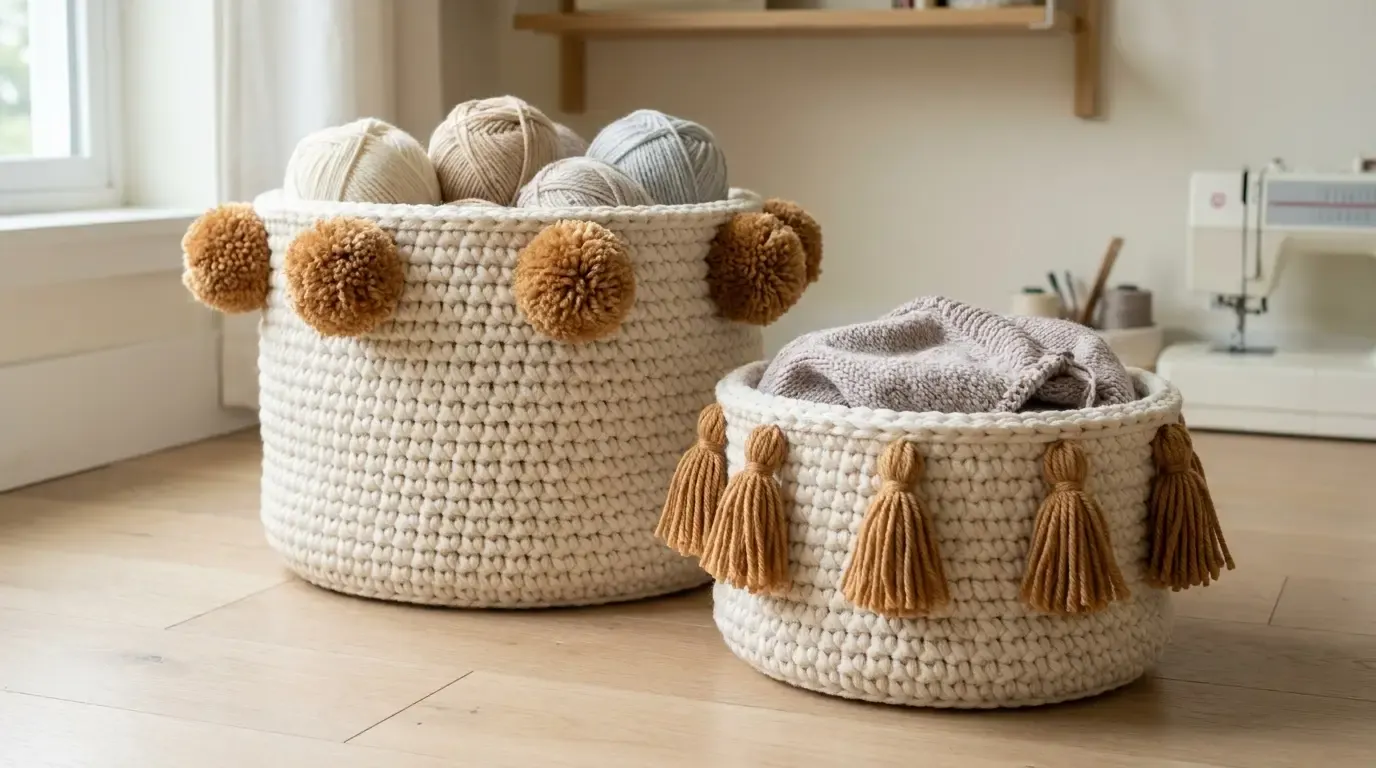
For another structured storage project, try the Cozy Boho Basket Duo or browse the Blankets & Home collection.
Helpful questions
What size does the basket finish?
The sample is approximately 12 inches in diameter and 11 inches high (30 × 28 cm), with the lace folded over the rim.
Why is the main yarn held double?
Two worsted-weight strands make a dense, sturdy basket fabric. The lace trim uses one strand of ivory so it stays lighter than the sage body.
How are the ivory bands made?
Each band has one ivory shell round and one ivory single-crochet round. Sage shell-and-single-crochet pairs sit between the ivory bands, followed by a solid sage upper section.
Can I adjust the basket size?
Yes. Each added or removed base increase round changes the base count by 8 stitches; keep the shell and lace repeats at one repeat for every 4 body stitches. Add or remove sage single-crochet rounds at the top to adjust height. Both changes affect yarn use and final proportions.