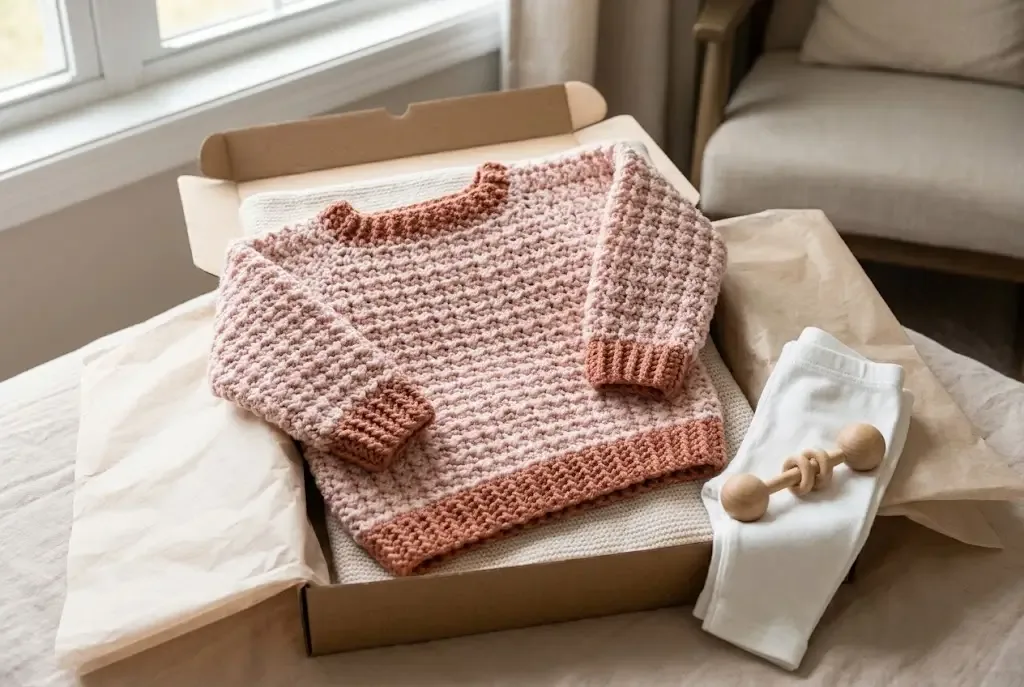
A handmade baby sweater can turn an everyday outfit into a keepsake. This softly textured pullover pairs a blush body with chai-brown ribbing for a warm, modern look, while its top-down construction keeps the silhouette simple and practical. This HookElla showcase explores why Tiffany Brown’s Even Moss Baby Sweater for Daisy Farm Crafts makes such a lovely gift.
Meet the Even Moss Baby Sweater
The Crochet Even Moss Baby Sweater was designed by Tiffany Brown for Daisy Farm Crafts. Brown created the sweaters as handmade baby gifts—including coordinating versions for twins—and paired one with little jeggings for a ready-to-wear present. That personal gifting story suits the design: it is special enough to feel celebratory but simple enough to become part of a baby’s everyday wardrobe.
This is an original HookElla inspiration and planning article, not a reproduction of the pattern. We do not republish Daisy Farm Crafts’ row instructions, stitch counts, size-specific joining rounds, video, or photography. Visit the original Crochet Even Moss Baby Sweater pattern at Daisy Farm Crafts for the complete authorized instructions.
Why a handmade baby sweater is a meaningful gift
A sweater carries the maker’s time in a very visible way. It can be worn for family visits, tucked into a changing bag for cool evenings, and saved afterward as a reminder of how small the child once was. Unlike a decorative nursery object, a soft pullover can become part of real family photographs and ordinary days.
The two-color finish also gives the gift a thoughtful, coordinated feel. A contrasting neckline, cuffs, and lower hem frame the main color without making the sweater fussy. Presented with leggings or a simple bodysuit, it looks like a complete outfit rather than a single handmade piece.
What makes the even moss texture special
Even moss stitch alternates half double crochet and slip stitch, keeping each stitch type aligned over the same stitch type in the row below. The height difference creates small, regular bumps across the surface. In a soft blush shade, those shadows make the fabric look plush and hand-finished without relying on lace, bobbles, or added decoration.
The stitch is especially appealing on a small sweater because it reads clearly at close range but remains quiet from across the room. A smooth yarn lets the pebbled surface show; a highly variegated or fuzzy yarn can blur the rhythm. The fabric is more substantial than an open stitch pattern, making it well suited to a cool-weather gift.
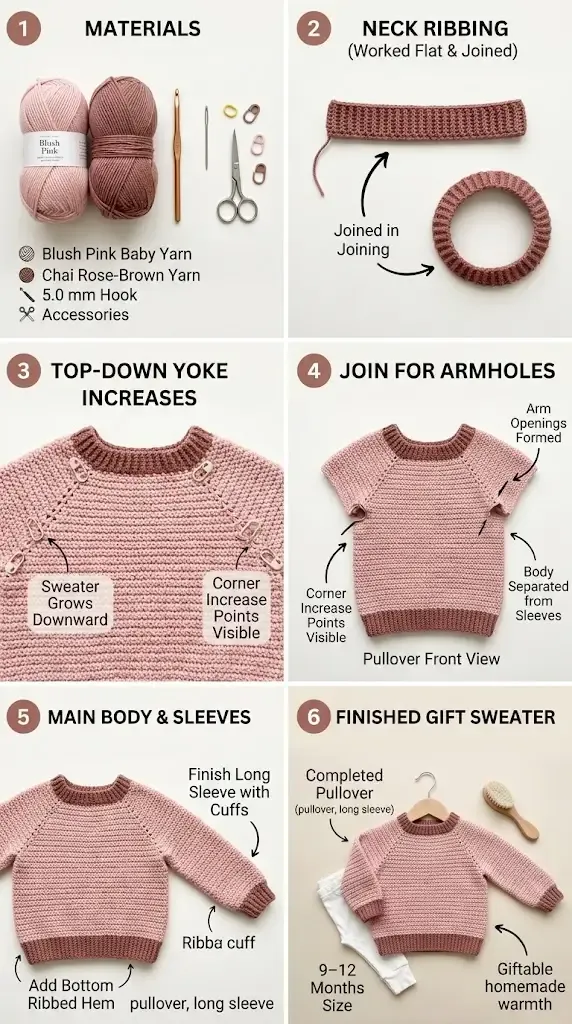
This HookElla image is a construction overview, not a substitute for the designer’s stitch counts or size instructions. Follow the linked Daisy Farm Crafts pattern while you crochet.
Skill level and techniques to expect
Daisy Farm Crafts places the project at advanced beginner to intermediate. The individual stitches are approachable, but the garment asks you to manage several ideas at once: a joined ribbed neck, turned rounds, marked yoke corners, regular increases, armhole separation, sleeves, and matching ribbed finishes.
You will have an easier time if you can recognize a half double crochet beside a much shorter slip stitch without recounting the whole round. Four contrasting stitch markers are also valuable at the yoke corners. Check their placement every round; a missed corner increase can shift an armhole and change the fit on both sides.
This is a rewarding first top-down sweater after one or two small projects worked in joined rounds. If garment shaping is new to you, read the full source pattern before starting and watch the designer’s accompanying help material rather than improvising at an armhole.
Materials at a glance
The original sample uses Red Heart Amore, a soft 100% polyester yarn supplied in 100 g / 198 yd (181 m) skeins, with a 5.0 mm (H-8) hook. The source lists:
- 1 skein of Color A for the contrasting ribbing
- 2 skeins of Color B for the main sweater color
- 3 skeins of Color B for the 18- and 24-month sizes
- Scissors, a tapestry needle, and stitch markers
The published gauge is approximately 8 stitches × 10 rows = 2 in (5 cm) in the pattern texture. On a baby garment, gauge directly affects the neckline, chest, yoke depth, and armholes. Wash and dry the swatch as you plan to wash the sweater, then measure it without stretching.
If you substitute yarn, compare total yardage and gauge rather than buying the same number of balls. Fiber density, twist, and skein size can vary widely even within a similar yarn weight.
Color ideas for baby gifts
Blush pink with chai or rose-brown trim feels warm and modern, but the simple silhouette suits many palettes.
- Soft neutral: oatmeal body with warm taupe ribbing
- Woodland: muted sage body with mushroom-brown trim
- Coastal: mist blue with soft navy or stone ribbing
- Sunny: creamy ivory with muted ochre accents
- Twin set: reverse the same two colors on the second sweater, keeping the pair coordinated but easy to tell apart
- One-color keepsake: use a single shade and let the even moss texture provide the contrast
Check strong colors for dye transfer before pairing the sweater with pale leggings. A washed swatch will also reveal whether the contrast yarn relaxes or grows differently from the main color.
Sizing from 6 to 24 months
The Daisy Farm Crafts pattern offers adjustments from approximately 6 months through 24 months. Treat age labels as a starting point: babies of the same age can have very different chest, arm, and torso measurements. Compare the source measurements with a sweater or bodysuit that currently fits the recipient, and consider the season in which the gift will be worn.
For a baby shower gift, sizing up often gives the family more time to use it. If the baby is due in summer, a 12- or 18-month sweater may be more useful for the following cool season than a newborn-size layer. Leave comfortable room for a cotton bodysuit underneath, but avoid oversized sleeves or a loose neckline that could bunch around the face.
Construction at a high level
The sweater begins at the neckline and grows downward. A ribbed strip is worked flat first, then joined into a ring. Stitches are worked around that ring to establish the yoke, with four marked corner points controlling the increases. Once the yoke reaches the appropriate depth, sections are joined to form the two armholes and the body continues below them.
The sleeves are completed from the arm openings, and contrast ribbing finishes the waist and cuffs. This top-down approach makes the garment’s structure easy to see as it develops and allows key lengths to be checked against another baby sweater before finishing.
Neckline ribbing
The contrast neck band gives the pullover a tidy frame and enough stretch to dress the baby comfortably. Because the ribbing is made first and joined, its seam should be smooth and flexible rather than bulky. Before building the yoke, confirm that the ring is not twisted and that the opening agrees with the source measurement for your chosen size.
A baby neckline should stretch gently without becoming loose. Do not tighten the joining seam or weave tails into one rigid spot; distribute them along the ribbing so the edge keeps its elasticity.
Marked yoke shaping
Four corner markers divide the yoke into front, back, and shoulder sections. Increases at those landmarks create the angular lines running from the neck toward the underarms. The visible diagonal shaping is one of the sweater’s prettiest details, especially in a solid main color.
Move or verify every marker as directed by the original pattern and count the texture sequence as you approach each corner. The short slip stitches can hide, so pause before and after a marked increase to confirm that the alternating pattern remains intact.
Joining the armholes
At the correct size-specific stage, the front and back are joined while the sleeve sections are left open. This is the moment when the yoke becomes a recognizable pullover. Do not choose the joining point by age label alone; compare yoke depth and chest width with the designer’s measurements and your intended wearer.
After joining, spread the garment flat and check that both arm openings match. An uneven join is much easier to correct before several inches of body have been added.
Body, sleeves, hem, and cuffs
The body continues in the even moss texture until it reaches the desired torso length, then the contrasting ribbing returns at the lower edge. The sleeves grow from the armholes and end with coordinating ribbed cuffs. Matching the rib direction at the neck, hem, and wrists gives the finished sweater a calm, intentional look.
Try to work both sleeves in the same sitting rhythm and keep notes about rounds or measurements. Even when the pattern is correct, a change in hand tension can make the second sleeve subtly narrower or longer than the first.
Choosing baby-friendly yarn
Softness at the ball is only one consideration. Look for yarn that remains comfortable and stable after washing, since baby clothing is laundered often.
- Follow the yarn label’s washing and drying directions and include them with the gift.
- Choose a smooth yarn that does not shed long fibers into the baby’s mouth or eyes.
- Avoid scratchy metallic threads, stiff novelty yarn, and heavy embellishment.
- Make sure all ends are woven securely through multiple directions.
- Wash the completed garment in fragrance-free detergent before gifting if the family’s preferences are known.
- Skip loose buttons, beads, cords, pom-poms, and long ties that could detach or catch.
If the child has known skin sensitivities, ask the parent about preferred fibers before choosing yarn. A neatly attached care card is more useful than assuming every “baby” yarn can be treated the same way.
Finishing and gift presentation
Weave in the last ends, then wash and shape the sweater according to the yarn label. Lay it flat so the yoke lines are symmetrical and the sleeves match. Check the neckline stretch, underarm joins, cuffs, and every contrast-color transition before wrapping.
For a baby shower outfit, fold white or cream cotton leggings beneath the sweater and add a plain bodysuit in the chosen size. A small card can name the designer, link to the care instructions, list the fiber content, and note the garment size. Wrap the set in tissue inside a reusable box so the handmade texture remains visible when the lid opens.
For twins, use the same palette with reversed body and trim colors, or choose two neighboring shades with identical contrast ribbing. The garments will look like a pair without requiring labels sewn near sensitive skin.
For another handmade layer, see HookElla’s Easy Ribbed Crochet Beanie. A Cream Basketweave Crochet Baby Blanket can turn the sweater into a larger coordinated gift, and the Baby Crochet collection gathers more small-size inspiration.
A sweet project with a personal story
The Even Moss Baby Sweater works beautifully as a gift because its texture feels special, its contrast ribbing looks polished, and its top-down shape is practical for everyday layering. Choose a gentle palette, take time over the gauge and finishing, and let Tiffany Brown’s original Daisy Farm Crafts pattern guide the crochet itself.
Helpful questions
Does this HookElla article include the complete sweater pattern?
No. This is an independent editorial showcase of Tiffany Brown’s design for Daisy Farm Crafts. Use the linked Daisy Farm Crafts page for the designer’s complete instructions, stitch counts, size changes, and video support.
What skill level is the Even Moss Baby Sweater?
Daisy Farm Crafts describes it as advanced beginner to intermediate. It is most comfortable for makers who can join and turn rounds, maintain a two-stitch texture, increase at marked yoke corners, form armholes, and add ribbing.
What sizes does the source cover?
The original pattern gives adjustments for roughly 6 months through 24 months. Baby proportions vary, so compare the pattern measurements with a well-fitting garment and allow comfortable ease.
What yarn and hook does the original use?
The source uses Red Heart Amore with a 5.0 mm hook. It lists one skein of Color A and two skeins of Color B, increasing Color B to three skeins for the 18- and 24-month sizes.
Can I substitute another baby yarn?
Yes, but match the published gauge and choose a smooth, washable yarn that feels soft after laundering. Compare yardage rather than skein count because ball sizes differ among brands.
Why is even moss stitch useful for baby clothes?
Alternating half double crochet and slip stitch creates a softly pebbled fabric with visual depth but no large lace openings. The texture looks polished in a solid color and remains understated enough for everyday outfits.
What can I pair with the sweater for a baby shower gift?
Add simple cotton leggings, a bodysuit, and a care card. Avoid loose buttons, ties, beads, or other detachable decorations on a baby garment.