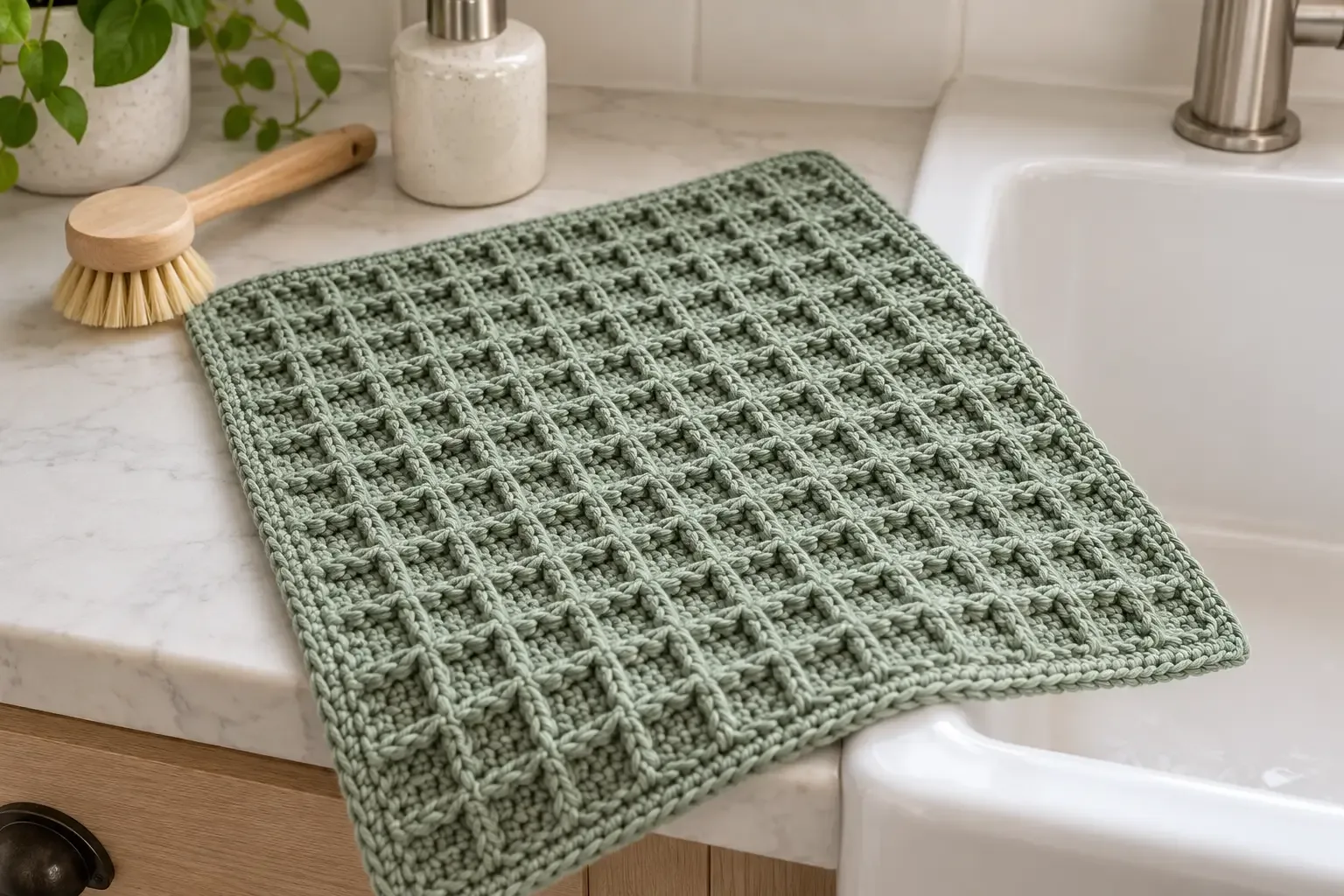
This waffle stitch crochet dishcloth uses sturdy cotton yarn and a clear two-row repeat to make a deeply textured cloth for the kitchen or bath. The raised squares look intricate, but the pattern is built from regular double crochet and front-post double crochet stitches.
About this pattern
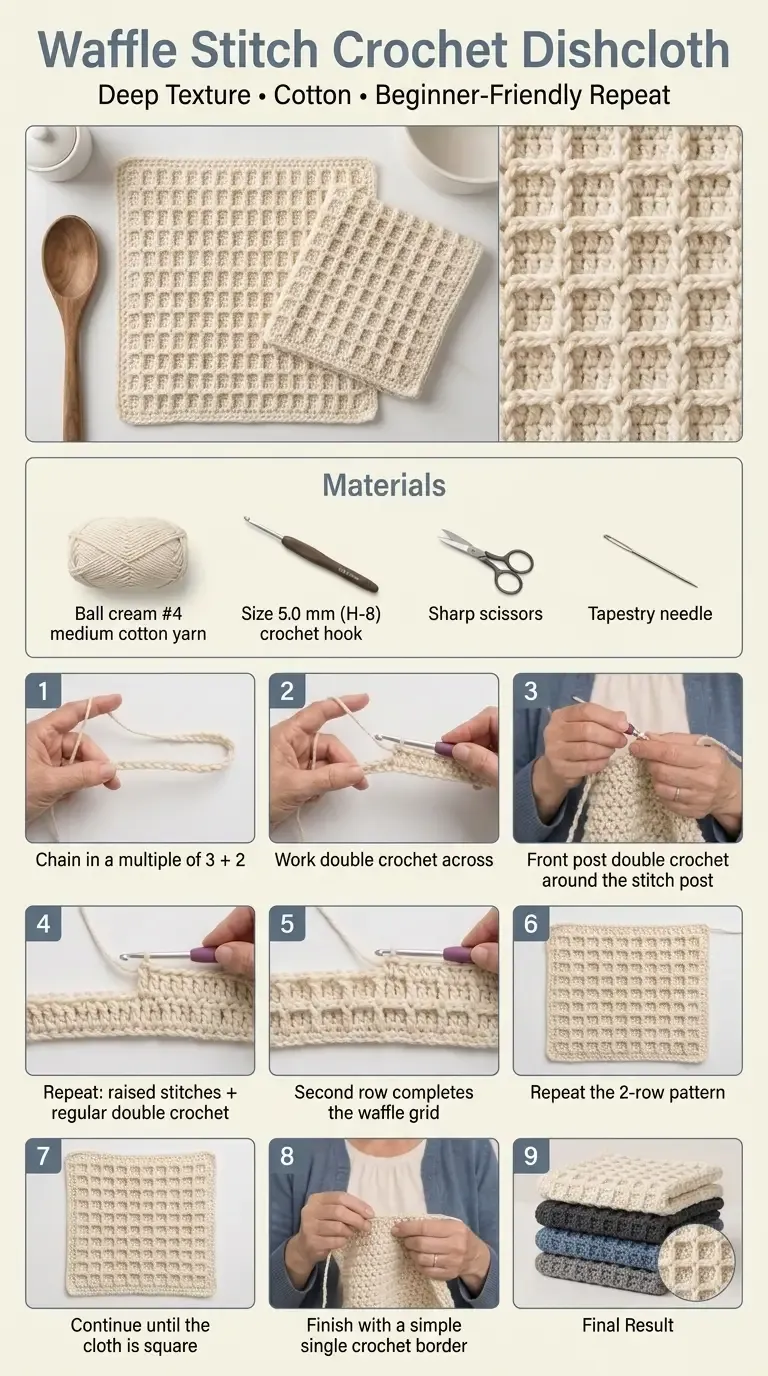
The waffle texture is made by alternating groups of front-post double crochet with regular double crochet. The raised posts create small square pockets on both sides of the fabric, while the dense cotton makes a useful, absorbent cloth. The pattern has a 3 + 2 foundation-chain repeat and finishes with one simple round of single crochet.
These are original HookElla instructions written in US terminology. The pattern has not been physically tested, so use the finished measurement as your checkpoint and adjust tension if needed.
Materials
- Category 4 medium-weight cotton yarn, approximately 150 yd (137 m)
- 5.0 mm (H-8) crochet hook, or size needed to meet the fabric feel
- Tapestry needle and scissors
- Measuring tape and stitch marker (optional)
Finished size and gauge
The finished dishcloth is approximately 12 × 12 in (30.5 × 30.5 cm). Gauge is flexible for a utility cloth; aim for a firm fabric that still drapes. If you need a specific size, measure after several repeats and adjust the number of rows.
Abbreviations
- ch — chain
- dc — double crochet
- FPdc — front-post double crochet
- sc — single crochet
- sl st — slip stitch
- st(s) — stitch(es)
Pattern notes
- Turning chains count as a stitch only where stated; in this pattern, ch 3 counts as the first dc.
- Work flat, turning after every row.
- For an FPdc, yarn over, insert the hook from front to back to front around the post of the indicated stitch, yarn over and pull up a loop, then complete a dc.
- Keep the post stitches relaxed so the top edge remains square.
Instructions
Dishcloth body
With cotton yarn, ch 38 (a multiple of 3 plus 2).
- Setup row: Dc in the fourth chain from the hook and in each chain across — 36 dc. Turn.
- Row 2: Ch 3 (counts as dc), dc in each stitch across — 36 dc. Turn.
- Row 3: Ch 3 (counts as dc), dc in the next 2 stitches, *FPdc around each of the next 3 stitches, dc in the next 3 stitches; repeat from * 5 times, dc in the last 3 stitches — 36 stitches. Turn.
- Row 4: Ch 3 (counts as dc), dc in the next 2 stitches, *dc in the next 3 stitches, FPdc around each of the next 3 stitches; repeat from * 5 times, dc in the last 3 stitches — 36 stitches. Turn.
Repeat Rows 3–4 until the cloth is close to square, ending after a Row 4. With the stated hook and cotton yarn, this is usually about 24–26 textured rows total after the setup rows. Do not force a row count; stop when the fabric measures about 11.5–12 inches long.
Single crochet border
Do not fasten off. Ch 1, then work sc evenly around the entire cloth. Place 3 sc in each corner so the border turns without pulling. Along the side edges, work approximately 1 sc in each row end; along the top and bottom, work 1 sc in each stitch. Join with a sl st to the first sc. Fasten off and weave in the ends.
Finishing and care
Weave in all tails securely on the wrong side. Gently wet the cloth and lay it flat to even the edges, allowing it to dry completely. Wash according to the cotton yarn label; reshape flat while damp if the waffle squares relax.
Helpful tips
- Count groups of three rather than trying to count every post individually.
- If the sides flare, use a slightly smaller hook or keep the border tension looser.
- A contrasting border makes the waffle squares stand out without changing the stitch repeat.
Helpful questions
Does the waffle stitch use a lot of yarn?
The raised texture uses more yarn than a flat fabric. Have at least 150 yards of category 4 cotton available so you can complete the border comfortably.
Can I make the dishcloth a different size?
Yes. Keep the foundation chain at a multiple of 3 plus 2, then work the two-row repeat until the piece reaches your preferred length.
Should I use cotton yarn?
Cotton is a practical choice because it is absorbent and washable. A smooth category 4 cotton makes the post stitches easy to see.