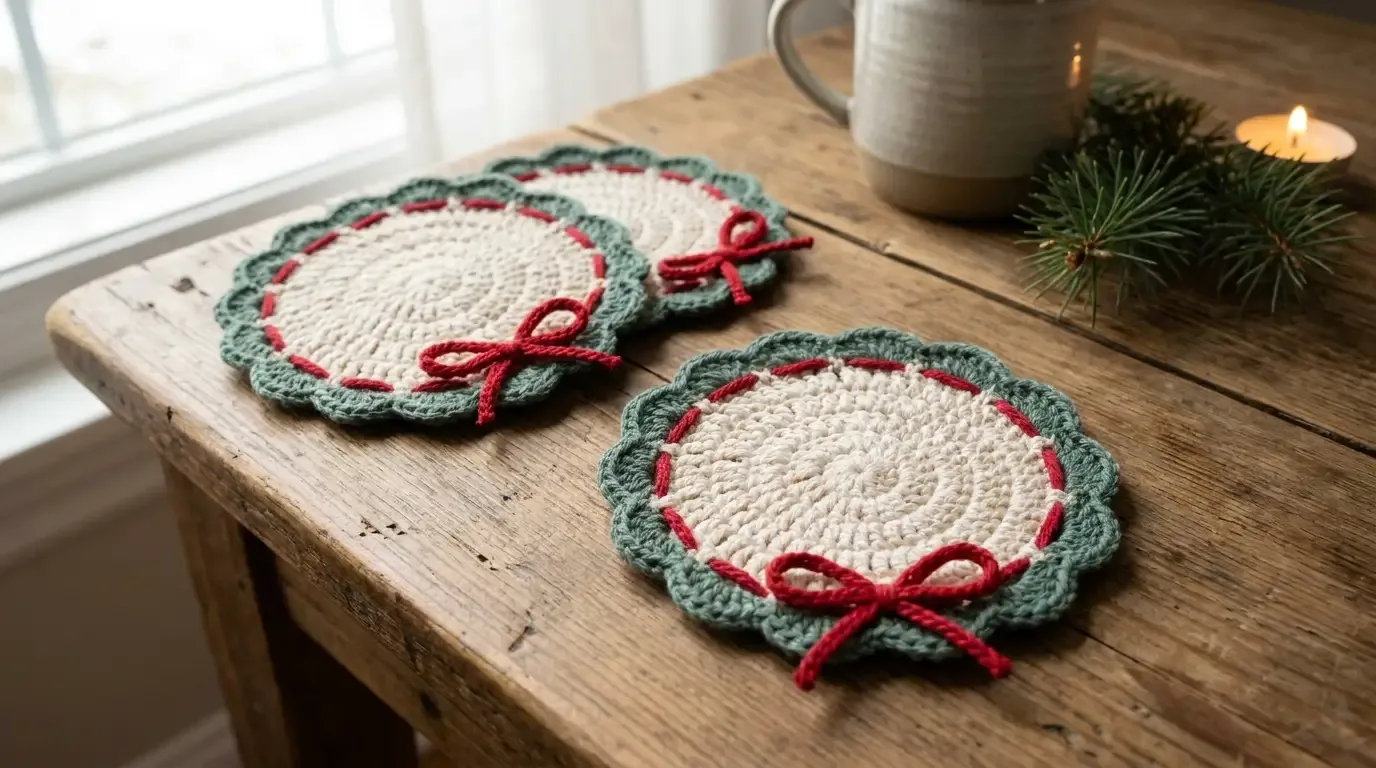
A handmade coaster is a small project with a big seasonal payoff. This festive wreath version starts as a simple cream circle, grows into a green scalloped edge, then gets its holiday character from a red running-stitch accent and a little tied bow.
A tiny wreath for every mug
This Festive Wreath Crochet Coaster is designed to be quick, useful, and cheerful. The center is worked in cream so it can catch a little condensation, the green edge forms a wreath of scallops, and a red woven line with a small bow supplies the holiday detail.
The crochet is intentionally simple: six increase rounds, two color-change rounds, and one repeatable scallop sequence. Make four for a place setting, six for a holiday table, or a single coaster as a stocking stuffer or host gift.
Finished size and gauge
The finished coaster measures approximately 6–6½ inches (15–16.5 cm) across the outer scallops. The inner cream circle is about 4¾–5 inches, leaving a visible green wreath border.
Gauge is not strict for a coaster. Work firmly enough that the circle lies flat and the scallops hold their shape. A useful target is about 16 single crochet stitches and 18 rounds = 4 inches (10 cm) in the cream center with a 4 mm hook.
Materials
- Small amounts of worsted-weight cotton yarn:
- Cream or soft ivory
- Leaf green or sage
- Holiday red
- 4.0 mm (G-6) crochet hook
- Tapestry needle
- Scissors
- Stitch marker (optional)
- Measuring tape
Cotton is recommended because it absorbs moisture and tolerates repeated washing. Choose smooth yarn so the red woven accent slides cleanly through the stitches. Avoid fuzzy novelty yarn for the center, since it can hide the round placement.
Abbreviations (US terms)
- ch — chain
- dc — double crochet
- inc — 2 sc in the same stitch
- sc — single crochet
- sl st — slip stitch
- st(s) — stitch(es)
- rep — repeat
Turning chains do not count as stitches. Join each round with a slip stitch to the first stitch unless noted.
Cream center
Work the first six rounds in cream. Place a marker in the first stitch if you prefer continuous-round counting, or join each round for a visible beginning point.
- Round 1: Make a magic ring. Ch 1, work 6 sc into the ring. Join. 6 sts.
- Round 2: Ch 1, inc in each stitch around. Join. 12 sts.
- Round 3: Ch 1, *sc in the next st, inc in the next st; rep from * around. Join. 18 sts.
- Round 4: Ch 1, *sc in the next 2 sts, inc in the next st; rep from * around. Join. 24 sts.
- Round 5: Ch 1, *sc in the next 3 sts, inc in the next st; rep from * around. Join. 30 sts.
- Round 6: Ch 1, *sc in the next 4 sts, inc in the next st; rep from * around. Join. 36 sts.
The circle should be flat. If it cups, your tension is tight or you need a larger hook. If it ruffles, use a smaller hook or check that each increase round contains exactly six increases.
Green wreath ring
Join green in any stitch of the cream circle.
- Round 7: Ch 1, *sc in the next 5 sts, inc in the next st; rep from * around. Join. 42 sts.
- Round 8: Ch 1, *sc in the next 6 sts, inc in the next st; rep from * around. Join. 48 sts.
Round 8 is the scallop foundation. Forty-eight stitches divide evenly into six groups of eight, so the outer edge can be spaced without crowding or stretching.
Scalloped wreath edge
Work the following repeat six times around Round 8:
- Round 9: Ch 1. *Work 5 dc in the next st, sc in each of the next 3 sts, skip the next st, sc in each of the next 3 sts; rep from * around. Join with a sl st to the first dc. Six scallops.
Each repeat uses eight base stitches: one shell stitch, three single crochets, one skipped stitch, and three more single crochets. The skipped stitch creates a gentle valley between shells. Do not pull the single crochets tight; the edge should remain flat when placed on a table.
Fasten off green and weave in the end on the back. If a shell tips forward, block the coaster lightly with your fingers while damp.
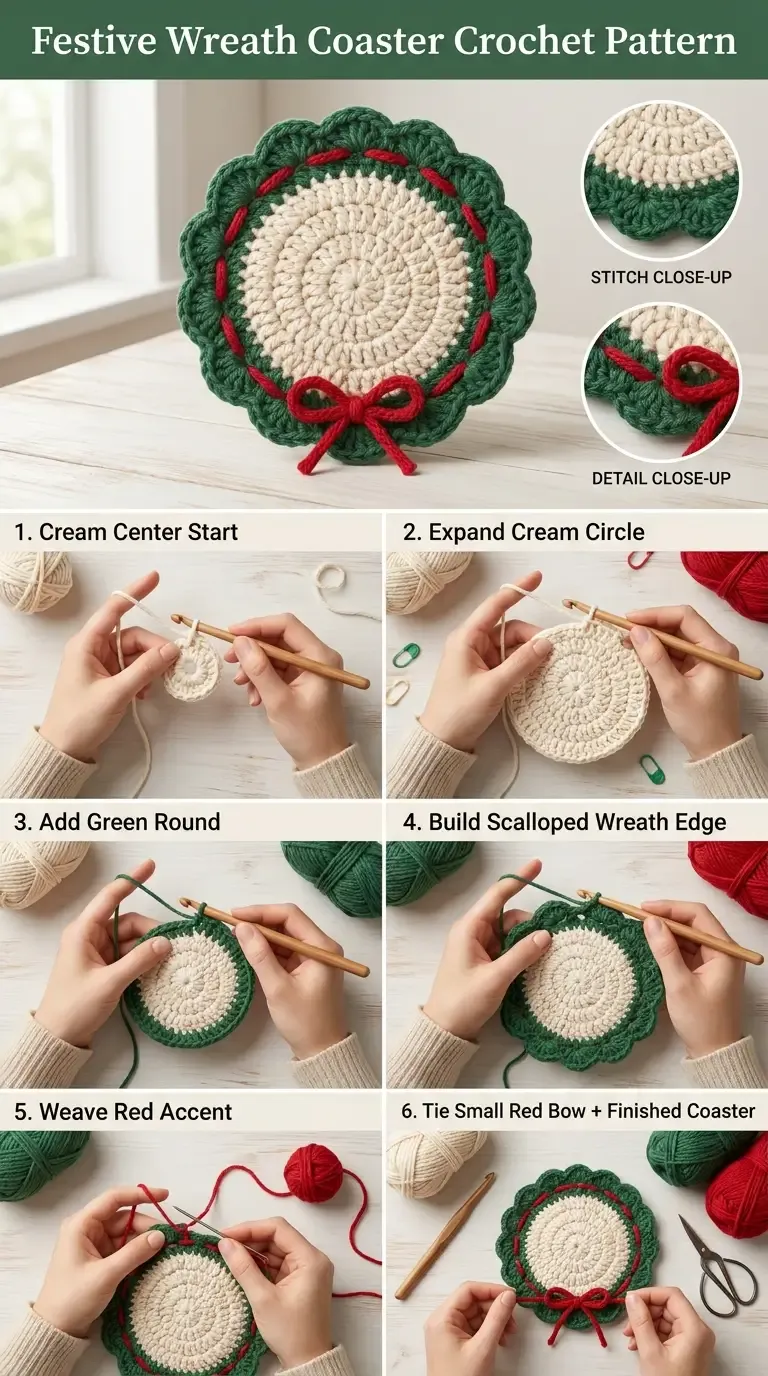
The construction image shows the color sequence and finishing placement for one coaster.
Add the red running-stitch accent
Thread a tapestry needle with red yarn. Starting on the back, weave the yarn in and out through the front loops or stitch posts around the boundary between the cream center and green wreath. Use one pass per repeat so the red line forms an even ring.
Keep the red yarn resting on top of the fabric rather than pulling it deeply into the stitches. Secure the beginning and end on the back with two small knots and weave the tails through neighboring stitches. Trim close without cutting the crocheted fabric.
For a subtler accent, weave red through every other stitch. For a brighter wreath, make a second pass beside the first, but avoid crowding the green shells.
Tie the small bow
Cut approximately 18 inches (46 cm) of red yarn. Wrap it loosely around two fingers to form two loops, tie the center with a short strand, and trim the tails to about 1½–2 inches. Alternatively, make a tiny chain of 10, tie it into a bow, and stitch the center to the lower green edge.
Attach the bow at the bottom of the coaster, centered over one scallop valley. Use the tapestry needle to sew through the bow’s center and the green stitches twice. Keep the bow decorative and compact so it does not catch on cups or snag during washing.
Finishing and blocking
Weave in every end on the back. Place the coaster face down on a towel, mist lightly with water, and pat the circle flat. Shape each green shell into a rounded fan and allow the coaster to dry completely.
Do not use a hot iron directly on the puffed edge. If you want extra stability, place a thin washable non-slip fabric circle beneath the coaster, but do not glue it permanently if the coaster will be laundered.
Make a matching set
For four coasters, repeat the pattern in the same color order. For a playful set, keep the cream center consistent and vary the green shade or bow placement. A deep forest green with cream and cranberry feels traditional; sage, ivory, and brick red suits a softer farmhouse table.
Stack the finished coasters with the bows alternating directions so they store flat. Add a paper belly band or tie them with leftover red yarn for a simple handmade gift presentation.
Resizing guidance
To make a larger wreath, continue the cream increase sequence after Round 6. Add one round with six evenly spaced increases at a time. When the base reaches the desired diameter, work green plain stitches until the total green stitch count is divisible by eight.
For example, 56 green stitches supports seven scallop repeats; 64 supports eight. Use the same Round 9 shell repeat, working one shell group per eight stitches. If the outer edge waves, remove an increase round or use a smaller hook for the green section.
To make a smaller coaster, stop the cream center earlier, then ensure the green foundation still divides by eight. A coaster with 40 green stitches can use five scallops, while 48 gives six.
Troubleshooting
- Center cups: Use a larger hook or loosen tension; the increase rounds need room to spread.
- Center ruffles: Check that each round has exactly six increases and that no stitch is accidentally worked twice.
- Scallops pull inward: Loosen the three single crochets between shells or use a larger hook for Round 9.
- Edge waves: The green foundation may have too many stitches for your gauge. Remove one increase round or reduce the shell spacing.
- Red accent looks uneven: Mark the cream/green boundary first and use a blunt tapestry needle to follow the same stitch line around.
- Bow comes loose: Sew through the bow center and two adjacent green stitches, then weave the tails on the back.
Care and table safety
Wash cotton coasters according to the yarn label, usually by hand or on a gentle cycle. Dry flat and reshape the scallops while damp. Remove the bow before machine washing if it is tied loosely, or secure it firmly and place the coaster in a laundry bag.
Keep the coaster away from open flames and do not place hot cookware on it. It is intended for mugs, glasses, and light seasonal styling—not as a trivet.
For more holiday home crochet, visit HookElla’s Fall Into Place Pumpkin Baskets Showcase, Ribbed Crochet Pumpkin Basket, and Waffle Stitch Crochet Dishcloth.
This wreath coaster is a small, satisfying finish: a flat cream circle, a mathematically even scalloped edge, and just enough red detail to make every cup feel festive.
Helpful questions
How large is the finished wreath coaster?
The sample is approximately 6 to 6.5 inches across the outer scallops. Yarn thickness and tension can change the final diameter slightly.
What yarn should I use?
Smooth worsted cotton is the best choice for absorbency, stitch definition, and easy washing. Acrylic works for decoration, but cotton is preferable for drinks.
Do I need to surface crochet the red accent?
No. The red round can be woven through the fabric with a tapestry needle after crocheting. This keeps the pattern beginner-friendly and makes color placement easy to adjust.
Can I make the coaster larger?
Yes. Add increase rounds in multiples of six until the base reaches your target diameter, then finish with a green round whose stitch count is divisible by eight for evenly spaced scallops.
Can I skip the bow?
Absolutely. The green scalloped circle and red woven accent still read as a wreath without the bow.
How many coasters can I make from one skein?
A small amount of each color makes one coaster. A standard worsted cotton skein will usually make several, but exact quantity depends on yarn and tension.