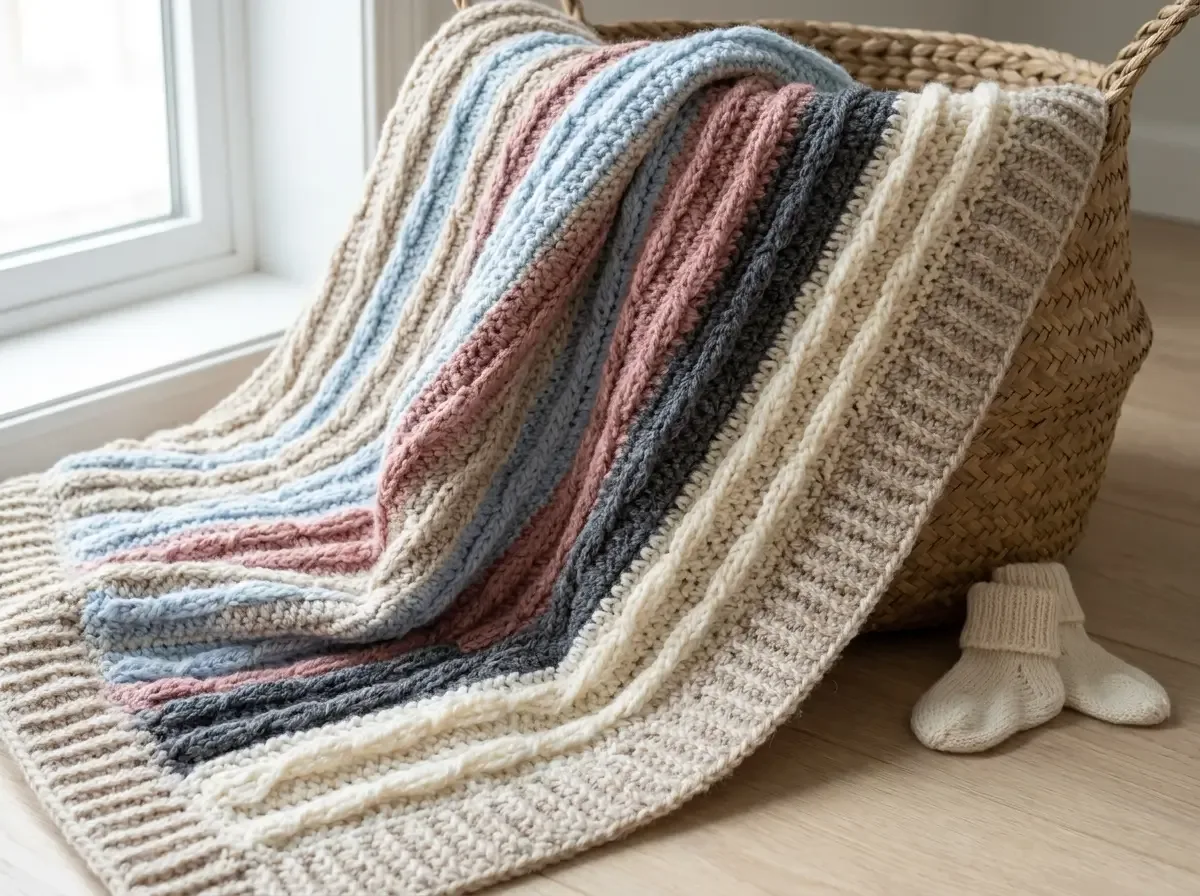
Alternating bands of half double crochet and slip stitch form the softly raised almond shapes in this restful baby blanket. A self-striping yarn cake supplies the gentle color story, while the deep camel-stitch border turns the simple rectangle into a polished handmade gift.
A quiet stitch with beautiful dimension
The Almond Stitch turns two basic stitches into deep, orderly texture. Four half double crochets create a raised section beside four low slip stitches. Working the same arrangement for two rows builds height; switching the blocks for the next two rows rounds the ridge into an almond-like shape.
The body is worked back and forth in rows, always through the back loop after the foundation row. Those unused front loops draw fine horizontal lines through the fabric and help the almond shapes stand out. A self-striping cake changes color without planned joins, so the finished blanket looks detailed while requiring very few ends.
This project is best for an advanced beginner or intermediate crocheter who can identify stitch tops, work into the back loop, maintain loose slip stitches, and recognize a repeating texture. The pattern uses US crochet terminology.
About the original design
The Almond Stitch Preemie or Baby Blanket was designed by Dana Nield Designs. This HookElla edition explains the published construction in fresh wording and uses only the two supplied HookElla images. For the designer’s complete resources, visit the free Ravelry pattern listing or Dana’s full technical page.
Finished sizes
The instructions are written Preemie (Baby). When only one number appears, it applies to both sizes.
- Preemie with border: approximately 30 × 24 in (76 × 61 cm)
- Baby with border: approximately 32 × 34 in (81 × 86 cm)
- Preemie body before border: approximately 26 × 20 in (66 × 51 cm)
- Baby body before border: approximately 26 × 28 in (66 × 71 cm)
Both versions begin with the same width and stitch count. The Preemie size uses 82 body rows and seven total border rounds; the Baby size uses 114 body rows and ten total border rounds.
Yarn, hook, and notions
- 1 cake Lion Brand Mandala Bonus Bundle, Cyclops colorway, category 3 / light yarn; 100% acrylic; 1,181 yd / 1,080 m; 10.5 oz / 300 g
- 5.0 mm (H-8) crochet hook, or size needed to meet gauge
- Scissors
- Tapestry needle
- Tape measure
- Optional: eight removable stitch markers for the border corners
One large cake is the published requirement for either size. The color changes emerge directly from the cake. If substituting yarn, choose approximately the same weight and total yardage, and allow extra for swatching or differences in tension.
For a baby gift, use yarn that feels soft against the skin and can be washed easily. Check the care label, avoid yarn that sheds heavily, and secure all ends thoroughly. If the blanket is intended for a NICU or donation program, confirm that organization’s current rules before choosing the fiber or size.
Gauge
17 stitches × 16 rows = 4 in (10 cm) in the Almond Stitch pattern.
Gauge matters because 108 working stitches measure about 26 inches before the border. Make a swatch that contains several complete eight-stitch repeats and at least one full four-row cycle. Measure it after washing and drying the way the finished blanket will be treated.
If the swatch is too narrow, loosen your tension or use a larger hook. If it is too wide, tighten your tension or use a smaller hook. Pay special attention to the slip stitches; when they are pulled tight, the fabric can contract even if the half double crochet gauge looks correct.
US abbreviations
- BLO — back loop only
- ch — chain
- hdc — half double crochet
- rep — repeat
- rnd — round
- RS — right side
- sl st — slip stitch
- sp — space
- st(s) — stitch(es)
- WS — wrong side
Camel stitch and the back third loop
A half double crochet has its normal top V plus a horizontal bar behind it. For the camel-stitch border, insert the hook under that rear horizontal bar—the back third loop—and complete the hdc. The untouched top loops roll toward the front and form the border’s knit-like ridge.
Do not confuse the back third loop with the ordinary back loop used in the blanket body. In the body, insert the hook under the rear strand of the top V. In the border, insert it under the separate horizontal bar behind the V.
Pattern notes
- Ch 1 at the end of a row or beginning of a border round does not count as a stitch.
- The foundation creates 108 working stitches.
- After Row 1, work every body stitch in the BLO.
- Keep all slip stitches relaxed enough to enter easily on the next row.
- Counts in angle-style checkpoints list slip stitches first and half double crochets second where both are present.
- The body repeat is Rows 2–5.
- Both sizes finish the body on Row 2 of the repeat, a WS row. Turn so the RS faces before continuing around the border.
Almond Stitch blanket body
Loosely ch 109. If your foundation chain tends to tighten, make it with a hook one size larger, then return to the 5.0 mm hook.
Row 1: establish the four-stitch blocks — RS
Beginning in the second chain from the hook, sl st in the first 4 chains. Across the remaining chains, repeat 4 hdc, then 4 sl st.
Ch 1 and turn — 108 stitches: 56 sl st and 52 hdc.
Row 2: stack the first pair — WS
Working in BLO, sl st across the first 4 slip stitches. Then repeat hdc in the next 4 hdc, sl st in the next 4 sl st across.
Ch 1 and turn — 56 sl st and 52 hdc.
Row 3: switch the high and low blocks — RS
Working in BLO, hdc across the first 4 slip stitches. Then repeat sl st in the next 4 hdc, hdc in the next 4 sl st across.
Ch 1 and turn — 52 sl st and 56 hdc.
Row 4: stack the second pair — WS
Working in BLO, hdc across the first 4 half double crochets. Then repeat sl st in the next 4 sl st, hdc in the next 4 hdc across.
Ch 1 and turn — 52 sl st and 56 hdc.
Row 5: switch back — RS
Working in BLO, sl st across the first 4 half double crochets. Then repeat hdc in the next 4 sl st, sl st in the next 4 hdc across.
Ch 1 and turn — 56 sl st and 52 hdc.
Continue to the chosen length
Repeat Rows 2–5 until the blanket contains:
- 82 total rows for Preemie, or
- 114 total rows for Baby.
For either size, the final row is Row 2 of the repeat. The last row is worked from the WS; ch 1 and turn at the end so the RS faces. That chain sets up the border, so do not add another. Do not cut the working yarn.
At gauge, the Preemie body measures approximately 26 × 20 inches and the Baby body approximately 26 × 28 inches.
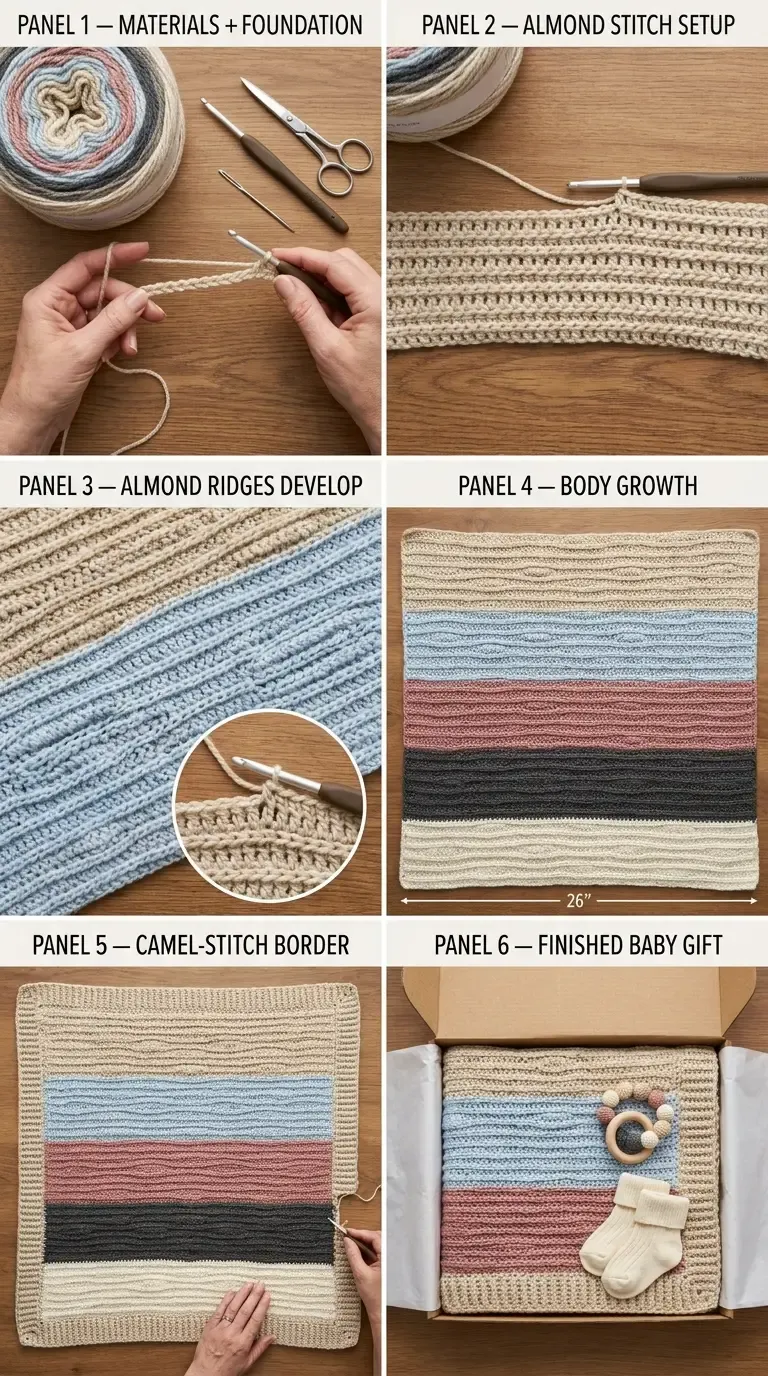
The HookElla construction image summarizes the sequence. Follow the written stitch placement and counts for the pattern.
How to read the almond shapes
The high hdc blocks are easy to count because each stitch has a visible post. Count in groups of four and make sure every row still contains 108 stitches.
If the top edge looks strongly bumpy, the paired rows for that arrangement are complete; on the next row, switch the stitch types over the blocks. If the top edge looks comparatively level, work one more row with hdc over hdc and sl st over sl st. This visual check is useful when a row counter is missed.
Place a marker in the first and last stitch of the row if the edges begin to wander. The low profile of a slip stitch can make the final stitch easy to overlook.
Camel-stitch border
The border is worked in joined rounds with the RS facing throughout. At each corner, the two hdc surrounding a ch-2 space become the last stitch of one side and the first stitch of the next. Using this convention keeps the edge counts clear.
For Round 1, place approximately one hdc in every body row-end along the two long sides. The correct pickup count is more important than blindly inserting into every visible strand: distribute the stitches evenly so the border lies flat.
Border Round 1: hdc foundation
With the RS facing and the body yarn still attached, work hdc evenly across the first edge. At the next corner work (hdc, ch 2, hdc). Repeat across each remaining edge and corner; at the fourth corner, work the first hdc and ch 2, then join with a sl st to the first hdc of the round. The joining stitch completes the final corner without adding a fifth side stitch.
Checkpoint, excluding the four ch-2 spaces:
- Top and bottom: 108 hdc each
- Preemie sides: 82 hdc each
- Baby sides: 114 hdc each
Mark the back third loop of the hdc on both sides of every corner if desired. Eight markers make the first and last stitch of each side easy to identify and help prevent accidental work into a corner chain.
Border Round 2: begin camel stitch
Ch 1. Work 1 hdc back into the current ch-2 corner space. Across the next side, work hdc in the back third loop of every hdc. In the following corner space, work (hdc, ch 2, hdc).
Repeat that side-and-corner sequence around. At the final corner, stop after the ch 2 and join with a sl st to the first hdc already made in that corner. Each side has increased by 2 stitches.
Remaining border rounds
Repeat Border Round 2 until there are:
- 7 total border rounds for Preemie, or
- 10 total border rounds for Baby.
Final checkpoint, excluding the four ch-2 spaces:
- Preemie top and bottom: 120 hdc each
- Preemie sides: 94 hdc each
- Baby top and bottom: 126 hdc each
- Baby sides: 132 hdc each
The planned Baby version stops after Round 10 so the project remains within the one-cake yarn allowance. If you have verified extra yardage, an optional eleventh round will deepen the border and change the finished measurement.
Fasten off after the final join.
Border flatness check
Spread the blanket on a flat surface after Round 1 and again after the first camel-stitch round.
- If the side border ripples, remove a few side pickups from Round 1 and redistribute them evenly.
- If the side edge pulls inward, add pickups at evenly spaced row ends while preserving matching counts on opposite sides.
- If a corner rounds instead of turning cleanly, confirm that every corner contains hdc, ch 2, hdc and that no stitch was placed into the ch-2 chains by mistake.
- If the ridge is missing, make sure the hook enters the horizontal third loop behind the hdc, not the ordinary back loop of the top V.
Finishing and care
Weave tails through several stitches on the WS, change direction once, and trim only after the fabric relaxes. Wash and dry according to the yarn label, then lay the blanket flat or shape it while slightly damp. Straighten the almond columns and square all four corners without stretching the ribbing out of shape.
For gifting, include a care card and the yarn fiber information. A neutral wooden rattle, soft socks, or HookElla’s Teddy-Ear Crochet Baby Hat makes a simple coordinated presentation. Always follow current age-appropriate safe-sleep guidance when giving or using a baby blanket.
Resizing the blanket
To change the width, begin with a chain that is a multiple of 8 plus 5. The extra five chains account for the opening four-stitch block plus the turning allowance. Work the complete Row 1 across the new chain and confirm that the working stitch count is one less than the foundation chain.
To change the length, add or remove complete four-row repeats. For the same border orientation as the written sizes, finish after Row 2 of the repeat and turn so the RS faces.
Create the entire body first, then recalculate Round 1 from the actual stitch and row counts. Each additional camel-stitch round increases every side count by two. Custom sizes require extra yarn; estimate by comparing the new total area with the Baby blanket’s 32 × 34 inch finished area, then add at least 10% for swatching and tension differences.
Troubleshooting the Almond Stitch
- The body is narrowing: A first or last slip stitch is probably being missed. Mark both edge stitches and restore the row to 108 stitches.
- The slip-stitch rows are hard to enter: Loosen each slip stitch deliberately or try a hook with a slightly sharper tip.
- The almonds look staggered incorrectly: Work two rows with the same block arrangement before switching high and low stitches.
- A row has the wrong stitch totals: On Rows 1, 2, and 5, expect 56 slip stitches and 52 hdc. On Rows 3 and 4, expect 52 slip stitches and 56 hdc.
- The color changes feel uneven: That is normal with self-striping yarn. Let the cake change naturally unless you prefer to cut and control the transitions.
- The camel border has no raised line: Locate the rear horizontal third loop beneath the top V and work into that loop only.
- The corners are gaining too many stitches: Mark the two hdc flanking every ch-2 space and avoid treating the two corner chains as stitches.
For another softly textured nursery project, try the Evelyn Crochet Baby Blanket or the floral Rosy Heirloom Motif Blanket. Browse the Baby Crochet collection for more handmade gift patterns.
The Almond Stitch blanket is a satisfying combination of rhythm and detail: four small stitch blocks create the texture, the yarn supplies the color changes, and the camel-stitch frame gives both sizes a tailored finish.
Helpful questions
Who designed the original Almond Stitch Preemie or Baby Blanket?
The original pattern and technical specifications are by Dana Nield Designs; the free Ravelry listing and Dana’s full technical page are linked in the original-design section above. This HookElla article uses original wording and HookElla images while preserving the designer’s published sizing, stitch counts, yarn, hook, repeat, and camel-stitch border.
What are the two finished sizes?
The Preemie blanket is approximately 30 × 24 inches after seven border rounds, and the Baby blanket is approximately 32 × 34 inches after ten border rounds. Before the border, both are about 26 inches wide; their body lengths are approximately 20 and 28 inches.
How much yarn is needed?
The published yarn requirement is one 1,181-yard Lion Brand Mandala Bonus Bundle cake for either size. The ten-round Baby border is the planned one-cake finish, so do not assume there is enough yarn for an extra round.
Is the Almond Stitch reversible?
Both faces have attractive ribbing, although the pattern designates a right and wrong side for consistent row placement and for beginning the border with the right side facing.
Why do the slip stitches need to stay loose?
Tight slip stitches are difficult to enter on the following row and can pull the blanket narrower. Keep their loops at the same relaxed height throughout the project.
How do I resize the blanket width?
Use a starting chain that is a multiple of 8 plus 5. This preserves the opening four-stitch block and every following eight-stitch pair of blocks. Make a gauge swatch and recalculate the border and yarn requirement for a custom size.
How do I know which Almond Stitch row comes next?
Examine the top edge. When the blocks look level, repeat the same stitch type over each block for one more row. When the high and low blocks form a pronounced bumpy edge, switch them so half double crochet is worked over slip stitch and slip stitch over half double crochet.
Can I donate the Preemie size to a hospital or charity?
Ask the receiving organization for its current size, fiber, laundering, and packaging rules before starting. Requirements vary, and some programs do not accept every yarn or blanket dimension.