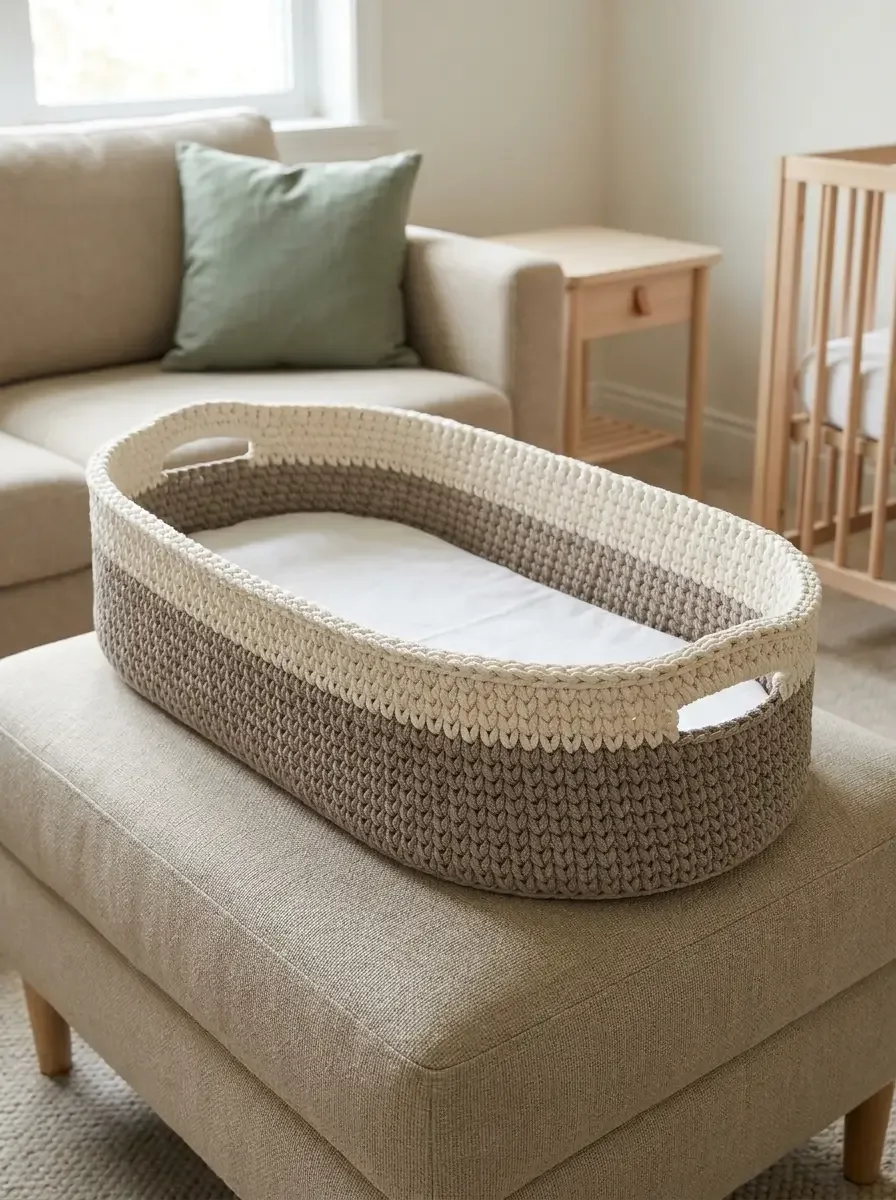
The Luna Baby Changing Basket pairs a clean nursery silhouette with the reassuring structure of a wooden base and thick braided cotton cord. Its neutral taupe-and-ivory styling feels calm in a nursery, while the paid pattern’s three variations let makers choose the look and handle arrangement that suits their space.
A calm, structured nursery project
The Luna Baby Changing Basket by Three Little Cubs is designed around a practical idea: crochet can soften the look of a nursery accessory without sacrificing a firm, useful shape. A plywood base establishes the oval footprint, while thick braided cotton cord builds dense walls that hold their form.
This HookElla article is an original inspiration and planning guide. It covers the public specifications, materials, construction logic, and styling possibilities without reproducing the paid pattern’s written instructions, charts, or source photography. Purchase the official Luna Baby Changing Basket pattern on Ravelry for the complete instructions.
Public project specifications
The original listing describes a one-size basket designed to fit a standard changing mat:
- Mat fit: approximately 73 × 34 cm (28 × 13 in)
- Plywood base: approximately 72 × 33 cm
- Cord: 9 mm braided cotton cord
- Hooks: 6.5 mm (K) and 9.0 mm (M/N)
- Yardage: approximately 1,750–1,969 yd (1,600–1,800 m) listed for the project
- Skill level: beginner to intermediate
- Variations: three complete designs, including a non-handled version and two handled styles
The large yardage range reflects the substantial size and thick cord used for a full changing basket. Check the paid listing and your supplier’s cord length before ordering; braided cord is often sold by weight or by short reels rather than conventional yarn balls.
Materials overview
Plan on gathering:
- 9 mm braided cotton cord in a main color and optional contrast color
- A 72 × 33 cm plywood base prepared for crochet, with smooth edges and the correct holes for the pattern
- 6.5 mm (K) crochet hook for detail or tighter sections
- 9.0 mm (M/N) crochet hook for the main cord fabric
- Waterproof mattress or baby changing mat sized for the finished basket
- Tapestry needle, scissors, and stitch markers
The HookElla sample uses a warm taupe lower body and an ivory upper section. The two-tone approach makes the rim and hand openings easy to see, but a single neutral shade can look just as polished. Soft beige, cappuccino, dusty rose, sage, and pale blue all suit a modern nursery.
Why the plywood base matters
The wooden base does more than make the basket sturdy. It fixes the oval length and width before the walls begin, which helps the finished basket accept a standard changing mat without an unstable or sagging floor.
Use a base made for crochet or prepare one exactly to the original pattern’s specifications. Sand every edge smooth, check that the holes are clean, and confirm that the base is flat before you begin. Do not substitute a warped board, sharp-edged panel, or unsealed material that could snag the cord or damage the mattress.
Construction overview
1. Crochet into the prepared base
The project begins by attaching the cord around the plywood perimeter. This first round establishes the stitch count for the long sides and rounded ends of the oval. Work evenly into every hole and keep the tension consistent; a tight section can pull the base out of shape, while a loose section may leave gaps.
The smaller hook is useful where the cord needs a controlled, compact entry. The larger 9 mm hook creates the main basket fabric without crushing the braided cord.
2. Build the lower walls
After the base round, the basket rises in dense crochet rounds. The taupe lower section in the HookElla image shows how the walls become upright while preserving the oval opening. Mark the round start and count regularly, especially around the curved ends where it is easy to add or lose a stitch.
Because this is a structured nursery accessory, avoid a loose drape. The fabric should feel firm in your hands and stand when the basket is empty. If your cord or tension produces a soft wall, stop and compare your gauge with the original pattern before continuing.
3. Add the ivory upper section
The contrast color begins above the lower body, creating a clean band around the basket. The transition is decorative, but it also makes the upper edge and handles visually clear. Change colors only where the paid pattern directs so the stripe remains level around both long sides and curved ends.
Keep the last few rounds relaxed enough for the changing mat to slide in without catching. A firm rim is desirable; a drawstring-tight rim is not.
4. Choose one of three variations
The original paid pattern includes three complete designs:
- A non-handled basket for a clean, tray-like nursery look
- Handled Style A, with integrated openings positioned for lifting or repositioning the empty basket
- Handled Style B, offering a second opening arrangement for a different visual balance
The variations are part of the pattern’s value. Select the handled version only after considering where the basket will sit and how it will be moved. Never lift a basket containing a baby, and do not assume handles make an infant basket suitable for carrying.
5. Finish the rim and openings
The final rounds stabilize the upper edge and tidy the transitions around any hand openings. Work slowly around these sections so the openings remain symmetrical. Weave the cord tails through several neighboring stitches; thick cotton can loosen if an end is trimmed too close to the surface.
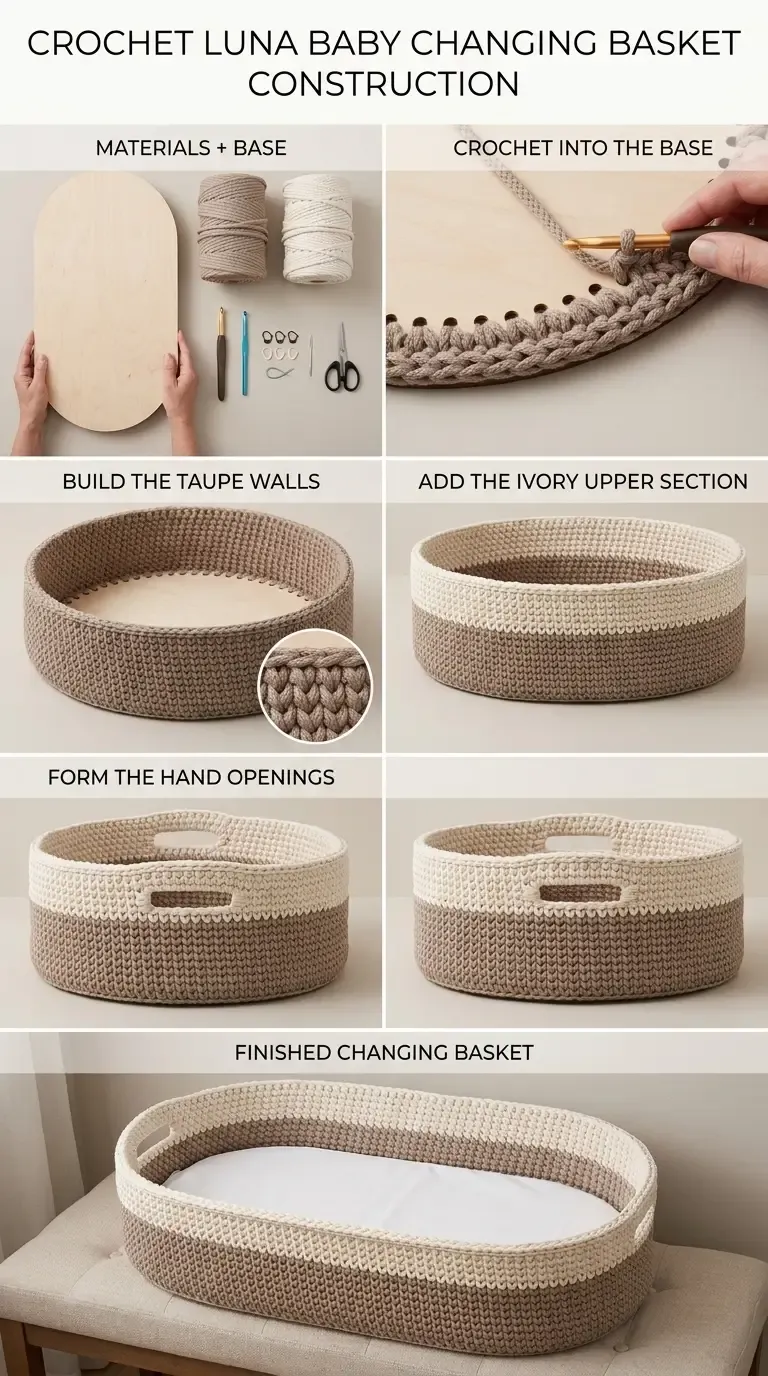
This HookElla construction image is a visual overview only. Three Little Cubs’ paid pattern controls the exact stitch counts, base-hole sequence, color changes, and handle shaping.
Styling a neutral Luna basket
Taupe and ivory create a quiet backdrop for a patterned changing mat. Add a washable fitted cover, a folded muslin, or a small basket of diapering supplies nearby. Keep the basket visually uncluttered so the oval shape and contrast rim remain the focus.
For a more colorful nursery, use one deep shade below and a lighter contrast at the rim. Sage and cream feel botanical, dusty blue and oatmeal feel coastal, and blush with warm beige adds softness without looking overly sweet.
Safety and responsible use
This section is especially important. A finished item made by an individual crocheter is not automatically safety-tested or certified because the original designer or a commercial product has been tested. Changing the cord, base, mattress, hook, tension, dimensions, or construction can change the basket’s strength and performance.
Use the basket only on a stable, level changing surface and keep one responsible adult within reach during every diaper change. Do not use a crocheted changing basket for unattended sleep, as a Moses basket, as a carrier, or as a substitute for regulated infant equipment. Follow current local safe-sleep guidance and the safety instructions supplied with the changing mat.
Inspect the base, cord, rim, and handle openings before each use. Retire the basket if the wood cracks, the cord separates, the base flexes, or a handle attachment loosens. For real-world nursery use, choose a waterproof mat with the appropriate local safety markings and follow its care instructions.
Cleaning and care
Braided cotton cord is practical for nursery storage, but a full basket is not usually convenient to machine wash. Empty it, wipe the crochet with a lightly damp cloth and mild soap, and allow it to dry completely before replacing the mat. Do not soak the plywood base unless the manufacturer specifically permits it.
Keep creams, oils, powders, and wet items inside sealed containers or on the removable mat rather than directly against the crochet. A washable liner or muslin can make everyday cleanup easier, but it does not replace a waterproof changing surface.
Who will enjoy this pattern?
The Luna project suits a crocheter who is comfortable working with very thick cord, crocheting around a prepared base, maintaining even tension, and following a long oval stitch path. The individual stitches are approachable; the challenge is producing a firm, symmetrical structure at a large scale.
It can be a memorable baby-shower gift when presented with a properly sized changing mat and a care card explaining supervised use. Makers who sell finished baskets should check their local rules for infant products, product testing, labeling, and liability before offering one for sale.
For smaller nursery projects, explore HookElla’s Even Moss Baby Sweater Showcase, Teddy Ear Baby Hat Showcase, and Scrap Yarn Crochet Storage Basket.
Three Little Cubs’ Luna Baby Changing Basket is compelling because its beauty comes from useful structure: a stable wood base, durable cord, clean color blocking, and a choice of three silhouettes. Use the official paid pattern for every construction detail, then make the finished basket part of a thoughtful, safety-conscious nursery setup.
Helpful questions
Who designed the Luna Baby Changing Basket?
The original paid pattern was designed by Three Little Cubs. HookElla is sharing an independent inspiration and planning guide, not reproducing the designer’s PDF.
What size mat does it fit?
The public listing describes a basket designed for a standard changing mat of approximately 73 × 34 cm, or 28 × 13 inches, using a 72 × 33 cm plywood base.
What materials are listed?
The public details list 9 mm braided cotton cord, a crochet plywood base, a waterproof mattress or baby changing mat, and crochet hooks in 6.5 mm and 9.0 mm sizes.
How many design variations are included?
The paid pattern includes three complete variations: a non-handled basket and two handled styles.
Is this safe for unattended sleep or carrying a baby?
No. A crocheted basket made from a digital pattern is not automatically safety-tested or approved for sleep, carrying, or unsupervised infant use. Follow local safe-sleep guidance and use it only for supervised changing or nursery storage unless a qualified authority confirms another use.
Is the full Luna pattern free?
No. The complete written instructions and construction guidance are in the paid original listing. Follow the Ravelry link in this article to purchase the official pattern.